Monday
The Bridge
6:00 PM
Streaming on our social media outlets and YouTube.
Grow in God’s Word through Hour of Power, Bible Study, Table Talk, prayer, and Christian Basic Training.
Tap a class or gathering for the lesson, Zoom link, prayer line, or details.
Streaming on our social media outlets and YouTube.
Morning prayer at 6:00 AM and evening prayer at 6:15 PM.
Dial 1-605-475-3215
Access code: 289768
Men gathering via Zoom.
Zoom link coming soon.Please join by 6:50 PM so we can begin promptly and prepared.
Join on ZoomWith Elder Ashley and the elders and ministers.
With Pastor Brenda on all social media platforms.
Dial 1-605-475-3215
Access code: 289768
Women’s, men’s, New Members/CBT, and youth learning opportunities.
Gather with the Christ Harvest Fellowship family.
Welcome to Christ Harvest Fellowship. Choose a topic below or follow the journey in order.
Welcome to Christ Harvest Fellowship. We are grateful that God has connected you with this church family. Whether you are beginning your relationship with Christ, returning to church, or continuing your spiritual journey, there is a place for you to grow, connect, serve, and become equipped.
Our official vision and mission is to fully engage our congregation in winning the lost and to transform the community by demonstrating the love of Jesus Christ.
A vibrant, loving, faith-filled body of believers called together by God and equipped spiritually, intellectually, physically, and financially to share the good news of Jesus Christ and mature in relationship with God, ourselves, and others.
We are a ministry of faith and prayer. We gather to study God’s Word, worship and praise God, welcome individuals and families, make disciples, grow in Christian fellowship, and equip believers for ministry and community impact.
Summary based on the church’s official website. Additional formal belief statements may be added when approved.
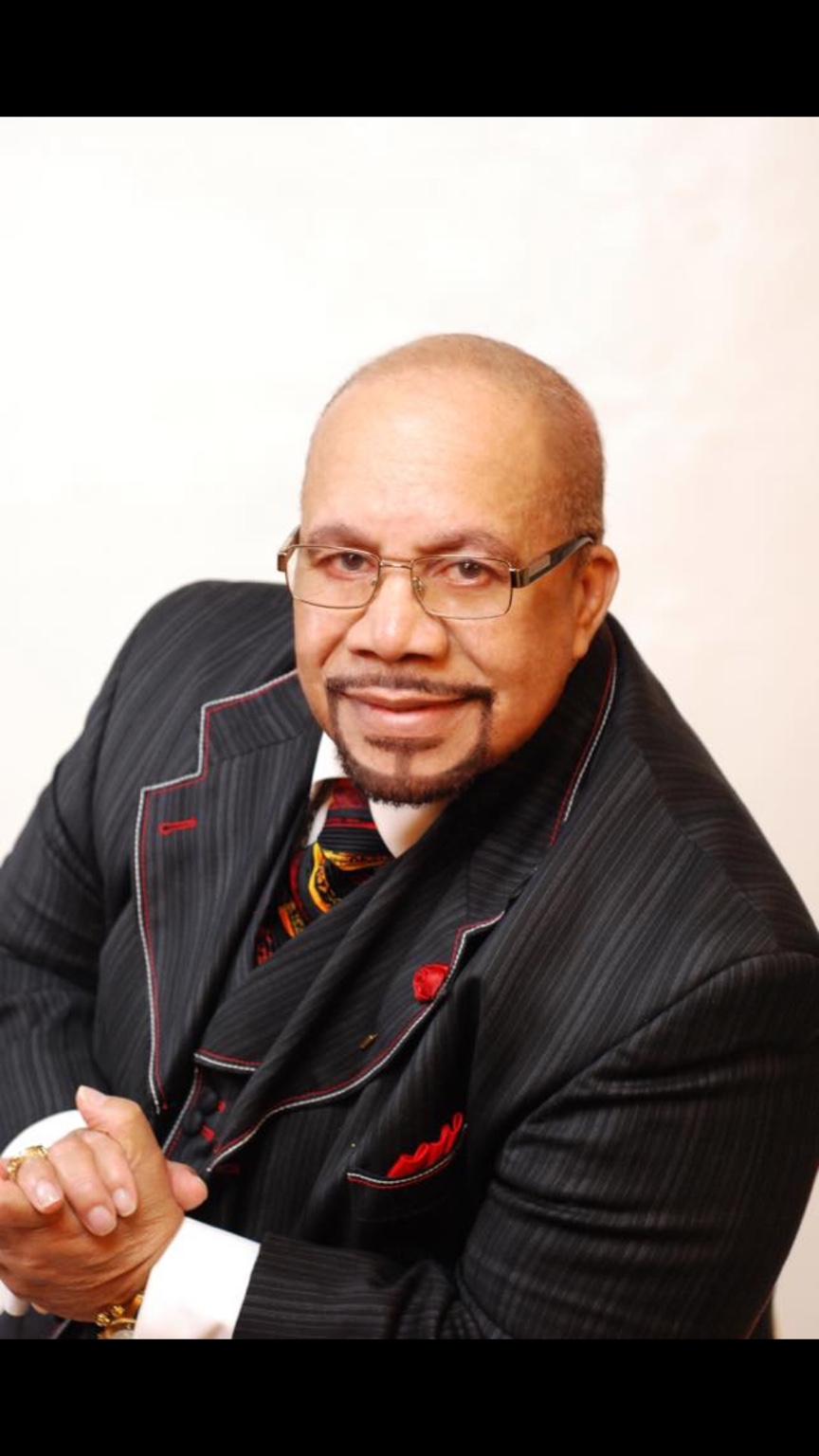
Senior Pastor / Bishop
Bishop Evans faithfully leads with a commitment to clear biblical teaching, prayer, discipleship, and equipping believers to serve.
Meet Our Pastors / Learn More
First Lady & Christian Educator
Mother Evans serves alongside Bishop Evans, helping believers grow through biblical instruction, encouragement, and Christian Basic Training.
Meet Our Pastors / Learn MoreThis original guide presents four biblical truths about God’s love, our need, and the new life offered through Jesus Christ.
God created you for relationship with Him. His love is personal, sacrificial, and life-giving.
Read: John 3:16; John 10:10
Reflect: What does knowing that God loves you personally mean to you?
Every person has sinned. Sin breaks fellowship with God, and human effort alone cannot repair that separation. The result of sin is death, but God offers another way.
Read: Romans 3:23; Romans 6:23
Jesus died for our sins, rose from the dead, and makes reconciliation with God possible. Where sin created separation, the cross opens the way to restored relationship.
Read: Romans 5:8; 1 Corinthians 15:3–6; John 14:6
God calls us to turn from sin and trust Jesus Christ as Savior and Lord. Salvation is God’s gracious gift; it is received by faith and cannot be earned through good works.
Read: John 1:12; Ephesians 2:8–9; Revelation 3:20; John 3
Prayer is talking with God. The words themselves do not save us; we are saved by grace through faith in Jesus Christ.
“Lord Jesus, I know that I need You. I believe You died for my sins and rose again. I turn from my sin and place my faith in You. Forgive me, come into my life, and be my Savior and Lord. Help me live the life You have called me to live. Thank You for Your grace, Your forgiveness, and the gift of new life. In Jesus’ name, Amen.”
If you have made a decision for Christ, connect with us so a ministry leader can welcome you and help guide your next steps.
Feelings can change from day to day. Your relationship with God rests on His trustworthy promises and His Word. When emotions are uncertain, return to what God has said and choose to trust Him.
Read: Revelation 3:20; John 1:12; John 5:24.
Salvation is the beginning of a lifelong journey. Build a daily life of faith and stay connected to other believers.
Baptism is a public expression of faith in Jesus Christ, a symbol of new life in Christ, an act of obedience after salvation, and a visible testimony of a person’s decision to follow Christ.
Baptism itself does not save us. Salvation is God’s gift, received by grace through faith in Jesus Christ. In baptism, the believer openly identifies with Jesus’ death, burial, and resurrection.
Read: Matthew 28:19; Acts 2:38; Romans 6:3–4.
Text BAPTISM to 1-833-551-4603. A ministry leader will follow up with information about baptism preparation and the next baptism opportunity.
Christian Basic Training helps new members build a strong biblical foundation, understand their faith, learn about the church, and become connected to ministry.
Hour of Power: Sunday, 9:00 AM
Bible Study: Wednesday, 7:00 PM
Table Talk: Thursday, 7:00 PM
Membership means becoming part of the life of the church. Future interest pathways will include Christian Education, women, men, youth, music and worship, prayer, outreach, hospitality, and other approved ministry opportunities.
Ministry names, leaders, and interest links will be added after verification.
We are committed to praying for members, teaching God’s Word, providing opportunities for spiritual growth, encouraging fellowship, and helping people discover ways to serve. We encourage every member to worship faithfully, pray, study Scripture, participate in Christian Education, build relationships, give, serve, share their faith, and strengthen the body of Christ.
After you complete the New Member connection process, you will receive a follow-up text message through our church communication system. A ministry leader or designated member of the Christ Harvest Fellowship team will also reach out to welcome you, answer your questions, and help you take your next steps in your walk with Christ and in the life of the church.
Those next steps may include Christian Basic Training, baptism, Christian Education, worship, prayer, and connection with a ministry.
Use the church text number, prayer line, and weekly gathering links.
The church uses one universal Gloo text number. Text the approved keyword that matches your need to 1-833-551-4603:
Stay connected to conferences, celebrations, and special worship experiences at Christ Harvest Fellowship.
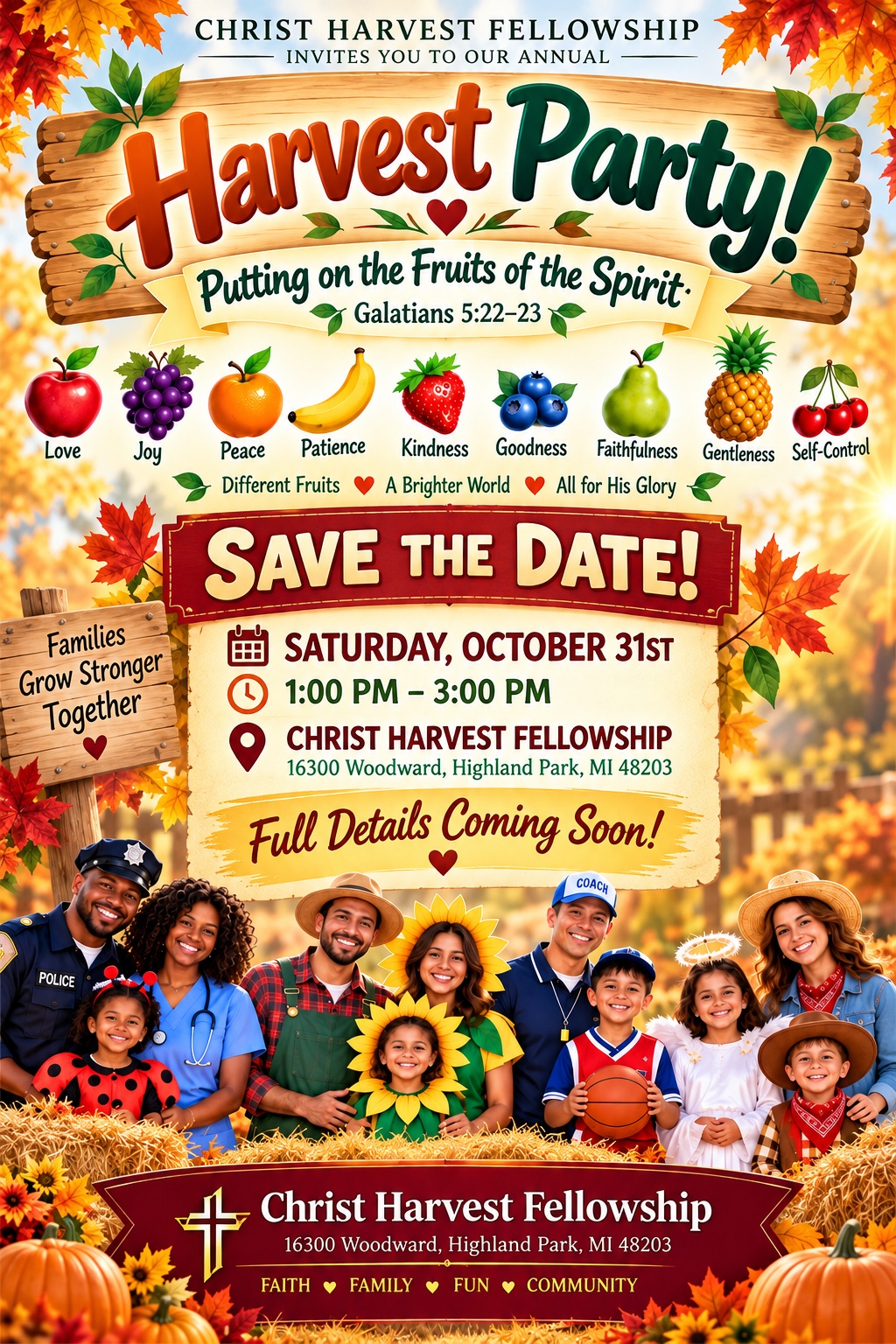
Putting on the Fruits of the Spirit
Galatians 5:22–23
Saturday, October 31, 2026
1:00 PM–3:00 PM
Location:
Christ Harvest Fellowship
16300 Woodward
Highland Park, MI 48203
FULL DETAILS COMING SOON
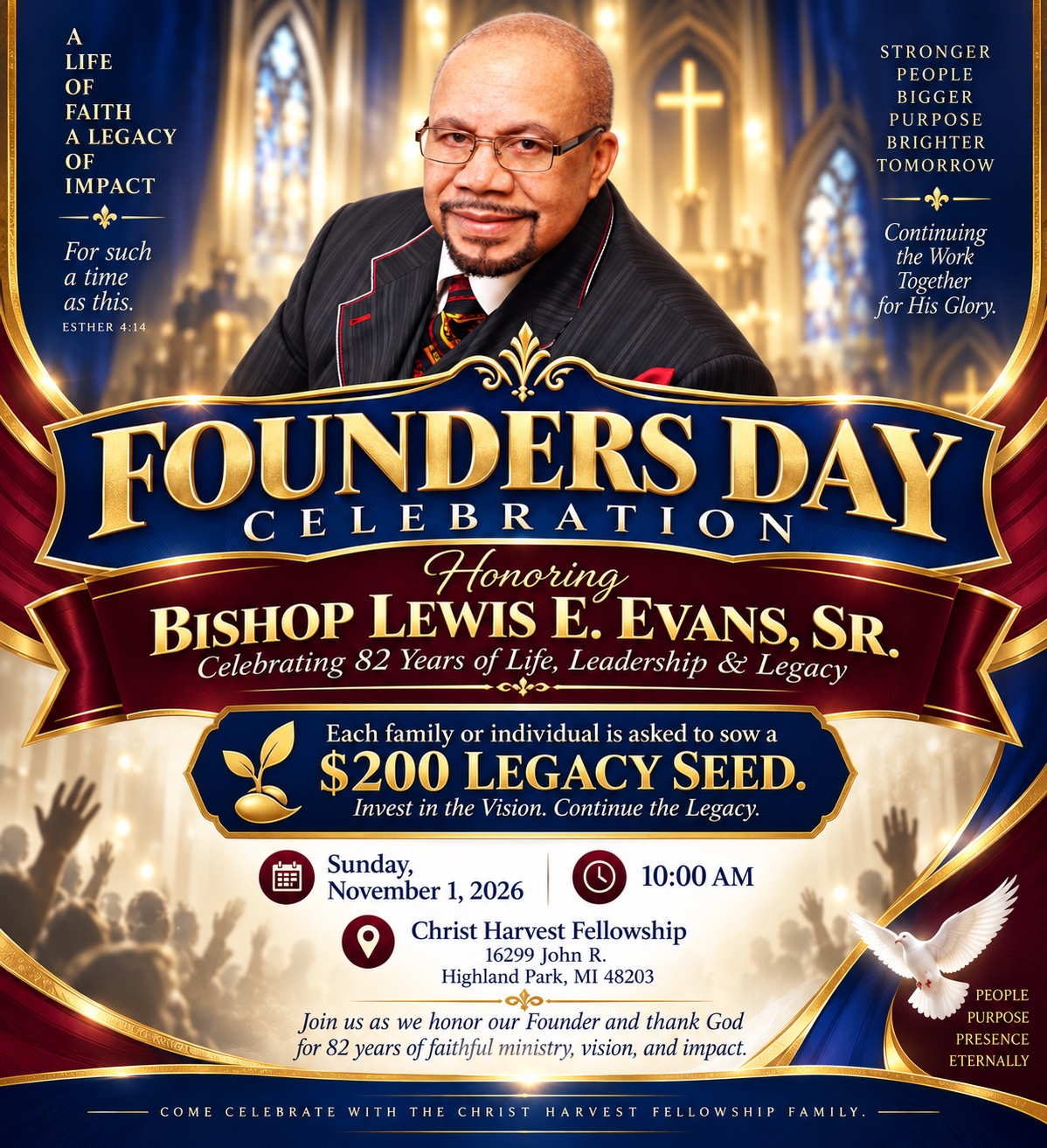
Honoring Bishop Lewis E. Evans, Sr.
Celebrating 82 Years of Life, Leadership & Legacy
Sunday, November 1, 2026
10:00 AM
Location:
Christ Harvest Fellowship
16299 John R.
Highland Park, MI 48203
Each family or individual is asked to sow a $200 Legacy Seed.
Join us as we honor our Founder and thank God for 82 years of life, leadership, vision, and impact.
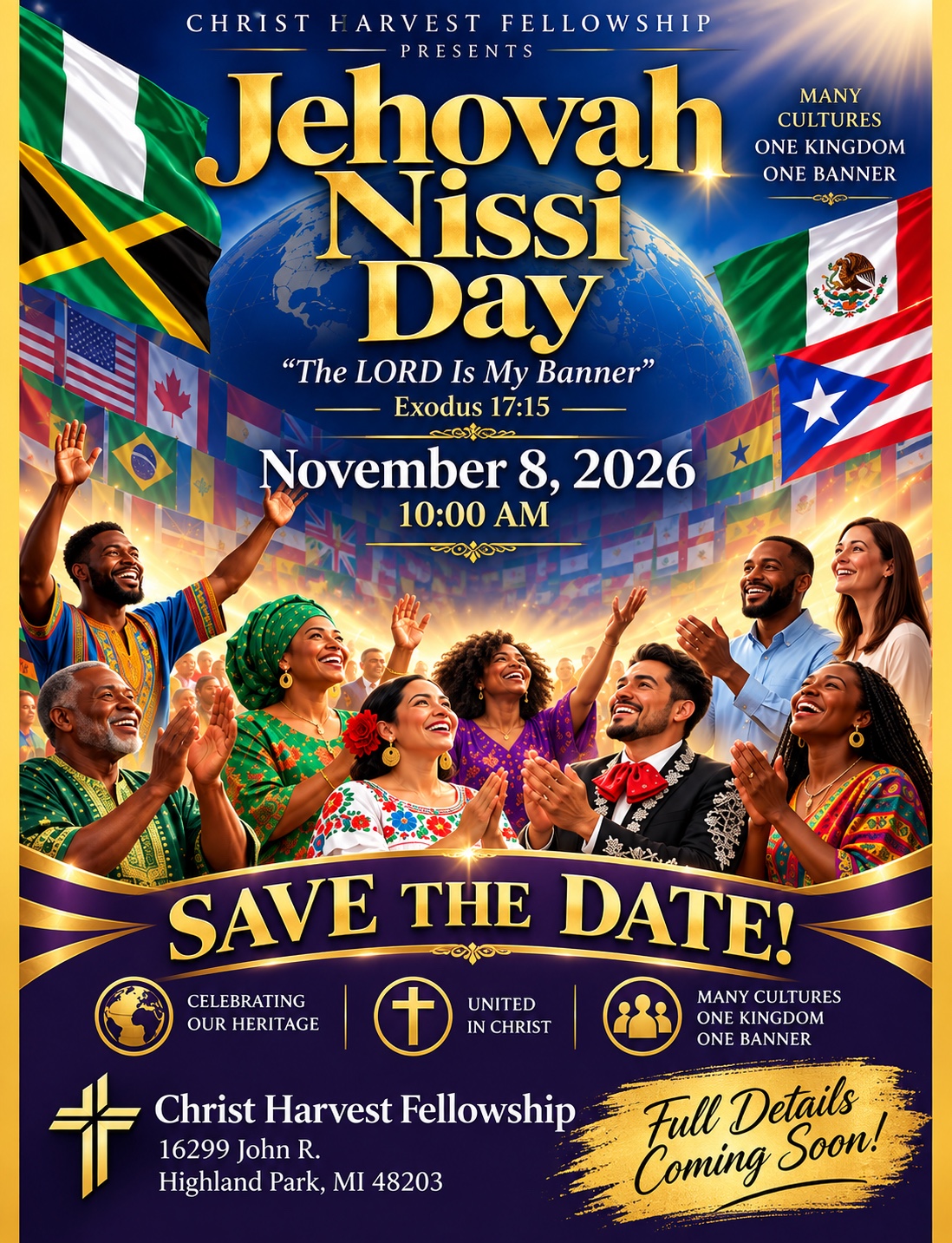
Many Cultures • One Kingdom • One Banner
Jehovah Nissi — “The LORD Is My Banner”
Exodus 17:15
Sunday, November 8, 2026
10:00 AM
Location:
Christ Harvest Fellowship
16299 John R.
Highland Park, MI 48203
FULL DETAILS COMING SOON
Jehovah Nissi means “The LORD Is My Banner.” In Exodus 17:8–16, Israel faced Amalek in battle. As Moses held up his hands, Israel prevailed; Aaron and Hur helped support him until the victory was complete. Moses then built an altar and named it Jehovah Nissi (Exodus 17:15).
A banner identifies the one under whom a people gather. For Jehovah Nissi Day, Many Cultures • One Kingdom • One Banner reminds us that people from different cultures and backgrounds are united under Christ.
Educational facts, Christian faith connections, cultural information, language expressions, and verified visuals will be added here.
Educational facts, Christian faith connections, cultural information, language expressions, and verified visuals will be added here.
Educational facts, Christian faith connections, cultural information, language expressions, and verified visuals will be added here.
“Always be ready to give a defense to everyone who asks you a reason for the hope that is in you.” — 1 Peter 3:15, NKJV
Select a ministry area to see its schedule, teachers, and resources.
Christian Basic Training is taught by Bishop Lewis E. Evans and Mother Lynda C. Evans. This foundational course follows the five assurances taught in The Navigators’ Beginning with Christ and Lessons on Assurance: salvation, answered prayer, victory, forgiveness, and guidance.
Select an assurance to study what the verse says, what it means, how it applies, and how to memorize it.
God has given eternal life. That life is in His Son. Whoever has Jesus Christ has life; whoever does not have the Son does not have life.
Our assurance rests on God’s testimony—not on changing emotions, past performance, or personal worthiness. Salvation is God’s gift and is found in Jesus Christ.
When doubt comes, answer it with God’s written promise. Ask yourself, “Have I received and trusted the Son?” Then thank God that your salvation rests on Christ.
Ask God to replace doubt with confidence in His Word.
Jesus commands His disciples to ask in His name and promises that answered prayer produces fullness of joy.
Praying in Jesus’ name means approaching the Father through Christ and asking in harmony with His character and will. Prayer is a privilege of relationship, not a formula for controlling outcomes.
Turn worry into a specific prayer. Ask boldly, submit the answer to God’s wisdom, and watch for how He responds.
Bring one need to God with faith, submission, and thanksgiving.
Temptation is common to humanity. God is faithful, limits what we face, and provides a way of escape so we can endure without surrendering.
Temptation is real, but it does not have final authority over the believer. Victory depends on God’s faithfulness and our willingness to recognize and take His way of escape.
Identify your common temptation and plan your escape before pressure comes: pray, leave the situation, call a trusted believer, or replace the wrong action with obedience.
Ask the Holy Spirit to help you recognize temptation early and choose God’s escape.
When believers confess their sins, God faithfully and justly forgives and cleanses them from all unrighteousness.
Confession means agreeing with God rather than hiding or excusing sin. Conviction draws us back to God; condemnation tries to drive us away. God restores fellowship through honest confession.
Name the sin honestly, confess it to God, turn from it, receive His forgiveness, and make restitution where appropriate.
Confess honestly and thank God for cleansing and restoration.
Trust the LORD wholeheartedly, refuse to depend only on your understanding, and acknowledge Him in every area. God promises to direct your paths.
Guidance grows from relationship and surrender. The promise is not that every answer arrives immediately, but that God faithfully directs a life submitted to Him.
Before making a decision, compare it with Scripture, pray for wisdom, seek godly counsel, and obey what God has already made clear.
Surrender one decision and ask for wisdom and courage to obey.
Scripture quotations marked NKJV are taken from the New King James Version®. Copyright © 1982 by Thomas Nelson. Used by permission. All rights reserved. Lesson summaries and questions are original teaching material prepared for Christ Harvest Fellowship.
Join Bishop Lewis E. Evans and the Christ Harvest Fellowship family every Wednesday at 7:00 PM. Please enter Zoom by 6:50 PM so everyone is settled and prepared to begin promptly.
Open a lesson to read the teaching notes as written.
(The Highest Goal as a Believer in Christ)
September 23, 2026 – 7:00–8:15pm
A common comprehension of faith is trusting in God. Not in something but some one, not in a belief system. The one and only key to our survival is faith in the person of Jesus Christ. It affects everything we think, say or do. 1 John 5:4, Faith is the victory that overcomes the world, the flesh and the devil. It’s the only way we’re able to live and to love. This is the only important thing we can ever do as believer’s, to learn how to understand, possess and walk in complete confidence in God. Roman 4:21, “being fully persuaded that what [God has] promised, He [will be] able also to perform.”
In other words, regardless of what we see, hear, feel or think, true faith is choosing to believe that God will do whatever He says He will do. Faith is simply a radical reliance upon God.
Hal Lindsey, “Combat Faith” - present promises that come to us through faith:
In addition, Faith is Not seeing and not feeling, yet still believing, “Blessed are those who have not seen, and yet have believed.” John 20:29
Satan knows that faith and doubt cannot coexist. Faith enables the believer to be an overcomer. Only faith can repel the enemy. When you lack faith, you leave yourself open for his vicious attacks.
Jesus is the source of Faith. He gives the living water by which we can be saved through grace. This is why we say faith is a gift from God and Jesus is both the founder and perfector (finisher) of our faith, who for the joy that was set before Him endured the cross, despising the shame, and has sat down at the right hand of the throne of God.”
Wednesday Bible Study • September 16, 2026 • 7:00 PM
Today’s lesson uses the metaphor of eating and feeding to describe how we consume information and shape our minds. Faith is the central processing center, governing force, and vital connection for the spiritual man, just as the brain is the physical control center, and life-support mediator for the human body.
The brain processes the physical world through the five senses. Faith processes the unseen spiritual realm by reading and meditating on Scripture on a constant basis.
One of God’s attributes is Omniscience; God is all-knowing, which means He knows every thought, desire, and intention before you say them out loud. Psalm 139:1-4
September 9, 2026 – 7:00 -8:15 PM
Biblical Proverbs are short, memorable sayings that express a general truth for practical, godly living. A parable is a short narrative story that illustrates a moral or spiritual lesson – a short earthly story with a heavenly meaning. While Proverbs lacks characters and a story, parables rely on human behavior and narrative action to make a point. However, both aim to teach timeless lessons about human nature and correct behavior.
Also, Hebrew Parallelism; In a verse, the second line contrasts with the first line to make a point through opposition. Note: 1:7, “The fear of the LORD is the beginning of knowledge, (check second line) But fools despise wisdom & instructions”.
The book of Proverbs provides practical, everyday wisdom for living a godly life and making skillful choices aligned with God’s character.
The key verse in Proverbs is Prov. 1:7; “The fear of the LORD is the beginning of knowledge, but fools despise wisdom and instruction.
King Solomon was the University president and chancellor of two schools, University of Lady Wisdom, and University of Lady Foolishness (Prov. 9:13-18).
Which enrollment is believed to have run over, leaving no room for new entries?
Why?
The Hebrew word for wisdom (chokhmah) is grammatically feminine. Wisdom is personified as a noble, nurturing, and divine woman calling humanity to righteousness.
Sept. 2, 2026 – 7:00-8:15pm
Scripture does not explicitly command formal academic degrees, but strongly expects leaders to continuously grow in wisdom, knowledge, spiritual maturity, and understanding of God’s Word. Leaders are not automatically endowed with knowledge. Leadership positions grant authority, status, and responsibility. However, it is required for Leaders to have a comprehension of Scripture sufficient to teach others and defend the faith. 1 Tim. 3:2 and Titus 1:9 state that Bishops / Pastors must be “able to teach” and hold firmly to the Word of God.
Example: Ezra 7:10, describes leaders who devote themselves to studying, living, and teaching the law of God (statues, ordinances) by example.
1 Tim. 4:13, “Until I come, devote yourself to the public reading of Scripture, to exhortation and to teaching”.
Key to breaking the code:
Proverbs 2:1-4, The Value of Wisdom & breaking the code
(dig dig, dig, - read, read, read – study, study, study)
THEN…
Institute Hour is Christ Harvest Fellowship’s Sunday morning teaching ministry. It consists of four learning classes designed for women, men, new members, and youth to grow in God’s Word and Christian community. Select a class below to open its lessons and resources.
This introductory overview will remain in place until Bishop Sean Coney’s complete lesson materials are added.
The Hour of Power remains part of the larger teaching ministry while keeping its own complete curriculum hub.
Recognizing the cost of rejecting correction, trusting riches, following pride, and choosing what merely seems right.
Learning to hear, receive, and practice God’s wisdom through Scripture.
Seeing the fruit that grows from reverence, obedience, discernment, and faithful living.
The current lesson comes first. Tap the + beside any lesson to open it; tap again to close it. September • Unit 1: The Way of the Fool. October • Unit 2: The Way of the Wise.
Who: Solomon presents Wisdom as a woman addressing the simple, scorners, and fools.
When: Israel’s wisdom tradition, associated with Solomon in the 10th century B.C.
Where: Streets, public squares, gathering places, and city gates—where real decisions were made.
Wisdom is not hidden. God makes wisdom available, but we must choose to listen, turn, and respond.
Key question: Where am I listening—and what am I doing with what I hear?
Key Scripture: “Turn at my rebuke; surely I will pour out my spirit on you; I will make my words known to you.” — Proverbs 1:23, NKJV
God’s correction is not rejection. It is evidence that He loves us enough to redirect us. Wisdom calls before consequences come, giving us an opportunity to stop, listen, and change. A wise person is willing to receive correction and respond to God.
Heart Check: Am I listening to God’s correction, or defending what He is asking me to change?
Audience: “Low and high, rich and poor together.” This wisdom psalm speaks to everyone.
Place: Jerusalem; exact time and authorship are unknown.
Golden Text: Psalm 49:16.
Money is a resource, but God is our Source. Wealth cannot redeem a soul or provide eternal security.
Key question: What am I trusting to make me feel secure?
Key Scripture: “But God will redeem my soul from the power of the grave, for He shall receive me. Selah.” — Psalm 49:15, NKJV
Wealth may provide temporary comfort, but it cannot purchase peace, salvation, purpose, or eternal life. Our confidence is not in what we possess but in the God who holds our lives and has redeemed our souls.
Heart Check: If something I value were removed, would my faith in God remain secure?
Tap any highlighted name or expression for a brief explanation.
1The words of the son of , even the : the man spake unto , even unto Ithiel and ,
2Surely I am more than any man, and have not the understanding of a man.
3I neither learned wisdom, nor have the .
4Who hath ascended up into heaven, or descended? who hath gathered the wind in his fists? who hath bound the waters in a garment? who hath established all the ends of the earth? what is his name, and what is his son’s name, if thou canst tell?
5Every word of God is : he is a shield unto them that put their trust in him.
6Add thou not unto his words, lest he reprove thee, and thou be found a liar.
7Two things have I required of thee; deny me them not before I die:
8Remove far from me and lies: give me neither poverty nor riches; feed me with :
9Lest I be full, and deny thee, and say, Who is the Lord? or lest I be poor, and steal, and take the name of my God in vain.
10Accuse not a servant unto his master, lest he curse thee, and thou be found guilty.
11There is a that curseth their father, and doth not bless their mother.
12There is a generation that are pure in their own eyes, and yet is not washed from their filthiness.
13There is a generation, O how lofty are their eyes! and their eyelids are lifted up.
14There is a generation, whose teeth are as swords, and their jaw teeth as knives, to devour the poor from off the earth, and the needy from among men.
Scripture text: King James Version.
Facts: Understand the attitudes of the humble wise person and the proud foolish person. Principle: Recognize that pride leads to a life marked by foolishness. Application: Pursue the way of humility that leads to a life of wisdom.
Agur son of Jakeh is the speaker and writer named in Proverbs 30:1. Scripture gives no additional biography for him. He addresses Ithiel and Ucal, whose identities are also uncertain. Agur directs attention away from himself and toward the greatness of God.
A wisdom oracle contrasting humble dependence with proud self-sufficiency. Agur admits human limitations, honors the purity of God’s Word, prays for truth and daily provision, and exposes a generation marked by dishonor, self-righteousness, arrogance, and oppression.
The exact date is unknown. Proverbs 30 is not attributed to Solomon; it is a separate collection preserved within the book of Proverbs. Its message is timeless: wisdom begins when we acknowledge what we do not know and submit to what God has revealed.
The lesson tradition places the setting in Judah, although Proverbs 30 does not name a specific city. The teaching belongs to Israel’s wisdom tradition and addresses life in the home, community, worship, finances, and treatment of vulnerable people.
Agur shows that humility is not weakness or lack of intelligence. Humility is the wisdom to recognize that God knows what we do not know. Pride says, “I already understand.” Wisdom says, “Lord, teach me, correct me, and order my life.”
Humility is both the doorway to wisdom and the evidence that wisdom is working.
Wisdom — Chokmah (khoke-MAH)
Hebrew: חָכְמָה
Chokmah means wisdom, skill, sound judgment, or the ability to live God’s truth correctly. In the Old Testament, the word can describe the skill of gifted artisans as well as the skill required for godly living (Exodus 31:3; Proverbs 9:10).
In Proverbs 30: Agur shows chokmah by admitting the limits of human understanding, trusting the purity of God’s Word, and asking God to govern his character and daily needs.
Memory aid: A proverb is usually a principle. A parable is usually a picture or story. Parallelism is the poetic pattern that connects the lines.
Key Scripture: “Every word of God is pure; He is a shield to those who put their trust in Him.” — Proverbs 30:5, NKJV
Agur’s humility released him from the pressure of pretending to know everything. He understood that human knowledge has limits, but God’s Word is pure, proven, and completely trustworthy. Humility does not mean denying the gifts God has placed within us. It means remembering where those gifts came from and remaining teachable before Him. A wise heart does not add to God’s Word or lean proudly on its own understanding—it receives His truth, trusts His provision, and lets His wisdom shape everyday conduct.
Heart Check: Am I honestly seeking God’s wisdom, or have I already decided what I want Him to say?
Supporting selections are from the King James Version. Full related readings: Ecclesiastes 3:9–14; Job 37–39; Psalms 12:1–8 and 14:1–7; Mark 10:17–31.
Your responses are saved on this device as you type.
1Every wise woman buildeth her house: but the foolish plucketh it down with her hands.
2He that walketh in his uprightness feareth the Lord: but he that is perverse in his ways despiseth him.
3In the mouth of the foolish is a rod of pride: but the lips of the wise shall preserve them.
4Where no oxen are, the crib is clean: but much increase is by the strength of the ox.
5A faithful witness will not lie: but a false witness will utter lies.
6A scorner seeketh wisdom, and findeth it not: but knowledge is easy unto him that understandeth.
7Go from the presence of a foolish man, when thou perceivest not in him the lips of knowledge.
8The wisdom of the prudent is to understand his way: but the folly of fools is deceit.
9Fools make a mock at sin: but among the righteous there is favour.
10The heart knoweth his own bitterness; and a stranger doth not intermeddle with his joy.
11The house of the wicked shall be overthrown: but the tabernacle of the upright shall flourish.
12There is a way which seemeth right unto a man, but the end thereof are the ways of death.
13Even in laughter the heart is sorrowful; and the end of that mirth is heaviness.
14The backslider in heart shall be filled with his own ways: and a good man shall be satisfied from himself.
15The simple believeth every word: but the prudent man looketh well to his going.
16A wise man feareth, and departeth from evil: but the fool rageth, and is confident.
17He that is soon angry dealeth foolishly: and a man of wicked devices is hated.
18The simple inherit folly: but the prudent are crowned with knowledge.
19The evil bow before the good; and the wicked at the gates of the righteous.
Scripture text: King James Version.
Facts: See the contrast between the way of the fool and the way of the wise. Principle: Recognize that God rewards those who choose to follow His way. Application: Shun the way that seems right to foolish people and follow the way of the Lord.
Solomon is traditionally associated with this collection of wisdom sayings. The lesson addresses women and men, the wise and foolish, the upright and wicked, the prudent and simple—every person choosing a course of life.
A series of contrasts showing how wisdom builds while folly destroys. Speech, work, truthfulness, private pain, discernment, anger, and decision-making reveal which path a person is following.
The curriculum places the setting between 971 and 931 B.C., during Solomon’s reign. The sayings remain timeless because every generation must choose between what merely seems right and what agrees with God’s wisdom.
Jerusalem, within Israel’s wisdom tradition. The teaching reaches beyond the city into the home, workplace, courtroom, relationships, inner life, and every crossroads where decisions are made.
A path can feel reasonable and still lead away from life. Wisdom does not ask only, “Does this seem right?” Wisdom asks, “Where will this way end—and does it agree with God’s Word?”
Golden Text: “The house of the wicked shall be overthrown: but the tabernacle of the upright shall flourish.” — Proverbs 14:11, KJV
Way — Derek (DEH-rek)
Hebrew: דֶּרֶךְ
The Hebrew word translated way can mean a road, path, journey, course of life, conduct, or manner of living. In Proverbs 14:12, derek describes more than one decision—it is the direction and pattern a life follows. A course of life may look straight to human eyes while its destination is death.
The contrast: Human perception judges the entrance to the road; godly wisdom considers the destination. Biblical discernment asks where a choice leads spiritually, relationally, and morally—not merely whether it feels comfortable now.
Key Scripture: “There is a way that seems right to a man, but its end is the way of death.” — Proverbs 14:12, NKJV
Some choices look right because they are popular, comfortable, or immediately rewarding. Proverbs reminds us that sincerity alone does not make a path wise. The prudent person slows down, examines her steps, compares the direction with God’s Word, and considers where the choice will lead. God sees the entire road when we can see only the next turn. Wisdom trusts His direction above appearances, pressure, and personal preference.
Heart Check: Is there a decision I have judged only by how it feels now instead of where it may lead?
Selected supporting passages are from the King James Version. Full related readings: Proverbs 9:1–18; Proverbs 15:1–33; Proverbs 26:1–12; Matthew 7:24–27; James 1:19–27.
Your responses are saved on this device as you type.
In a world of influencers, platforms, titles, opinions, and constant noise, how do we recognize the voice of wisdom?
DON’T CONFUSE VISIBILITY WITH VALUE.Ecclesiastes 9:11–18
Read It • Hear It • Live It
Take the lesson with you. Listen while driving, walking, getting ready, or during your quiet time, and come to Hour of Power ready to talk.
Social media, podcasts, friends, family, leaders, influencers, coworkers, and online personalities all compete for our attention. Some voices can help us. Others simply sound certain. What makes somebody worth listening to?
Volume, popularity, confidence, status, and visibility do not automatically equal wisdom. Ecclesiastes 9 asks us to notice the quiet wisdom that can save a city while a powerful voice attracts the crowd.
Tap one to reflect. There is no scored answer.
The Teacher describes a small city threatened by a powerful king. A poor man had wisdom that delivered the city, yet no one remembered him. The story does not say he held a title, had wealth, or received credit. It shows that his wisdom mattered even when people overlooked him.
The lack of recognition did not erase the value of the poor man’s wisdom. Ask God to help you hear truth wherever He places it.
The quiet words of the wise deserve a hearing. When someone offers counsel, slow down. Compare it with Scripture, consider its truth and likely fruit, and seek godly counsel where needed (Proverbs 11:14; James 3:17). Do not let reach or volume make the decision for you.
Before accepting advice or making a decision, ask:
Before asking “Who said it?” ask, “Is it true, wise, and consistent with God’s Word?”
Find all 14 words from Ecclesiastes 9 and our study. Tap a word’s first and last letters. Look across, down, up, backward, and diagonally.
On a phone, swipe the letter grid sideways to see every column.
Choose a first letter to begin.
Each found word saves in this browser on this device. If your iPad opens the site in a different app or browser, copy a resume link before leaving.
To enter the drawing, text this phrase:
WISDOM IS BETTER THAN STRENGTHSend it to Pastor A or to the Christ Harvest church text number. Your completed puzzle stays saved on this device.
Connect it: Which word reminds you most to listen for wisdom beyond titles and attention? See Ecclesiastes 9:16–17.
Maybe you kept serving when no one called your name. You cared for family, steadied a team, solved a problem at work, or made room for someone else to grow. You may wonder if anybody saw it. Ecclesiastes does not pretend that being forgotten feels good. The poor wise man was overlooked, and the Teacher named that injustice honestly.
Recognition is not the evidence that your contribution mattered. Your wisdom can bring help even when no applause follows. Stay faithful, but do not confuse faithfulness with accepting mistreatment or never speaking up. Ask God for both a steady heart and the courage to make your contribution known when appropriate.
Heart check: Where do I need to release the need for applause, and where do I need to speak truth about what I contributed?
Prayer: Lord, help me value what You value. Keep my heart wise when I am seen and when I am unseen. Amen.
Wisdom is better than weapons of war, yet one sinner can destroy much good. One wise person may help a city; one foolish action may undo the work of many. Our choices have a reach beyond the moment.
Think about a conversation at home, a decision about money, a post online, or the way you lead at church or work. Where could a wise, quieter response protect what God is building? Where do you need to repair harm from a careless word?
October 4, 2026 • Between 971 and 931 B.C. • Jerusalem
11I returned, and saw under the sun, that the race is not to the swift, nor the battle to the strong, neither yet bread to the wise, nor yet riches to men of understanding, nor yet favour to men of skill; but time and chance happeneth to them all.
12For man also knoweth not his time: as the fishes that are taken in an evil net, and as the birds that are caught in the snare; so are the sons of men snared in an evil time, when it falleth suddenly upon them.
13This wisdom have I seen also under the sun, and it seemed great unto me:
14There was a little city, and few men within it; and there came a great king against it, and besieged it, and built great bulwarks against it:
15Now there was found in it a poor wise man, and he by his wisdom delivered the city; yet no man remembered that same poor man.
16Then said I, Wisdom is better than strength: nevertheless the poor man’s wisdom is despised, and his words are not heard.
17The words of wise men are heard in quiet more than the cry of him that ruleth among fools.
18Wisdom is better than weapons of war: but one sinner destroyeth much good.
Scripture text: King James Version.
“Then said I, Wisdom is better than strength: nevertheless the poor man’s wisdom is despised, and his words are not heard.”
The poor man’s wisdom saved a city, yet his lack of rank meant his voice was soon forgotten. The verse calls us to judge counsel by its truth and fruit, rather than by a speaker’s power, popularity, or appearance. It also corrects the fear that an unseen contribution has no value. Wisdom may be overlooked by people and still be worth practicing.
Related Scriptures: Psalm 33:12–22; Ecclesiastes 2:12–16; 7:11–14; Proverbs 15:14–17; 16:32–17:1
Understand the inferiority of human power, skill, and ability.
Appreciate the superiority of godly wisdom, even when it is not recognized.
Fear the Lord, the beginning point of wisdom.
The Teacher observes that speed, strength, knowledge, and skill do not guarantee outcomes. Then he tells of a poor wise man whose counsel delivered a small city, even though the people forgot him. The lesson invites us to value wisdom for what it accomplishes, listen beyond a person’s status, and remain faithful when recognition never comes.
Ecclesiastes presents the observations of the Teacher. This passage describes what he has seen “under the sun,” including a poor man whose wisdom saved a city.
The Teacher first lists outcomes that do not always follow human ability (vv. 11–12). Then he tells a story of wisdom that prevailed over a king’s military strength but was forgotten (vv. 13–16).
The passage neither promises the wise constant success nor dismisses wisdom. It asks us to notice its value even when life feels unfair and recognition is absent.
The passage does not date the event in the little city. The curriculum places the lesson in the wisdom setting of ancient Israel; the Teacher’s observations speak to the uncertainty people face in every generation.
The Teacher describes life “under the sun” and tells of an unnamed little city under siege. The text does not identify that city, so its lesson is larger than one location.
The right word from an overlooked person can do more good than the loudest display of power. Godly wisdom deserves a hearing even when its messenger has no title, wealth, or spotlight.
The Teacher’s recurring way of speaking about life as people observe it in this world.
Events whose timing and outcome people cannot control or predict (Ecclesiastes 9:11).
Defensive or siege structures in the account of a city under attack (v. 14).
Treated as having little worth, as the poor man’s wisdom was treated (v. 16).
Hebrew for wisdom or skill; the wise man’s insight mattered more than the strength surrounding the city.
Hebrew nugget: chokmah (חָכְמָה) refers to wisdom or skill; here wisdom proves stronger than military force.
Consider how this word helps you read the passage in context.
The fastest and strongest do not always prevail. “Time and chance” describes events people cannot schedule or master; humility keeps us from treating our abilities as guarantees.
The man had no wealth or rank, yet his wisdom delivered the city. The city forgot him. His overlooked contribution exposes our habit of listening to status before substance.
Listen to the content of wise words rather than the volume or position of the speaker. The closing warning about one sinner reminds us that choices can affect many people.
These are reflection notes for students as we live the lesson throughout the week.
Talk it through: Whose counsel have I dismissed because of their position? Where am I withholding a wise action because I may not get credit?
Read: Ecclesiastes 9:11–18 • Focus: Ecclesiastes 9:16
Have you ever brought a good idea, helped somebody through a hard moment, or quietly kept something from falling apart—and nobody even knew it was you? Maybe someone else received the credit. Maybe there was no thank-you at all. That can sting. The Teacher does not pretend otherwise. He tells us about a poor man whose wisdom rescued a whole city, and then says the people forgot him.
But, beloved, look again: the city was still delivered. Their memory failed; the wisdom did not. People may miss the value of a person because they are looking at money, influence, or a title. God calls us to listen more carefully. The best answer may come from someone the room barely notices.
There is another side to this lesson. We cannot make every outcome obey our effort. The fastest person does not win every race, and the strongest person does not win every battle. So prepare. Work faithfully. Speak wisely. Then release the demand to control the result or receive the applause. Your responsibility is to walk in wisdom; recognition is not the measure of your obedience.
This week, when a quiet voice offers wise counsel, honor it. And when you are the one serving without a spotlight, keep your heart steady. A faithful act can bless people who may never know your name.
Heart Check: Am I listening to wisdom wherever God allows it to appear? Am I willing to do good even when no one credits me?
Prayer: Lord, give me ears to hear truth, humility to receive it, and courage to offer it. Heal the places where being overlooked has made me bitter. Help me serve faithfully and trust You with what I cannot control. Amen.
My declaration: I will value wisdom above status. I will listen with humility, act with courage, and let my faithful work speak even when the room is quiet.
Read the complete passages in your Bible. These study notes summarize their connection to the lesson.
Questions from the supplied lesson book. Responses save on this device as you type.
Find the verse for each truth, then consider how that truth would shape a choice you face this week.
TEXT THIS WEEK’S PHRASE TO PASTOR A
TO BE ENTERED INTO THE WEEKLY DRAWING.
If texting does not open on this device, copy the phrase and send it to Pastor A.
On paper: explain which choices reflect the lesson Scripture and why. __________________________________________
Your reflections save on this device as you type.
October 11, 2026 • Between 971 and 931 B.C. • Jerusalem
1A good name is rather to be chosen than great riches, and loving favour rather than silver and gold.
2The rich and poor meet together: the Lord is the maker of them all.
3A prudent man foreseeth the evil, and hideth himself: but the simple pass on, and are punished.
4By humility and the fear of the Lord are riches, and honour, and life.
5Thorns and snares are in the way of the froward: he that doth keep his soul shall be far from them.
6Train up a child in the way he should go: and when he is old, he will not depart from it.
7The rich ruleth over the poor, and the borrower is servant to the lender.
8He that soweth iniquity shall reap vanity: and the rod of his anger shall fail.
9He that hath a bountiful eye shall be blessed; for he giveth of his bread to the poor.
10Cast out the scorner, and contention shall go out; yea, strife and reproach shall cease.
11He that loveth pureness of heart, for the grace of his lips the king shall be his friend.
12The eyes of the Lord preserve knowledge, and he overthroweth the words of the transgressor.
13The slothful man saith, There is a lion without, I shall be slain in the streets.
14The mouth of strange women is a deep pit: he that is abhorred of the Lord shall fall therein.
15Foolishness is bound in the heart of a child; but the rod of correction shall drive it far from him.
16He that oppresseth the poor to increase his riches, and he that giveth to the rich, shall surely come to want.
Scripture text: King James Version.
“By humility and the fear of the Lord are riches, and honour, and life.”
This verse locates lasting value in humility and reverence toward God. It calls us to assess wealth within the larger life of faith, honor, and obedience.
Related Scriptures: Proverbs 3:1–12; 11:1–8, 24–31; 1 Timothy 6:6–10; Luke 12:13–21
Understand how biblical wisdom relates to the use of money.
Develop a proper perspective on money and possessions.
Align the ways we earn and use money with biblical principles.
Proverbs 22 weighs a good name against riches, reminds rich and poor that they share one Maker, and connects prudence, humility, generosity, justice, and teachability to the way we handle resources. It gives us a way to ask whether money is serving our values or quietly shaping them.
These sayings address people across social and economic circumstances: rich and poor, parents and children, lenders and borrowers, generous and oppressive neighbors.
Proverbs 22:1–16 gathers concise wisdom sayings rather than a single story. The lesson considers character, prudence, influence, family instruction, generosity, and justice.
Read the sayings as wisdom for faithful living, not a promise of guaranteed wealth. Verse 4 joins humility and fear of the Lord; verses 9 and 16 test the way we treat people in need.
Money is a tool, but integrity and reverence for God must guide how we gain it, use it, and treat people who have less of it.
A reputation shaped by character and integrity; valued above great riches (Proverbs 22:1).
Discerning enough to see danger and respond wisely (v. 3).
Reverent regard for God that guides a person’s choices (v. 4).
A generous disposition shown by sharing bread with the poor (v. 9).
A person who mocks correction and creates contention (v. 10).
Hebrew for humility; paired with fear of the Lord in Proverbs 22:4.
Hebrew nugget: anavah (עֲנָוָה) means humility; Proverbs 22:4 pairs humility with reverence for the Lord.
Consider how this word helps you read the passage in context.
The first comparison places reputation and favor above silver and gold. Wealth does not change the fact that rich and poor alike are made by the Lord.
A prudent person responds to danger; foolishness ignores it. Instruction shapes how children view character, consequences, and the way they walk.
Verse 7 recognizes the power imbalance between borrower and lender. Verse 9 commends sharing bread with the poor; the wise do not use advantage to exploit.
The slothful person invents a reason to avoid responsibility. The unit closes with a warning against oppressing the poor to increase wealth.
Reflection notes for students to take into everyday life.
Read: Proverbs 22:1–16 • Focus: Proverbs 22:1–2
There are moments when the easier choice could put a little more in your pocket. Maybe you could stay quiet about an error that benefits you. Maybe a deal looks good until you realize someone else will carry the unfair cost. Proverbs asks a question that can stop us in our tracks: What is a good name worth?
Beloved, a good name is more than people thinking highly of us. It is the fruit of who we are when the room is empty. Money is useful. Bills are real. Needs are real. Yet no amount in an account can make dishonesty feel like integrity or turn exploitation into generosity. God cares about the person on the other side of our decisions.
The rich and the poor meet under the care of the same Maker. That truth leaves no room to dismiss someone because they have less, flatter someone because they have more, or confuse financial success with spiritual maturity. We can pursue provision and still remain humble. We can plan wisely and still hold our resources with open hands.
So before the next money choice, pause. Ask: Will this honor God? Is it honest? Who might be harmed? What would love and wisdom require? Let your answer protect a name shaped by faith, fairness, and generosity.
Heart Check: Is there an advantage I am tempted to gain at the expense of integrity or someone else’s dignity?
Prayer: Lord, provide for my needs and guard my heart. Teach me to handle money without letting money handle me. Make my choices honest, prudent, generous, and fair. Amen.
My declaration: My worth is not my wealth. I will choose integrity, honor people, and steward what God has placed in my hands.
Read the complete passages in your Bible. These study notes summarize their connection to the lesson.
Questions from the supplied lesson book. Responses save on this device as you type.
Choose an answer for each prompt, then check your responses. You can use the Scripture above as you work.
TEXT THIS WEEK’S PHRASE TO PASTOR A
TO BE ENTERED INTO THE WEEKLY DRAWING.
If texting does not open on this device, copy the phrase and send it to Pastor A.
On paper: explain which choices reflect the lesson Scripture and why. __________________________________________
October 18, 2026 • Between 971 and 931 B.C. • Jerusalem
1A soft answer turneth away wrath: but grievous words stir up anger.
2The tongue of the wise useth knowledge aright: but the mouth of fools poureth out foolishness.
3The eyes of the Lord are in every place, beholding the evil and the good.
4A wholesome tongue is a tree of life: but perverseness therein is a breach in the spirit.
5A fool despiseth his father’s instruction: but he that regardeth reproof is prudent.
6In the house of the righteous is much treasure: but in the revenues of the wicked is trouble.
7The lips of the wise disperse knowledge: but the heart of the foolish doeth not so.
8The sacrifice of the wicked is an abomination to the Lord: but the prayer of the upright is his delight.
9The way of the wicked is an abomination unto the Lord: but he loveth him that followeth after righteousness.
10Correction is grievous unto him that forsaketh the way: and he that hateth reproof shall die.
11Hell and destruction are before the Lord: how much more then the hearts of the children of men?
12A scorner loveth not one that reproveth him: neither will he go unto the wise.
13A merry heart maketh a cheerful countenance: but by sorrow of the heart the spirit is broken.
14The heart of him that hath understanding seeketh knowledge: but the mouth of fools feedeth on foolishness.
15All the days of the afflicted are evil: but he that is of a merry heart hath a continual feast.
Scripture text: King James Version.
“A soft answer turneth away wrath: but grievous words stir up anger.”
A response can change the direction of a tense exchange. The verse gives a practical choice: answer gently and reduce anger, or speak harshly and stir it up.
Related Scriptures: Proverbs 17:22–28; James 1:19–27; 3:1–12; 1 Samuel 15:12–23; Psalm 69:30–36
Understand how words can be used for good or harm.
Recognize that our words affect people around us.
Speak words of gentleness and encouragement.
Proverbs 15 shows that speech can calm anger or intensify it. The passage also connects our words to correction, prayer, the condition of the heart, and the knowledge God sees in private as well as in public. Wisdom is heard in our response and seen in our willingness to learn.
The sayings contrast wise and foolish speakers, people who receive or reject correction, and those whose outward worship differs from their conduct.
Proverbs 15:1–15 connects the tongue, the teachable heart, and the way people respond to hardship.
Begin with a soft answer (v. 1), keep learning from correction (v. 5), and examine the heart that shapes words and attitudes (vv. 8–15).
A gentle answer can interrupt anger, and a teachable heart can change the words we choose next.
A gentle reply that can turn away wrath (Proverbs 15:1).
Harsh words that stir up anger (v. 1).
Speech that brings life rather than harm (v. 4).
Correction or rebuke that a prudent person is willing to receive (v. 5).
A mocker who refuses correction or the company of the wise (v. 12).
Hebrew for soft or gentle in the answer of Proverbs 15:1.
Hebrew nugget: rakh (רַךְ), translated “soft,” describes gentleness in the answer of Proverbs 15:1.
Consider how this word helps you read the passage in context.
Verse 1 contrasts a soft answer with grievous words. Wise speech uses knowledge well, and a wholesome tongue becomes a tree of life.
The fool despises instruction. The prudent person receives reproof, and wise lips share knowledge that helps others.
The Lord sees more than outward acts. Sincere prayer and a path of righteousness matter; even the hidden heart is open before Him.
A scorner avoids correction. By contrast, an understanding heart keeps seeking knowledge. The passage acknowledges sorrow while describing the strength of a merry heart.
Reflection notes for students to take into everyday life.
Read: Proverbs 15:1–15 • Focus: Proverbs 15:1
You know that moment: a message comes in, your shoulders tighten, and your fingers are ready to answer before your heart has caught up. You may even be right about the facts. But Proverbs asks us to think about what our words will do once they leave us.
A soft answer is not a weak answer. It can tell the truth. It can name a problem. It can set a boundary. Its strength is that it refuses to let another person’s anger choose our tone for us. Gentle words can lower the temperature enough for truth to be heard. Harsh words can turn a small disagreement into a fire.
Notice that this lesson is bigger than one sentence. Proverbs moves from our tongues to our hearts, our response to correction, and our life before God. We cannot simply practice a pleasant voice while feeding resentment inside. We need the Lord to work on the source of our words.
This week, take one holy pause. Before you speak, send, post, or respond, ask God for wisdom. Listen. Choose a truthful sentence that does not injure for the sake of winning. And if you have already spoken too sharply, humility can still make room for an apology and a better conversation.
Heart Check: What conversation needs both my honesty and a gentler tone?
Prayer: Lord, slow my reaction and search my heart. Give me words that are truthful and life-giving. Help me receive correction, repair harm, and speak with wisdom when emotions run high. Amen.
My declaration: I will not let anger write my response. God is teaching me to speak truth with wisdom and grace.
Read the complete passages in your Bible. These study notes summarize their connection to the lesson.
Questions from the supplied lesson book. Responses save on this device as you type.
Choose an answer for each prompt, then check your responses. You can use the Scripture above as you work.
TEXT THIS WEEK’S PHRASE TO PASTOR A
TO BE ENTERED INTO THE WEEKLY DRAWING.
If texting does not open on this device, copy the phrase and send it to Pastor A.
On paper: explain which choices reflect the lesson Scripture and why. __________________________________________
October 25, 2026 • Between A.D. 40 and 48 • From Jerusalem
13Who is a wise man and endued with knowledge among you? let him shew out of a good conversation his works with meekness of wisdom.
14But if ye have bitter envying and strife in your hearts, glory not, and lie not against the truth.
15This wisdom descendeth not from above, but is earthly, sensual, devilish.
16For where envying and strife is, there is confusion and every evil work.
17But the wisdom that is from above is first pure, then peaceable, gentle, and easy to be intreated, full of mercy and good fruits, without partiality, and without hypocrisy.
18And the fruit of righteousness is sown in peace of them that make peace.
Scripture text: King James Version.
“Who is a wise man and endued with knowledge among you? let him shew out of a good conversation his works with meekness of wisdom.”
James calls wisdom visible: its evidence is a good way of life expressed with meekness, not a claim to superior knowledge.
Related Scriptures: Colossians 3:12–17; 1 Corinthians 3:18–23; 1 Peter 3:8–12; James 4:1–10
Understand the difference between earthly wisdom and God’s wisdom.
Recognize the role meekness (humility) plays in godly wisdom.
Demonstrate godly wisdom and reject earthly wisdom in every word and action.
James does not measure wisdom by clever speech or influence. He asks whether good conduct is joined to meekness, then contrasts envy and selfish ambition with wisdom from above: purity, peace, gentleness, openness to reason, mercy, impartiality, and sincerity. The fruit reveals the source.
James addresses believers who may claim to be wise or knowledgeable. He points them to conduct rather than status or self-promotion.
The passage contrasts bitter envy and selfish ambition with wisdom from above, then describes the fruit produced by peacemakers.
Meekness is a humble and gentle way of putting wisdom to work. It is not the absence of conviction or simply weakness.
Godly wisdom is visible in humble conduct and in the peace, mercy, and righteousness it helps grow.
Gentle, humble strength expressed in good conduct; it is not simply weakness (James 3:13).
Bitter jealousy that competes for status and breeds disorder (vv. 14–16).
Self-seeking rivalry or selfish ambition in this passage (vv. 14, 16).
Willing to listen and open to reason (v. 17).
Not favoring one person unfairly over another (v. 17).
Greek for gentleness or meekness; the manner in which wise conduct is shown (v. 13).
Greek nugget: prautēs (πραΰτης) means gentleness or meekness, a humble manner of exercising strength (James 3:13).
Consider how this word helps you read the passage in context.
Bitter envy and selfish ambition; boasting despite what is true; disorder and harmful conduct (vv. 14–16).
Pure, peaceable, gentle, open to reason, full of mercy and good fruits, impartial and sincere; it sows peace (vv. 13, 17–18).
James asks for visible works performed with meekness. Good conduct tests a claim to wisdom.
Bitter envy and selfish ambition distort the truth. Their fruit is disorder rather than peace.
Purity comes first, followed by peace, gentleness, willingness to listen, mercy, good fruit, impartiality, and sincerity.
Peacemaking is an active work. The verse links the fruit of righteousness with people who sow in peace.
Reflection notes for students to take into everyday life.
Read: James 3:13–18 • Focus: James 3:13, 17–18
Some people can sound wise in a room and leave that same room divided. They may have the sharpest answer, the strongest opinion, or the last word. James asks us to look past the performance. What grows in the wake of that “wisdom”?
Beloved, wisdom from above has a recognizable spirit. It is pure and peaceable. It is gentle without being dishonest, merciful without pretending wrongdoing does not matter, and willing to listen without losing conviction. It does not need envy or selfish ambition to prove its strength. Meekness is not shrinking back; it is letting God govern how our strength is used.
That can get very real. Think about a ministry decision, a family disagreement, or a conversation at work. Are we trying to help people find what is right, or are we trying to be seen as the one who was right? The question is uncomfortable, and that is why it is useful. God can correct a motive before it becomes a conflict.
James says peacemakers sow in peace. Seeds do not become fruit overnight. Keep showing mercy. Be fair. Tell the truth. Listen again. Let the Lord grow a harvest of righteousness where competition could have planted confusion.
Heart Check: Is my approach producing peace and mercy, or am I using a good cause to feed envy or ego?
Prayer: Lord, search the motives beneath my words and decisions. Remove selfish ambition, teach me to listen, and give me the courage to sow peace with truth and mercy. Amen.
My declaration: I will show wisdom by my conduct. My strength will be guided by humility, and my choices will sow peace.
Read the complete passages in your Bible. These study notes summarize their connection to the lesson.
Questions from the supplied lesson book. Responses save on this device as you type.
Choose an answer for each prompt, then check your responses. You can use the Scripture above as you work.
TEXT THIS WEEK’S PHRASE TO PASTOR A
TO BE ENTERED INTO THE WEEKLY DRAWING.
If texting does not open on this device, copy the phrase and send it to Pastor A.
On paper: explain which choices reflect the lesson Scripture and why. __________________________________________
Each lesson moves from understanding Scripture to applying it faithfully in daily life.
“I will listen when wisdom calls. I will trust God above riches, choose humility over pride, and allow His Word to direct my path.”Proverbs 3:5–6, NKJV
Real Conversations. Real People. Real Growth. Table Talk is a welcoming weekly conversation where we engage in God’s Word, share real-life experiences, and grow together in faith. It is facilitated by Elder Ashley with the elders and ministers.
Open the flyer, review the lesson focus, and use the presentation before or during Thursday’s conversation.

This conversation examines choices, words, attitudes, and reactions in Proverbs 14. The lesson asks us to look beyond what merely seems right, seek godly wisdom, and consider where a choice will lead.
Zoom Meeting ID: 835 0369 5576 • Passcode: POWER
Earlier flyers and lesson slides remain available for study.

This conversation explores why true wisdom begins with humility, dependence on God, and trust in His Word. Together we will contrast humility with pride, integrity with dishonesty, contentment with greed, and respect with self-importance.
Zoom Meeting ID: 835 0369 5576 • Passcode: POWER
The Youth Sunday School class is taught by Minister Lakeita at 9:00 AM. Youth study the same quarterly themes and Scripture passages as the adult classes, with age-appropriate explanations, activities, questions, and real-life applications.
Open this week or next week for a youth-friendly lesson and interactive challenge.
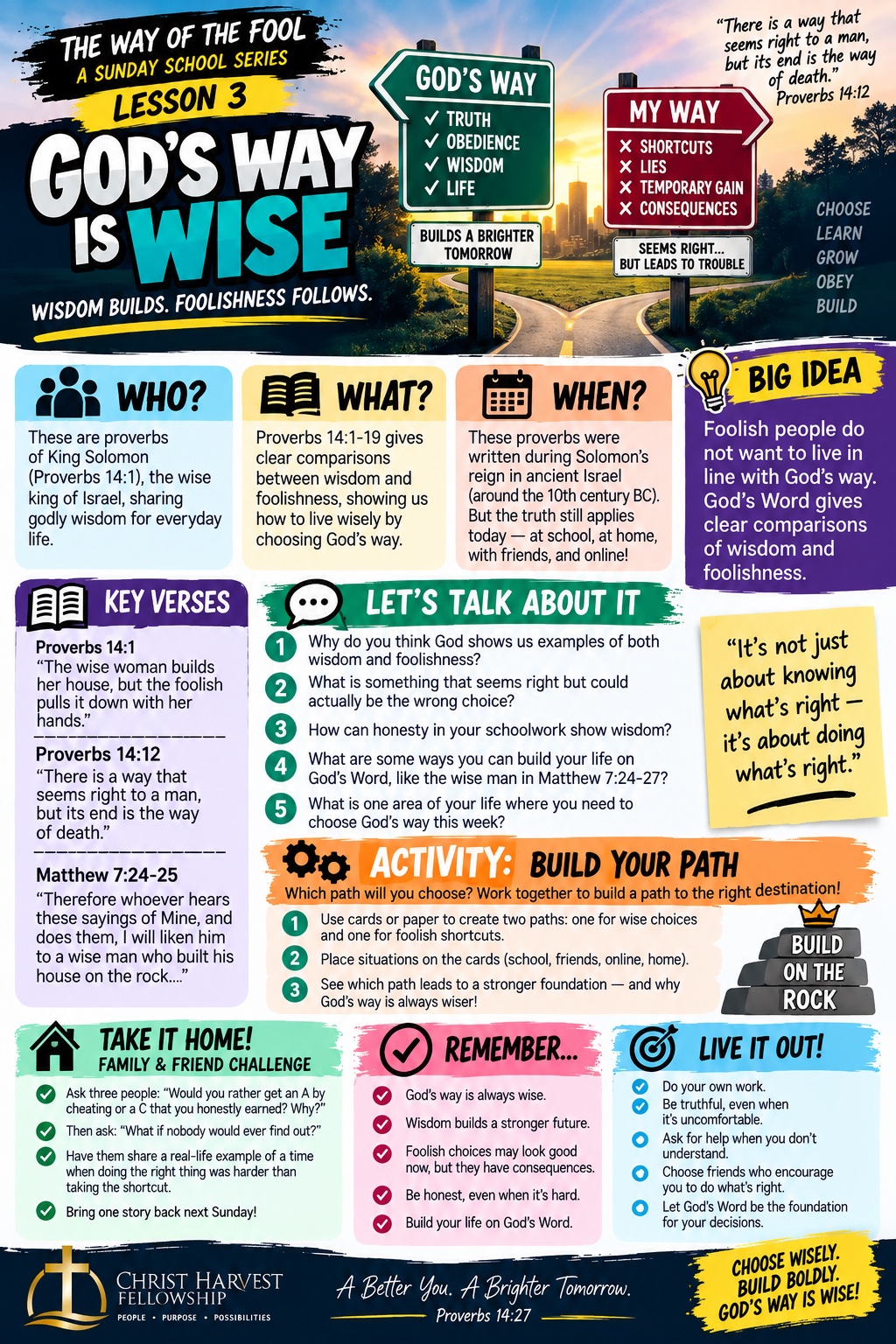
Proverbs 14:1–19 • Open the full flyer or print a one-page copy.
On iPad: open the PDF, then tap Share → Print.
Wise kids can say, “I need help.” God knows everything, and His Word always tells the truth.
Say it together: “God, help me listen and learn.”
Read Proverbs 30:5 aloud with an adult. Then find these words in your Bible: word, pure, shield, and trust.
Picture it: A shield protects a person. God’s true Word protects our hearts and choices.
Say each piece in order: Every word of God / is pure / He is a shield / to those who trust Him.
Your friend gives the wrong answer. What is the kind and humble choice?
Draw or write one thing you want to ask about God’s wisdom.
Draw a shield. Inside it, write or draw one way God’s Word helps you. Give your picture to Minister Lakeita or Pastor April before 9:15 AM for the youth drawing.
You do not have to pretend to know everything. Real wisdom begins when you stay humble, ask God for help, and trust His Word.
Say it: “I can be teachable because God is trustworthy.”
Who: Agur, a wisdom teacher who admits his limits.
What: Humility, God’s pure Word, honest prayer, contentment, and the danger of pride.
Where: Israel’s wisdom tradition—and wherever you make choices today.
Read Proverbs 30:1–14 in your Bible. Check each part as you finish.
Look again: Circle or write down one phrase that stands out to you.
Build Proverbs 30:5 by tapping the phrases in the right order.
A classmate answers a question incorrectly. Other students laugh, and someone invites you to post about it in the group chat. What is the wisest response?
A teacher, coach, or parent corrects something you did. Your first feeling is embarrassment. What shows humble wisdom?
Your friends are comparing clothes, shoes, and phones. Someone makes fun of what another student has. What is the wise response?
What question do you still have about humility, pride, contentment, or trusting God’s Word?
Your question stays on this device until you copy or erase it. Bring it to class and ask Minister Lakeita.
Explore this past lesson’s activities. The drawing for September 20 has closed.
This phrase belongs to the September 20 lesson. Ask Minister Lakeita about the current drawing in class.
Stop and think before you choose. A wise choice agrees with God’s Word and helps—not hurts—people.
Say it together: “Pause. Pray. Choose God’s way.”
Read Proverbs 14:15 with an adult. Listen for two kinds of people: the simple person believes everything, but the prudent person thinks carefully.
Try it: Take three slow steps while saying, “I consider my steps.”
Put these thoughts in order: Someone says it / I stop and check / I ask what God says / I make a wise choice.
A friend says, “Everyone is doing it, so it must be okay.” What should you do?
Draw or write about one choice you want God to help you make.
Draw two paths. Label one “My Way” and one “God’s Wise Way.” Draw yourself choosing God’s path. Give your picture to Minister Lakeita or Pastor April before 9:15 AM for the youth drawing.
A choice can feel right and still lead the wrong way. Wisdom checks feelings, advice, and popular opinions against God’s Word—and thinks about where a choice will end.
Say it: “I will pause, pray, and consider my steps.”
Who: Solomon teaches the wise, the foolish, the simple, and the prudent.
What: Everyday choices reveal what is in the heart and lead toward different outcomes.
Where: Home, school, friendships, social media, and every place decisions are made.
Read Proverbs 14:1–19 in your Bible. Check each part as you finish.
Look again: Which verse gives the best advice for a decision you face?
Build Proverbs 14:15 by tapping the phrases in the right order.
A friend sends you a dramatic rumor and says, “Everybody knows it’s true—share it now.” What is the wisest response?
You are invited somewhere, but there will be no trusted adult supervision and you are told to hide the details from home. What is wise?
Answers to tomorrow’s test appear in a group chat. Everyone says using them is harmless. What choice follows wisdom?
What question do you have about wise choices, peer pressure, truth, or knowing which way is right?
Your question stays on this device until you copy or erase it. Bring it to class and ask Minister Lakeita.
Complete the lesson activities, then unlock next week’s drawing-entry phrase.
Tell Minister Lakeita or Pastor April this phrase in class before 9:15 AM to be entered into the youth drawing.
Youth lessons follow the same weekly Scripture and theme as the women’s Hour of Power lesson. Minister Lakeita may personalize or expand each lesson in class. Scripture wording in the Verse Builder follows the NKJV.