Welcome to the Teaching Ministry of Christ Harvest Fellowship. We believe strong disciples are built through prayerful, consistent study of God’s Word. Scripture must be more than something we hear on Sunday; it must be hidden in our hearts, lived in our homes, and shared with grace and truth.
As you participate in Bible Study, Hour of Power, Christian Basic Training, and youth learning, ask God to make you a faithful student and a prepared witness—one who can explain what you believe, why you believe it, and how the Word of God transforms your life.
Come ready to read, ask questions, receive instruction, and grow.
Welcome to Christ Harvest Fellowship. We are grateful that God has connected you with this church family. Whether you are beginning your relationship with Christ, returning to church, or continuing your spiritual journey, there is a place for you to grow, connect, serve, and become equipped.
Our official vision and mission is to fully engage our congregation in winning the lost and to transform the community by demonstrating the love of Jesus Christ.
Who We Are
A vibrant, loving, faith-filled body of believers called together by God and equipped spiritually, intellectually, physically, and financially to share the good news of Jesus Christ and mature in relationship with God, ourselves, and others.
What We Believe
We are a ministry of faith and prayer. We gather to study God’s Word, worship and praise God, welcome individuals and families, make disciples, grow in Christian fellowship, and equip believers for ministry and community impact.
Summary based on the church’s official website. Additional formal belief statements may be added when approved.
Meet Our Pastors
Servant leaders who teach, shepherd, and equip
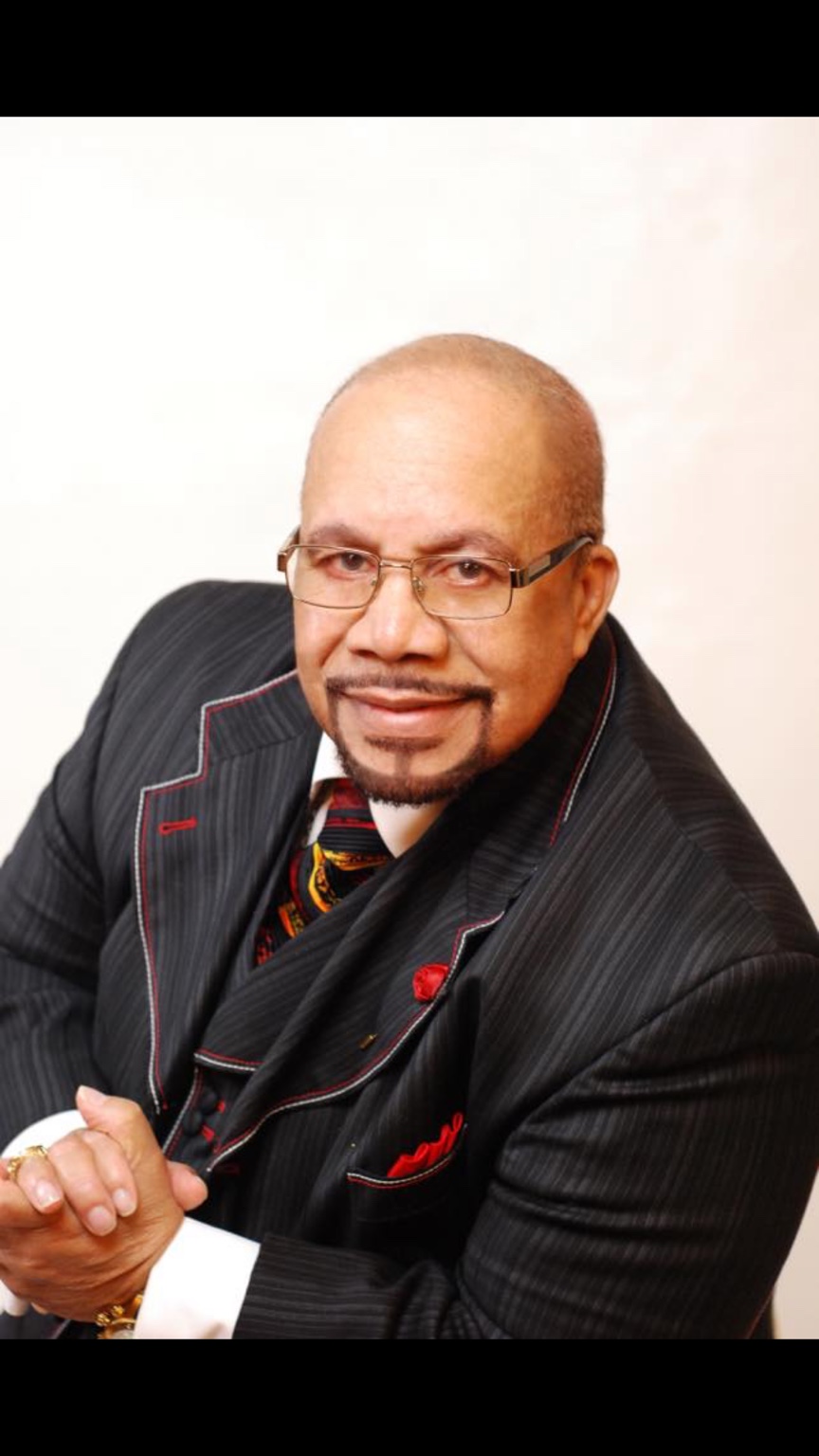
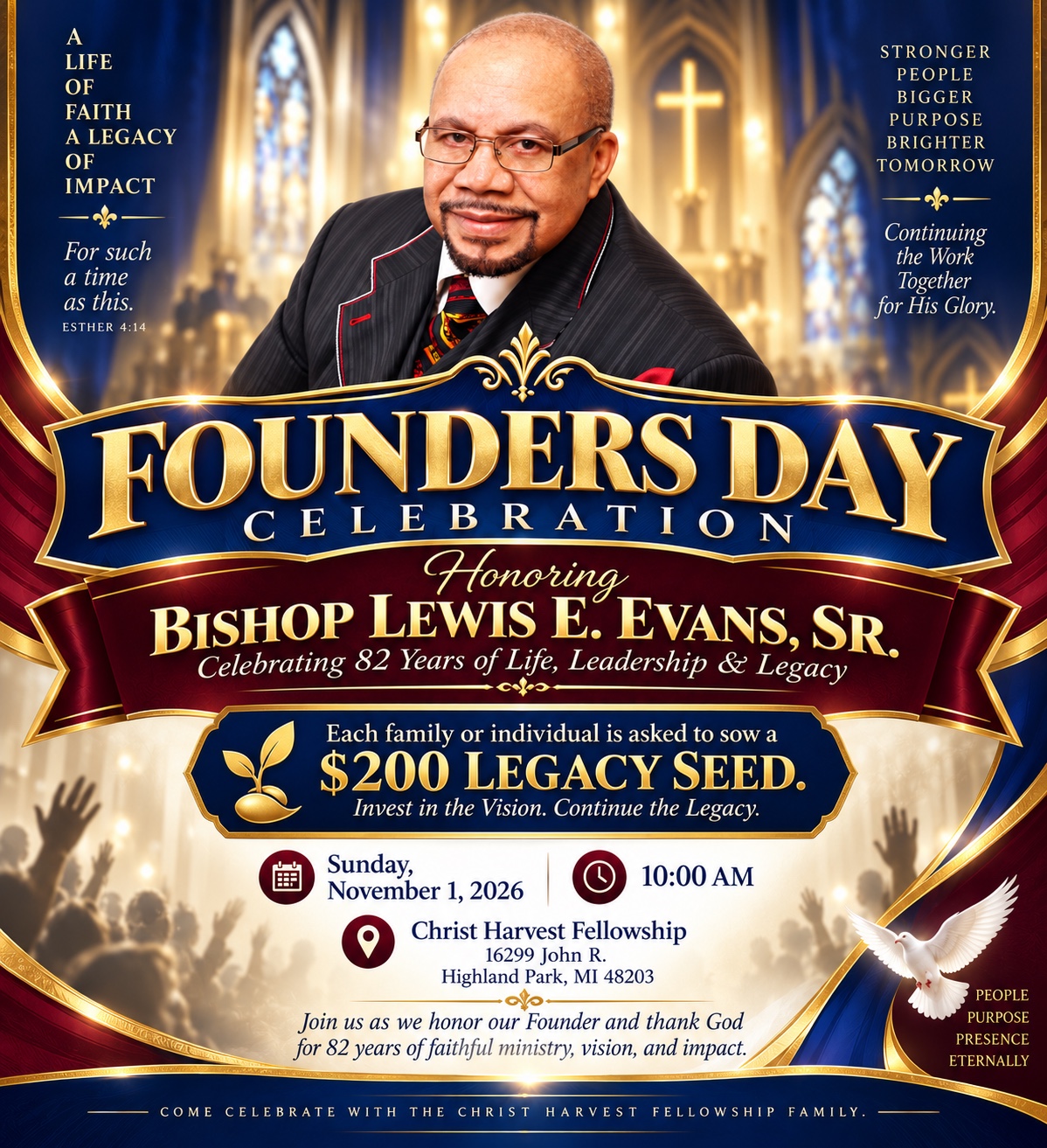
Bishop Lewis E. Evans, Sr.
Senior Pastor / Bishop
Bishop Evans faithfully leads with a commitment to clear biblical teaching, prayer, discipleship, and equipping believers to serve.
This original guide presents four biblical truths about God’s love, our need, and the new life offered through Jesus Christ.
1
God loves you and has a purpose for your life
God created you for relationship with Him. His love is personal, sacrificial, and life-giving.
Read: John 3:16; John 10:10
Reflect: What does knowing that God loves you personally mean to you?
2
Sin separates us from God
Every person has sinned. Sin breaks fellowship with God, and human effort alone cannot repair that separation. The result of sin is death, but God offers another way.
Read: Romans 3:23; Romans 6:23
3
Jesus Christ is God’s provision
Jesus died for our sins, rose from the dead, and makes reconciliation with God possible. Where sin created separation, the cross opens the way to restored relationship.
Read: Romans 5:8; 1 Corinthians 15:3–6; John 14:6
4
We personally receive Christ by faith
God calls us to turn from sin and trust Jesus Christ as Savior and Lord. Salvation is God’s gracious gift; it is received by faith and cannot be earned through good works.
Read: John 1:12; Ephesians 2:8–9; Revelation 3:20; John 3
Your Response
I’m Ready to Receive Christ
Prayer is talking with God. The words themselves do not save us; we are saved by grace through faith in Jesus Christ.
“Lord Jesus, I know that I need You. I believe You died for my sins and rose again. I turn from my sin and place my faith in You. Forgive me, come into my life, and be my Savior and Lord. Help me live the life You have called me to live. Thank You for Your grace, Your forgiveness, and the gift of new life. In Jesus’ name, Amen.”
If you have made a decision for Christ, connect with us so a ministry leader can welcome you and help guide your next steps.
You have begun a new life in Christ — 2 Corinthians 5:17.
You are beginning a lifelong journey with God.
Faith Over Feelings
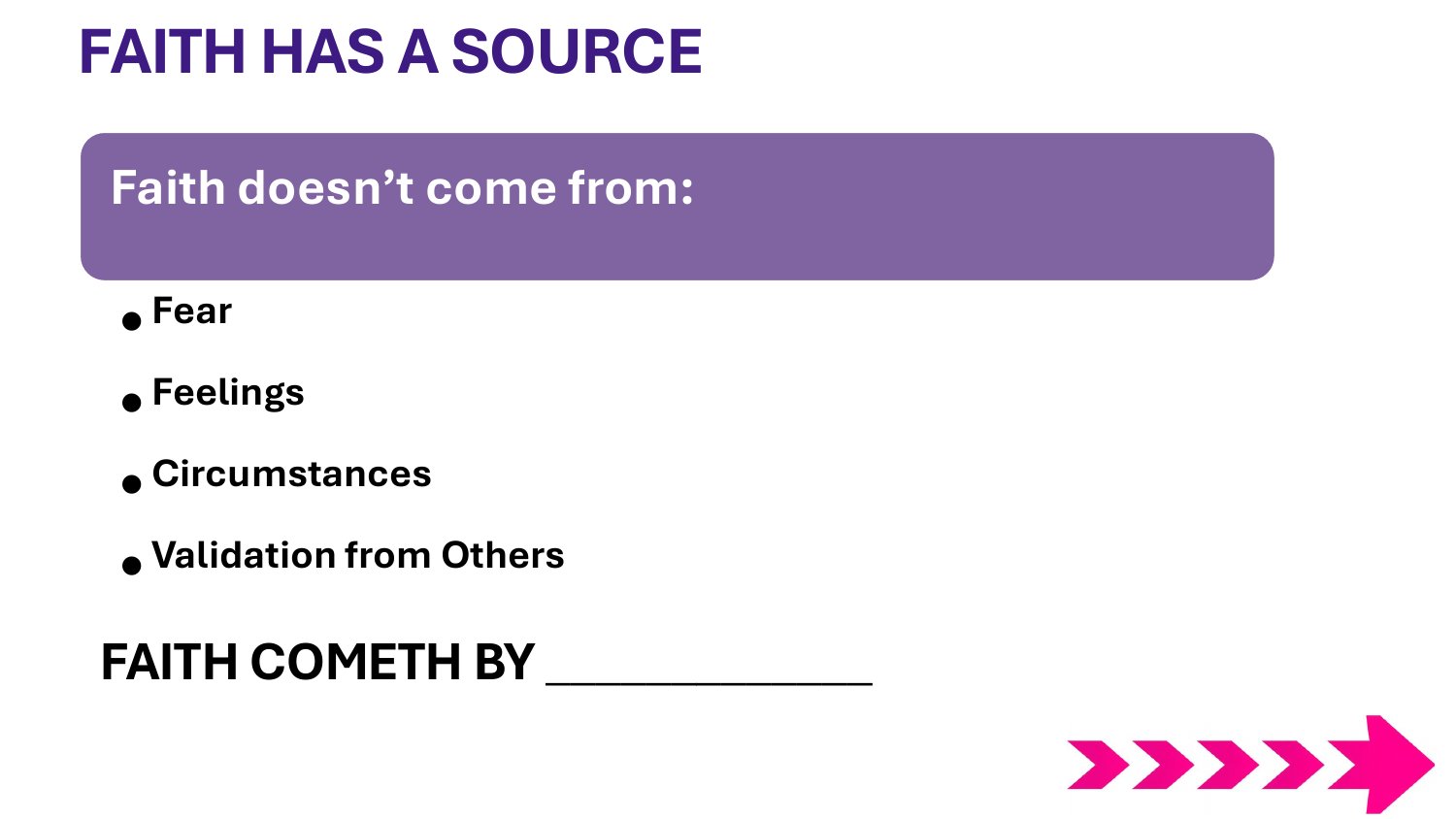
Feelings can change from day to day. Your relationship with God rests on His trustworthy promises and His Word. When emotions are uncertain, return to what God has said and choose to trust Him.
Read: Revelation 3:20; John 1:12; John 5:24.
Your Next Steps
Growing in Christ
Salvation is the beginning of a lifelong journey. Build a daily life of faith and stay connected to other believers.
Pray regularly
Read and study God’s Word
Obey Scripture
Share your faith
Trust God in daily life
Depend on the Holy Spirit
Worship and fellowship
Connect to the local church
Serve with your gifts
Baptism — What Is It?
A public expression of faith
Baptism is a public expression of faith in Jesus Christ, a symbol of new life in Christ, an act of obedience after salvation, and a visible testimony of a person’s decision to follow Christ.
Baptism itself does not save us. Salvation is God’s gift, received by grace through faith in Jesus Christ. In baptism, the believer openly identifies with Jesus’ death, burial, and resurrection.
Read: Matthew 28:19; Acts 2:38; Romans 6:3–4.
Ready to learn more about baptism?
Text BAPTISM to 1-833-551-4603. A ministry leader will follow up with information about baptism preparation and the next baptism opportunity.
Christian Basic Training helps new members build a strong biblical foundation, understand their faith, learn about the church, and become connected to ministry.
Membership means becoming part of the life of the church. Future interest pathways will include Christian Education, women, men, youth, music and worship, prayer, outreach, hospitality, and other approved ministry opportunities.
Ministry names, leaders, and interest links will be added after verification.
We’re Growing Together
A grace-centered church family
We are committed to praying for members, teaching God’s Word, providing opportunities for spiritual growth, encouraging fellowship, and helping people discover ways to serve. We encourage every member to worship faithfully, pray, study Scripture, participate in Christian Education, build relationships, give, serve, share their faith, and strengthen the body of Christ.
What Happens Next?
You will not walk alone.
After you complete the New Member connection process, you will receive a follow-up text message through our church communication system. A ministry leader or designated member of the Christ Harvest Fellowship team will also reach out to welcome you, answer your questions, and help you take your next steps in your walk with Christ and in the life of the church.
Those next steps may include Christian Basic Training, baptism, Christian Education, worship, prayer, and connection with a ministry.
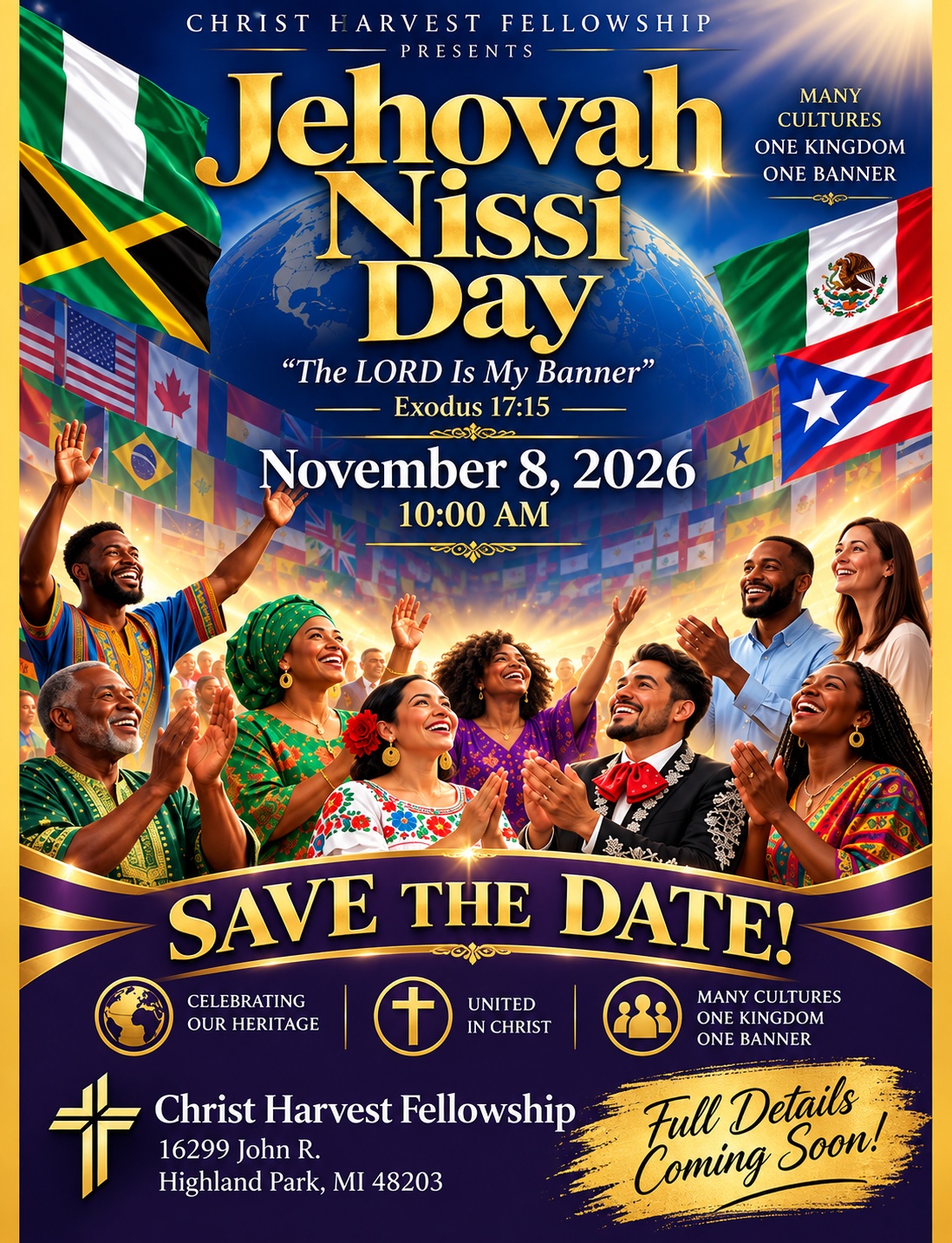
Jehovah Nissi means “The LORD Is My Banner.” In Exodus 17:8–16, Israel faced Amalek in battle. As Moses held up his hands, Israel prevailed; Aaron and Hur helped support him until the victory was complete. Moses then built an altar and named it Jehovah Nissi (Exodus 17:15).
A banner identifies the one under whom a people gather. For Jehovah Nissi Day, Many Cultures • One Kingdom • One Banner reminds us that people from different cultures and backgrounds are united under Christ.
Explore Our Heritage
African Heritage
Educational facts, Christian faith connections, cultural information, language expressions, and verified visuals will be added here.
Jamaican Heritage
Educational facts, Christian faith connections, cultural information, language expressions, and verified visuals will be added here.
African American Heritage
Educational facts, Christian faith connections, cultural information, language expressions, and verified visuals will be added here.
Future feature: How Do You Say “Praise the Lord”? Verified translations coming soon. This area is ready to expand into an interactive Ethnos/Heritage Digital Passport.
Study to Stand
Becoming a Ready Defender of the Faith
“Always be ready to give a defense to everyone who asks you a reason for the hope that is in you.” — 1 Peter 3:15, NKJV
01Know the WordRead Scripture in context and study it consistently.
02Know the GospelBe able to explain salvation through Jesus Christ clearly.
03Answer with GraceListen carefully and speak truth with meekness and respect.
04Live What You BelieveLet your character support the truth you share.
Learning Hubs
Choose your class
Select a ministry area to see its schedule, teachers, and resources.
Christian Basic Training is taught by Bishop Lewis E. Evans and Mother Lynda C. Evans. This foundational course follows the five assurances taught in The Navigators’ Beginning with Christ and Lessons on Assurance: salvation, answered prayer, victory, forgiveness, and guidance.
Sunday Schedule Classes begin at 9:00 AM.
Course Practice Read the lesson, memorize the key Scripture, answer the questions, and apply God’s promise.
Select an assurance to study what the verse says, what it means, how it applies, and how to memorize it.
Step 1Read it aloud
Step 2Break it into phrases
Step 3Say the reference first and last
Step 4Write it from memory
Step 5Review: today, tomorrow, day 3, and day 7
1Assurance of Salvation1 John 5:11–12
“And this is the testimony: that God has given us eternal life, and this life is in His Son. He who has the Son has life; he who does not have the Son of God does not have life.”1 John 5:11–12, NKJV
What It Says
God has given eternal life. That life is in His Son. Whoever has Jesus Christ has life; whoever does not have the Son does not have life.
What It Means
Our assurance rests on God’s testimony—not on changing emotions, past performance, or personal worthiness. Salvation is God’s gift and is found in Jesus Christ.
Supporting Scriptures
John 1:12 — Receiving Christ and becoming God’s child
John 10:27–29 — Secure in the Shepherd’s hand
1 John 5:13 — Knowing that you have eternal life
Apply It to Your Life
When doubt comes, answer it with God’s written promise. Ask yourself, “Have I received and trusted the Son?” Then thank God that your salvation rests on Christ.
Study Questions
Who gives eternal life?
Where is eternal life found?
What is true of the person who has the Son?
Prayer Focus
Ask God to replace doubt with confidence in His Word.
Memorization Tip
Break it into four thoughts: God’s testimony → God’s gift → life in His Son → who has life.
Use the bookends: Say “1 John 5:11–12” before and after reciting the verse.
Fill in the blanks:
God has given us .
This life is in His .
He who has the Son has .
2Assurance of Answered PrayerJohn 16:24
“Until now you have asked nothing in My name. Ask, and you will receive, that your joy may be full.”John 16:24, NKJV
What It Says
Jesus commands His disciples to ask in His name and promises that answered prayer produces fullness of joy.
What It Means
Praying in Jesus’ name means approaching the Father through Christ and asking in harmony with His character and will. Prayer is a privilege of relationship, not a formula for controlling outcomes.
Supporting Scriptures
Philippians 4:6–7 — Bring everything to God in prayer
1 John 5:14–15 — Ask according to His will
Hebrews 4:16 — Come boldly to the throne of grace
Apply It to Your Life
Turn worry into a specific prayer. Ask boldly, submit the answer to God’s wisdom, and watch for how He responds.
Study Questions
What invitation does Jesus give?
What does it mean to pray in Jesus’ name?
What concern should you bring to God today?
Prayer Focus
Bring one need to God with faith, submission, and thanksgiving.
Memorization Tip
Listen for the movement: Nothing asked → ask in My name → receive → joy made full.
Practice in prayer: Recite the verse before presenting your request to God.
Fill in the blanks:
You have asked nothing in My .
Ask, and you will .
That your may be full.
3Assurance of Victory1 Corinthians 10:13
“No temptation has overtaken you except such as is common to man; but God is faithful, who will not allow you to be tempted beyond what you are able, but with the temptation will also make the way of escape, that you may be able to bear it.”1 Corinthians 10:13, NKJV
What It Says
Temptation is common to humanity. God is faithful, limits what we face, and provides a way of escape so we can endure without surrendering.
What It Means
Temptation is real, but it does not have final authority over the believer. Victory depends on God’s faithfulness and our willingness to recognize and take His way of escape.
Supporting Scriptures
James 4:7 — Submit to God and resist the devil
Galatians 5:16 — Walk in the Spirit
Hebrews 4:15–16 — Receive timely help
Apply It to Your Life
Identify your common temptation and plan your escape before pressure comes: pray, leave the situation, call a trusted believer, or replace the wrong action with obedience.
Study Questions
What does this verse reveal about God?
What might a way of escape look like?
Where do you need victory now?
Prayer Focus
Ask the Holy Spirit to help you recognize temptation early and choose God’s escape.
Memorization Tip
Remember the three promises: God is faithful → God sets a limit → God makes an escape.
Use first letters: T–G–A: Temptation, God’s faithfulness, A way of escape.
Fill in the blanks:
But God is .
He will make the way of .
That you may be able to it.
4Assurance of Forgiveness1 John 1:9
“If we confess our sins, He is faithful and just to forgive us our sins and to cleanse us from all unrighteousness.”1 John 1:9, NKJV
What It Says
When believers confess their sins, God faithfully and justly forgives and cleanses them from all unrighteousness.
What It Means
Confession means agreeing with God rather than hiding or excusing sin. Conviction draws us back to God; condemnation tries to drive us away. God restores fellowship through honest confession.
Supporting Scriptures
Psalm 32:5 — Acknowledging sin
Proverbs 28:13 — Confess, forsake, and obtain mercy
Romans 8:1 — No condemnation in Christ
Apply It to Your Life
Name the sin honestly, confess it to God, turn from it, receive His forgiveness, and make restitution where appropriate.
Study Questions
What is our responsibility when we sin?
What two things does God promise?
What do you need to release today?
Prayer Focus
Confess honestly and thank God for cleansing and restoration.
Memorization Tip
Use the promise pattern: If we confess → He is faithful and just → He forgives and cleanses.
Pair the actions: Our action is confession. God’s actions are forgiveness and cleansing.
Fill in the blanks:
If we our sins.
He is faithful and .
To cleanse us from all .
5Assurance of GuidanceProverbs 3:5–6
“Trust in the LORD with all your heart, And lean not on your own understanding; In all your ways acknowledge Him, And He shall direct your paths.”Proverbs 3:5–6, NKJV
What It Says
Trust the LORD wholeheartedly, refuse to depend only on your understanding, and acknowledge Him in every area. God promises to direct your paths.
What It Means
Guidance grows from relationship and surrender. The promise is not that every answer arrives immediately, but that God faithfully directs a life submitted to Him.
Supporting Scriptures
Psalm 119:105 — God’s Word lights our path
James 1:5 — Ask God for wisdom
Isaiah 30:21 — Walk in God’s way
Apply It to Your Life
Before making a decision, compare it with Scripture, pray for wisdom, seek godly counsel, and obey what God has already made clear.
Study Questions
What three instructions appear here?
What does acknowledging God look like?
Where are you leaning on yourself?
Prayer Focus
Surrender one decision and ask for wisdom and courage to obey.
Memorization Tip
Remember three commands and a promise: Trust → lean not → acknowledge → He directs.
Use hand motions: Point to heart, shake head “no,” lift hands to God, then point forward.
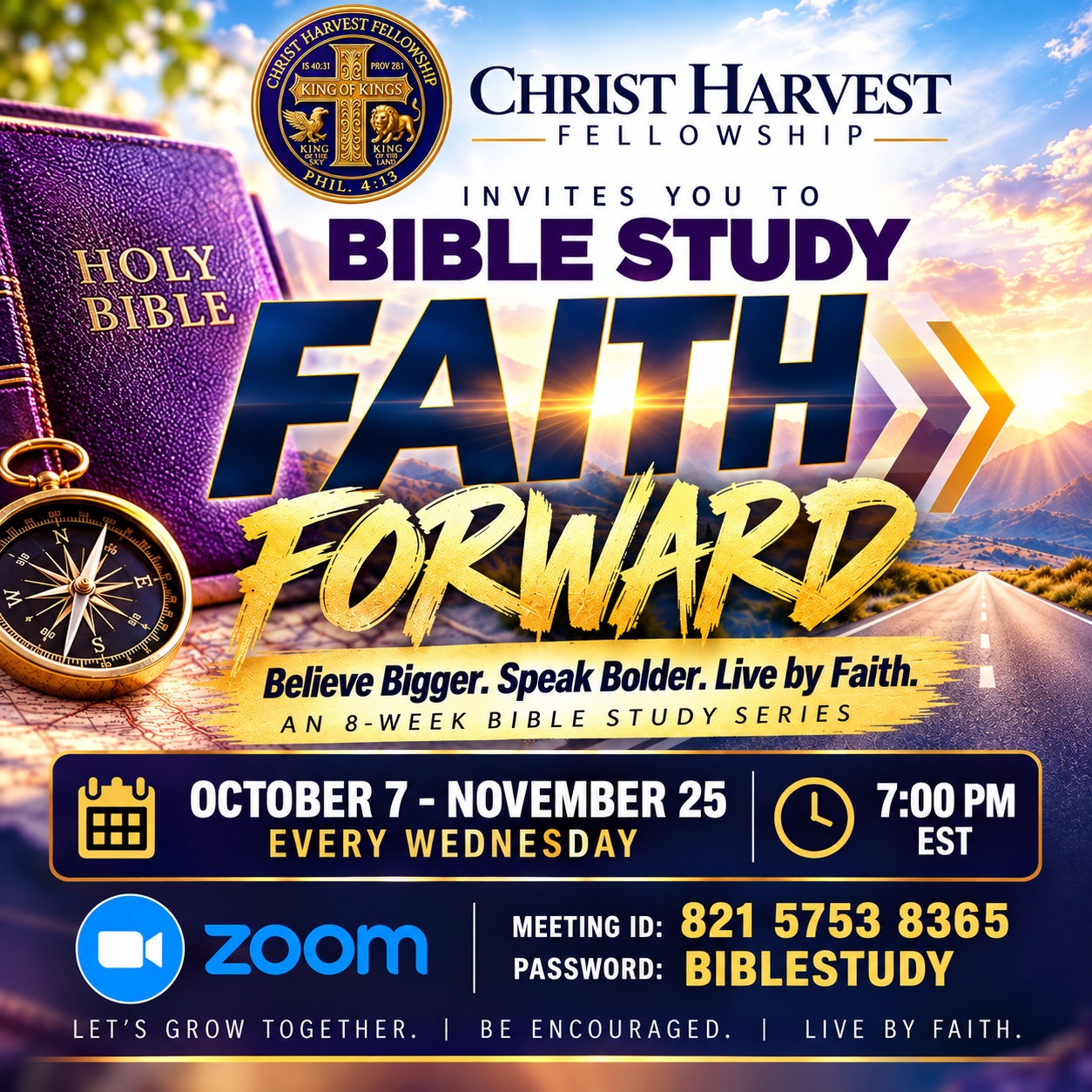
Join Bishop Lewis E. Evans and the Christ Harvest Fellowship family every Wednesday at 7:00 PM. Please enter Zoom by 6:50 PM so everyone is settled and prepared to begin promptly.
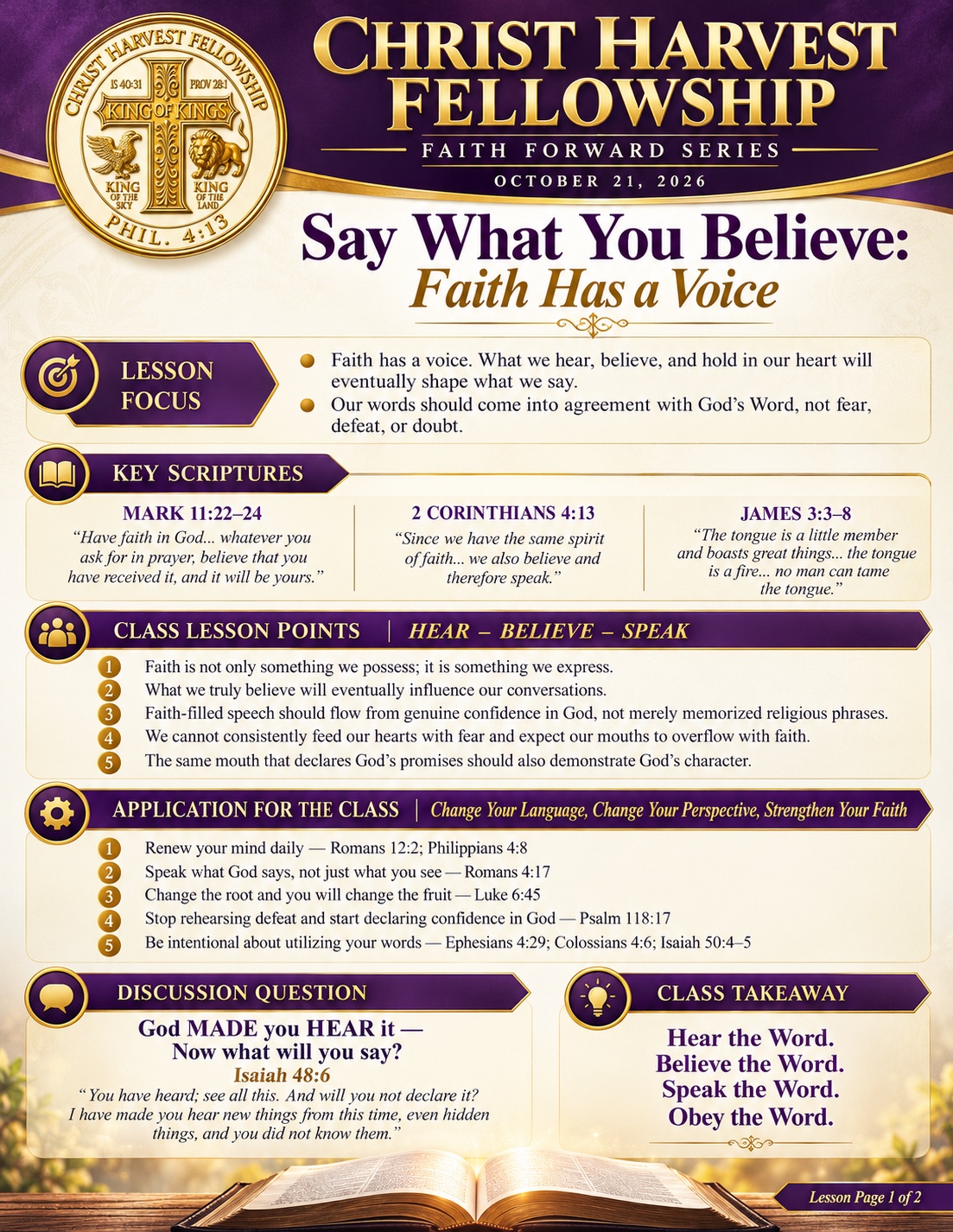
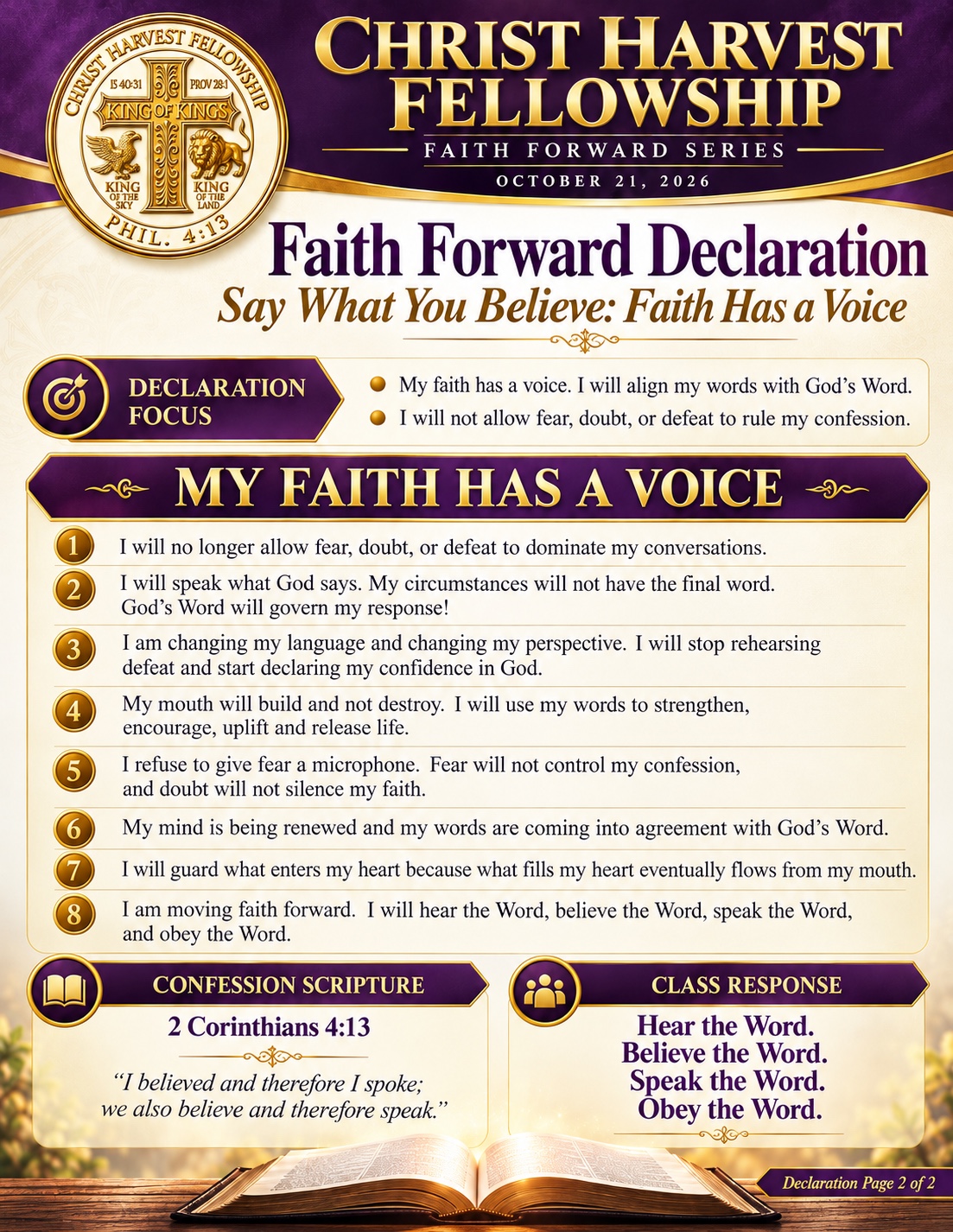
Teacher: Pastor Brenda Key Scripture: Mark 11:22–24; 2 Corinthians 4:13
Open lesson overview
Lesson Focus: What we truly believe shapes how we speak.
Let your words reflect your faith
In Mark 11:22–24, Jesus begins with faith in God and teaches about believing, speaking, and praying. Second Corinthians 4:13 connects belief with speech. This lesson invites us to examine whether our words reflect confidence in God’s Word. Speaking in faith means expressing trust in God and His promises while bringing our needs honestly before Him.
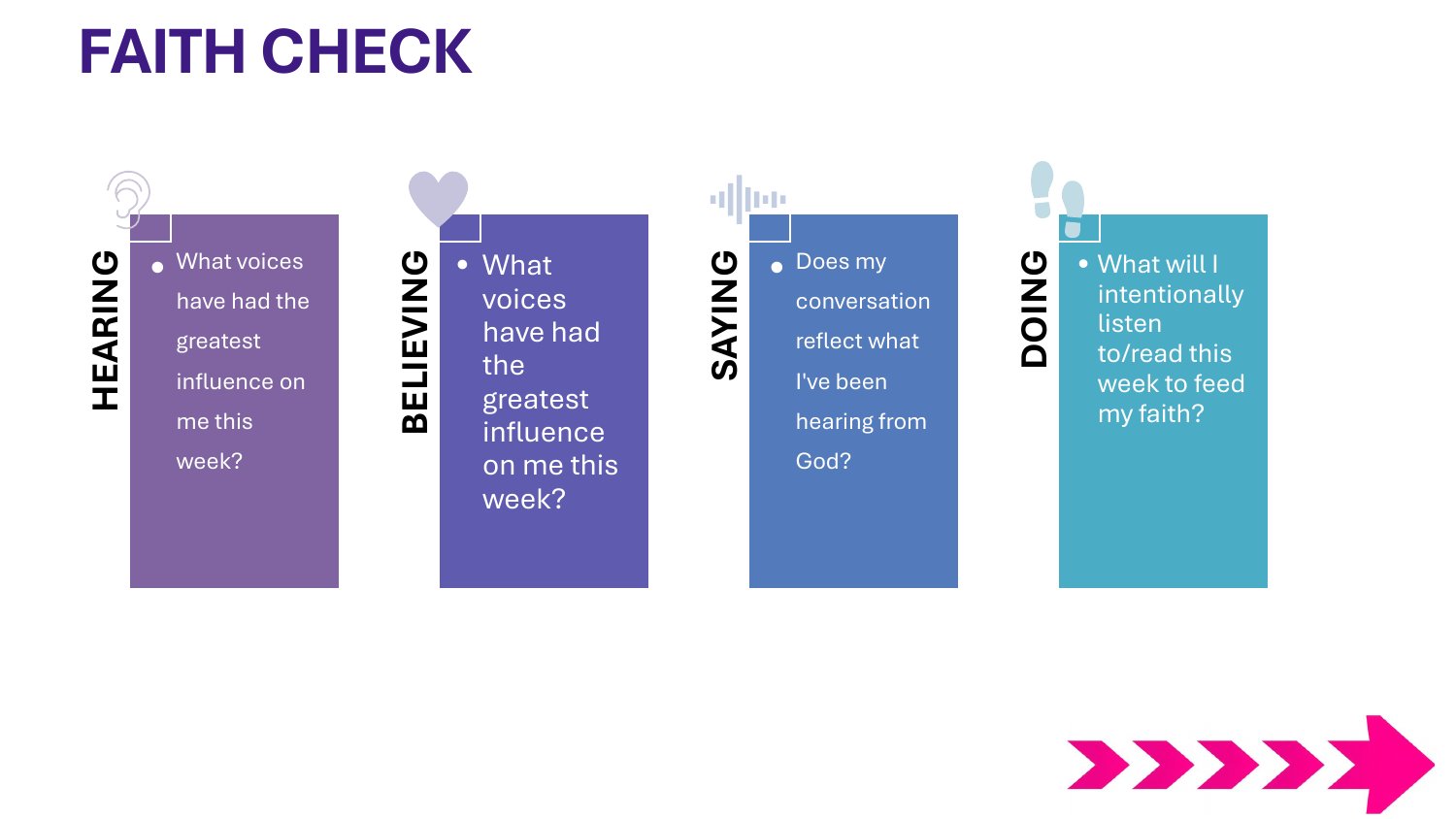
Faith Check
What am I hearing?
What am I believing?
What am I saying?
What am I doing?
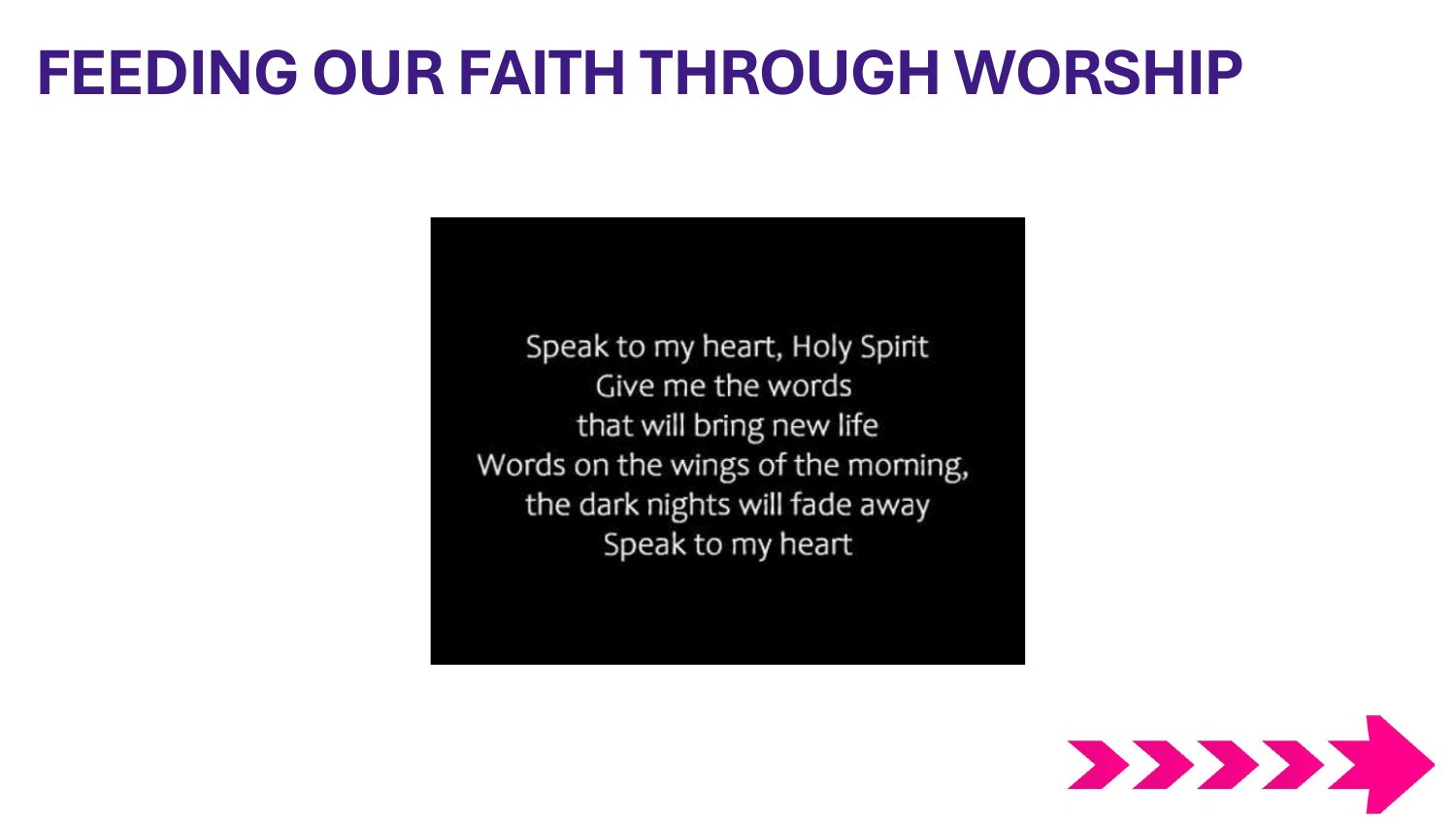
🎧 THIS WEEK’S FAITH SOUNDTRACK
“Speak” — Myron Butler & Levi
October 21, 2026 · Bible Study with Pastor Brenda
Before Bible Study: Listen to this week’s song and come ready to reflect.
Faith Connection: What we believe shapes how we speak. As you listen, consider how your words can express trust in God and His promises.
Faith Check
Where do my words need to reflect greater confidence in God’s Word this week?
Scripture Connection: Mark 11:22–24; 2 Corinthians 4:13
Teacher: Pastor A Key Scripture: Hebrews 11:6; Mark 5:25–34
Open lesson overview
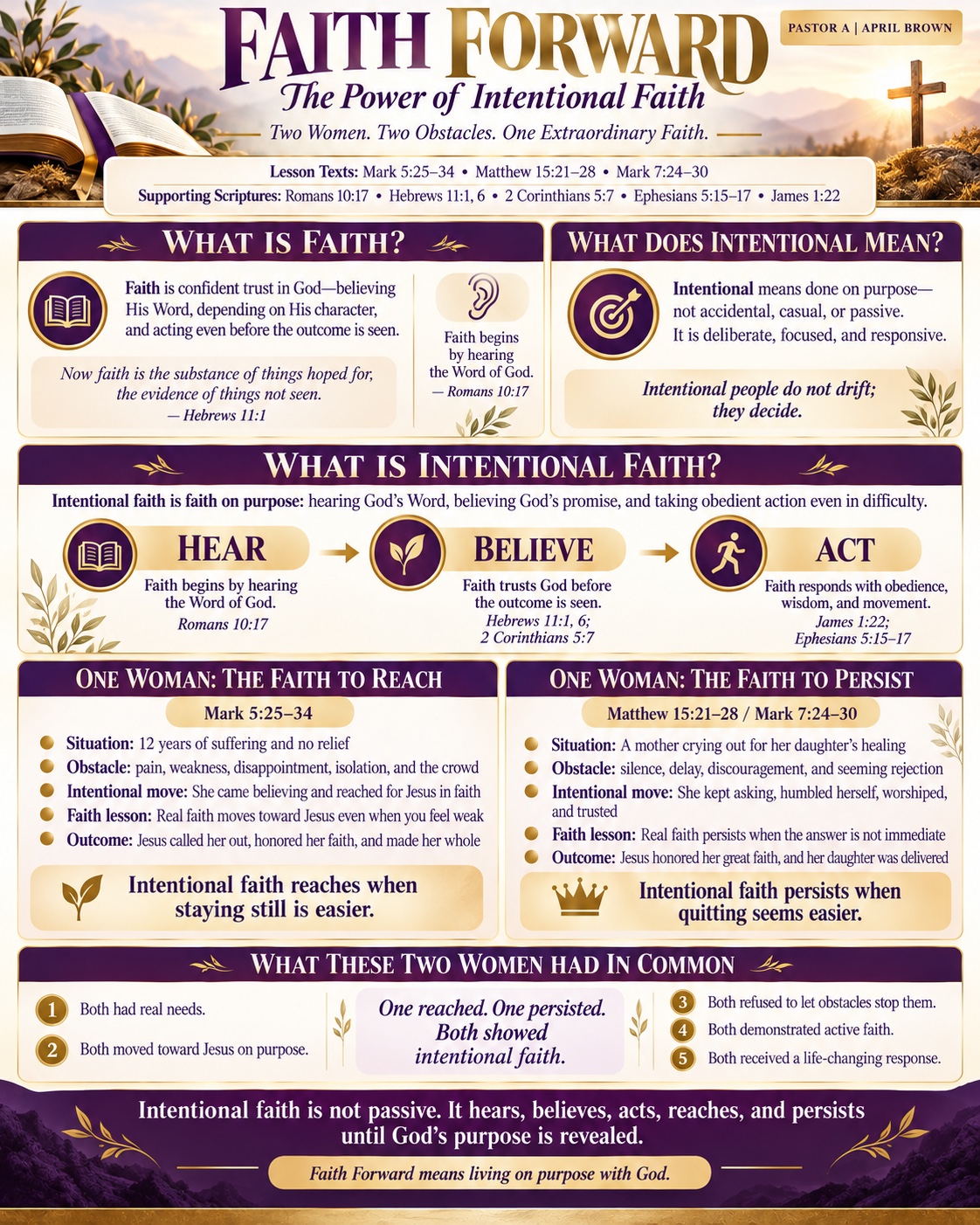
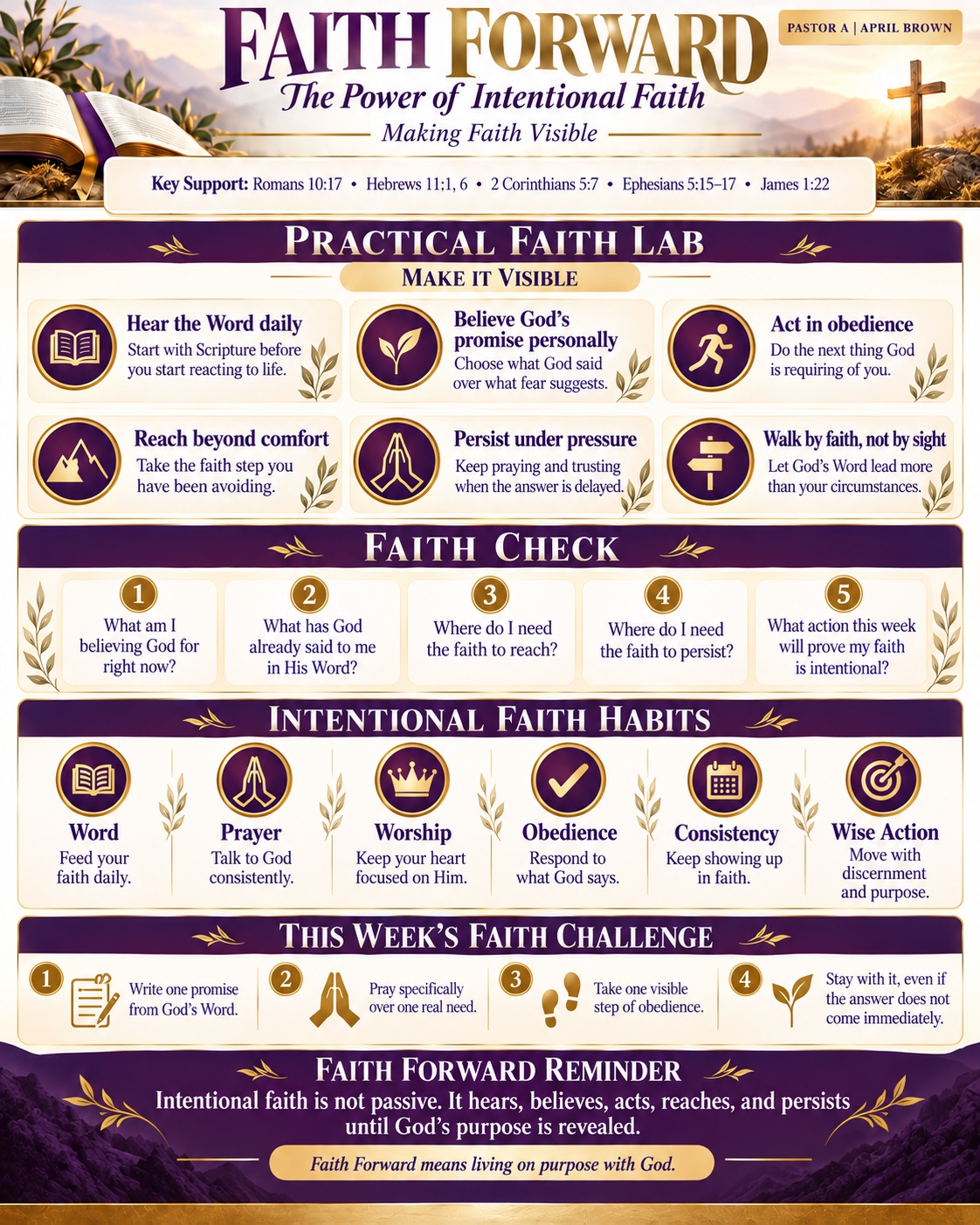
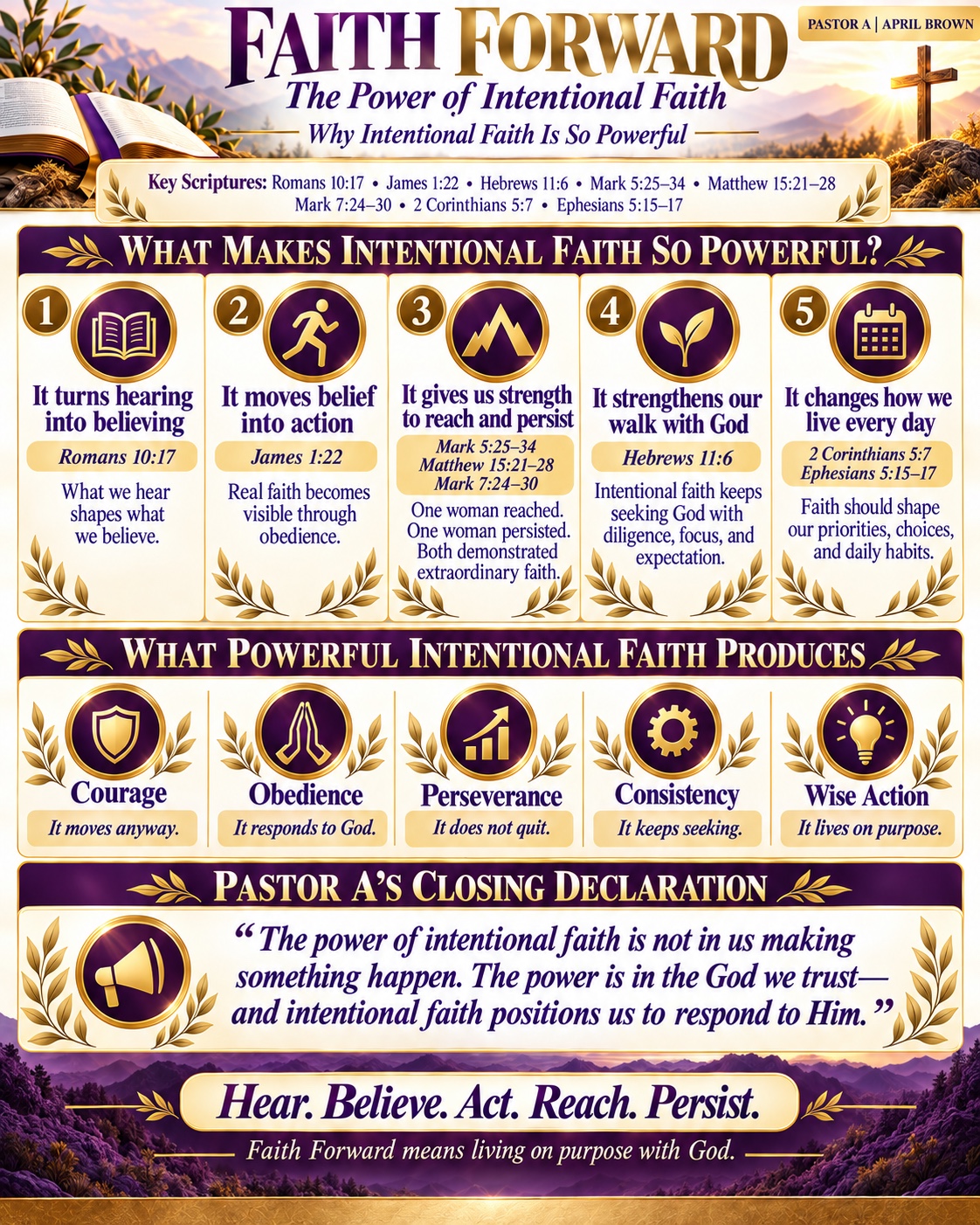
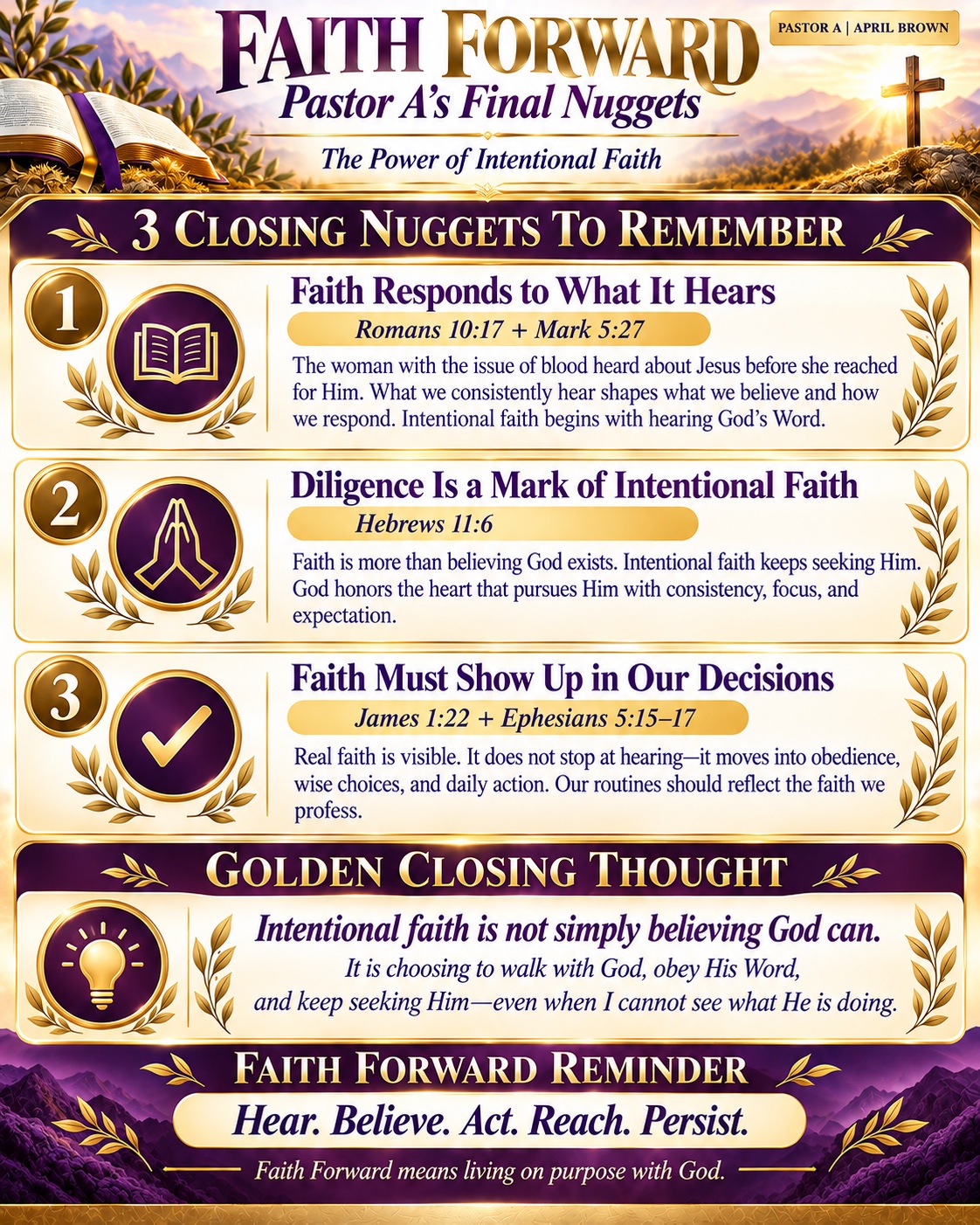
Lesson Focus: Faith is deliberate: what we hear, believe, say, and do matters.
Faith with intention
Hebrews 11:6 describes faith that believes God exists and earnestly seeks Him. In Mark 5:25–34, the woman heard about Jesus, believed she could be healed, spoke her conviction, and moved toward Him to touch His garment. Her faith was deliberate: what she believed shaped what she did. Intentional faith means purposefully directing our hearing, believing, speaking, and actions toward God. Ask where your daily choices can reflect the faith you profess; the power rests in Jesus, whom you trust.
Faith Check
What am I hearing?
What am I believing?
What am I saying?
What am I doing?
🎧 THIS WEEK’S FAITH SOUNDTRACK
“Intentional” — Travis Greene
Before Bible Study: Listen to this week’s song and come ready to reflect.
Faith Connection: God is not random about His work in our lives. As we study Intentional Faith, consider how trusting God’s purpose changes the way we pray, plan, respond, and move forward.
Faith Check
Where do I need to stop living accidentally and begin walking intentionally by faith?
Scripture Connection: “For we walk by faith, not by sight.” — 2 Corinthians 5:7 (NKJV)
Teacher: Elder Ashley Key Scripture: Romans 10:17; Mark 4:23–24
Open lesson overview
Lesson Focus: Faith grows as we consistently hear and receive God’s Word.
Hearing with a receptive heart
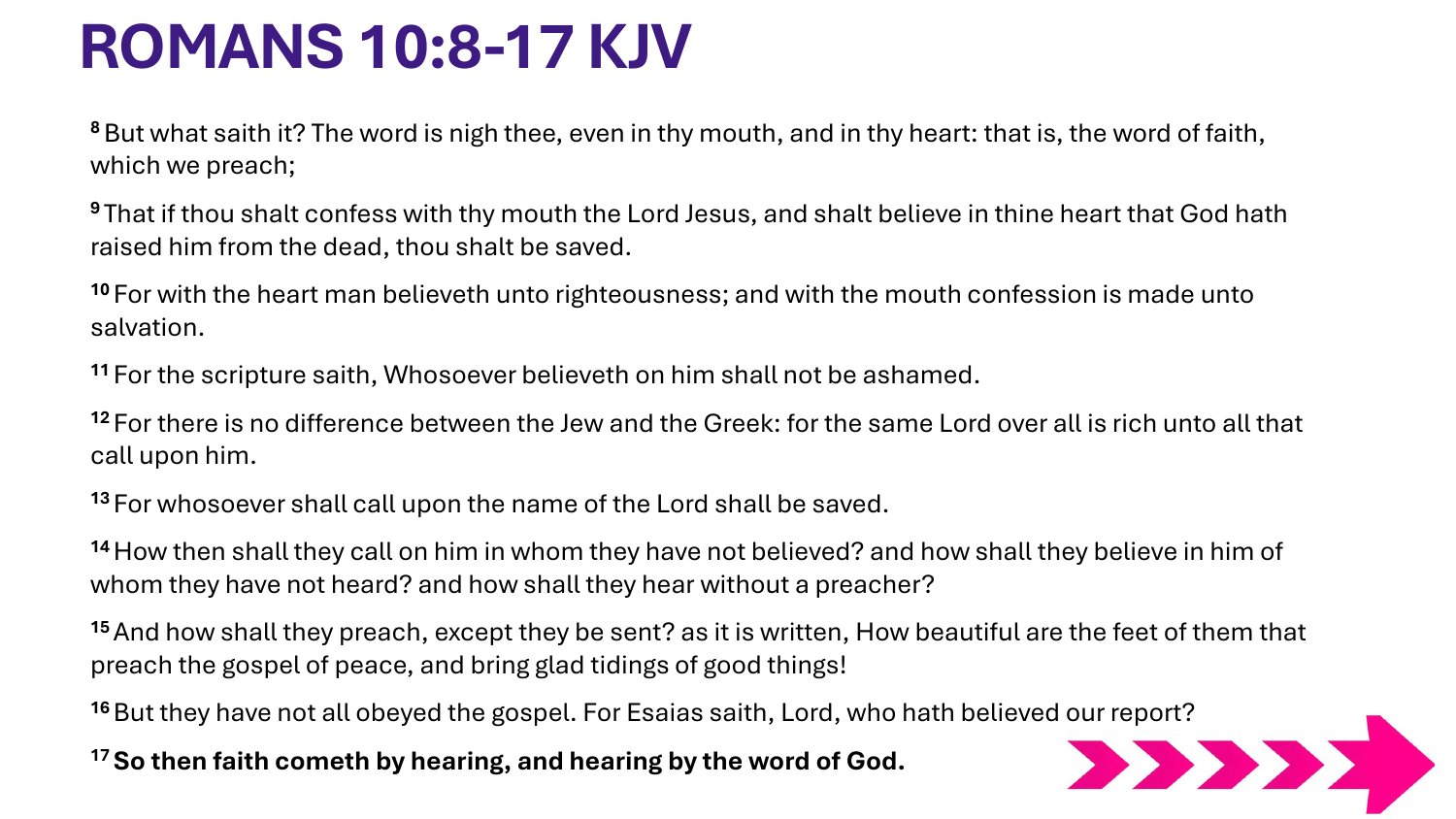
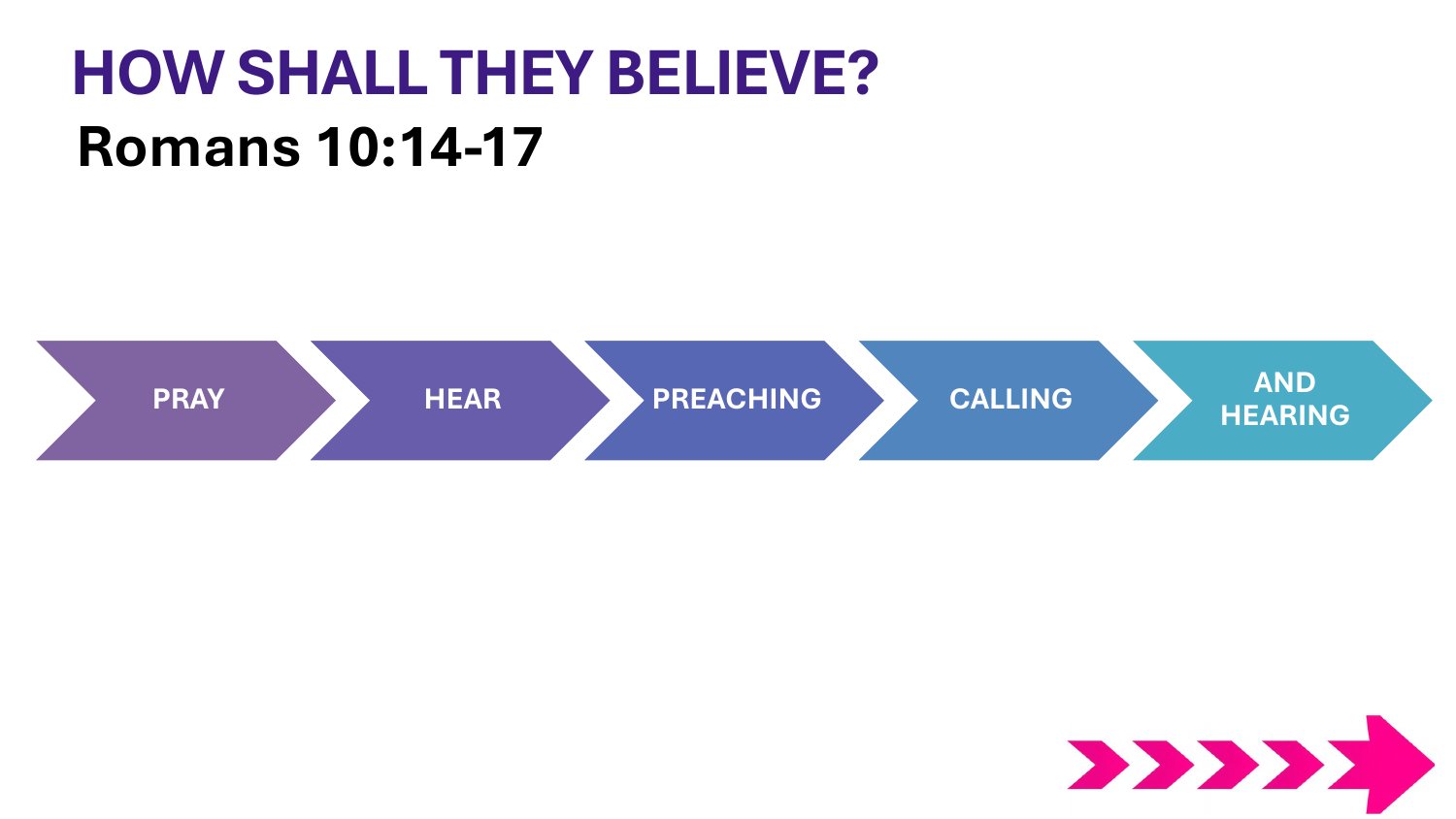
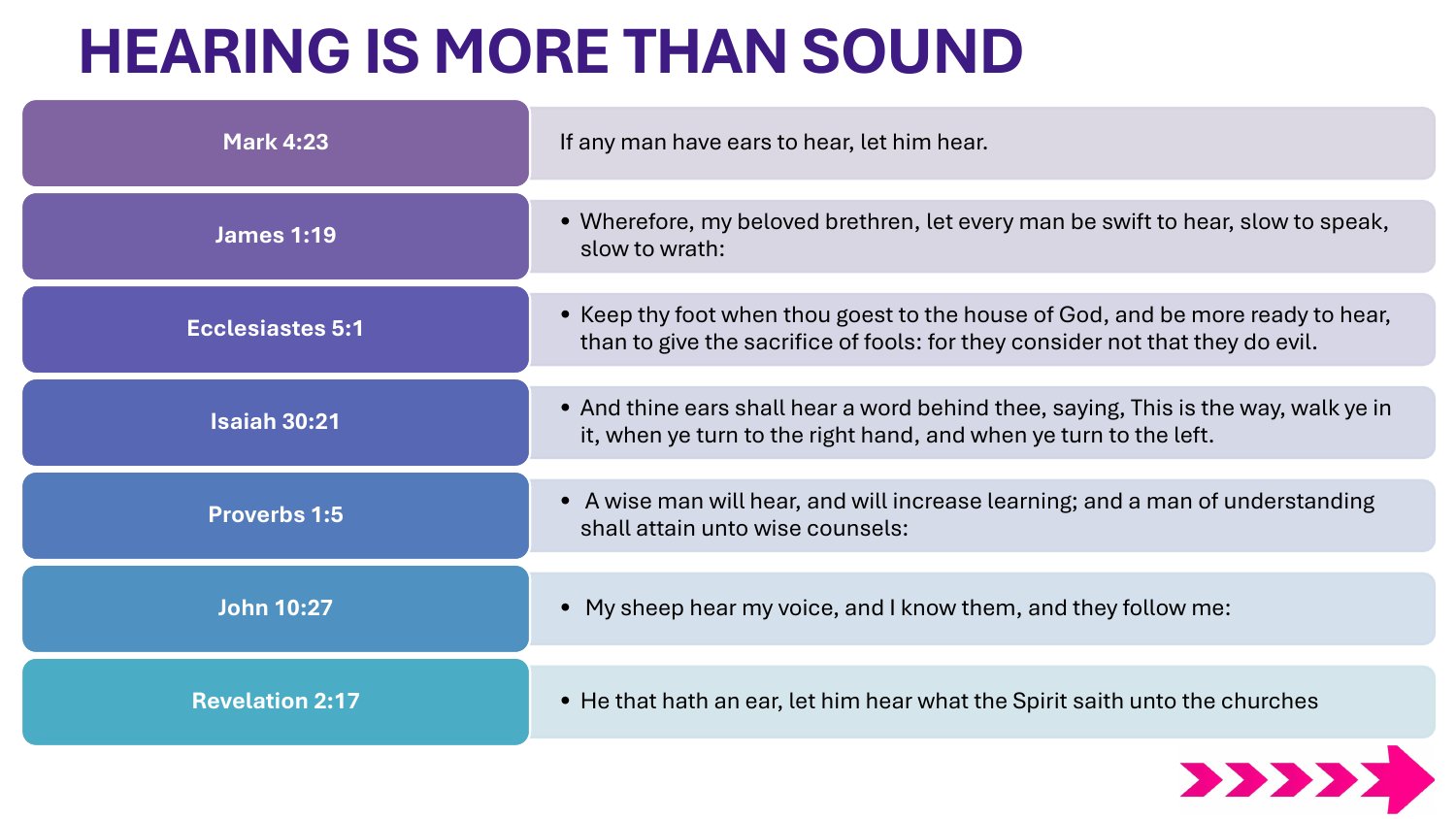
Romans 10:17 connects faith with hearing the message of Christ. In Mark 4:23–24, Jesus calls His listeners to pay attention to what they hear. Consistently receiving God’s Word helps shape what we believe and how we respond. Consider which voices you are giving the most attention to and how you can make room for the Word this week.
Faith Check
What am I hearing?
What am I believing?
What am I saying?
What am I doing?
🎧 This Week’s Faith Soundtrack
Before Bible Study: Listen and reflect on how what you hear shapes what you believe.
Slide 1 of 14Slide 2 of 14Slide 3 of 14Slide 4 of 14Slide 5 of 14Slide 6 of 14Slide 7 of 14Slide 8 of 14Slide 9 of 14Slide 10 of 14Slide 11 of 14Slide 12 of 14Slide 13 of 14Slide 14 of 14
What Report Will You Believe? • 2-page student handout • Key Scripture: Mark 11:23
Lesson Focus: Give God’s Word greater authority than fearful reports.
Choose God’s promise over fear
The spies saw the same land but gave different reports. In Numbers 13:30–33 and 14:6–9, Joshua and Caleb trusted God’s presence and promise while others focused on the obstacles. Second Timothy 1:7 reminds us of the power, love, and sound judgment God gives. Faith acknowledges real challenges while allowing God’s Word to guide our response.
Faith Check
What am I hearing?
What am I believing?
What am I saying?
What am I doing?
🎧 THIS WEEK’S FAITH SOUNDTRACK
“No Weapon” — Fred Hammond
Official audio · Verity Records
Before Bible Study: Listen to this week’s song and come ready to reflect.
Faith Connection: Joshua and Caleb gave God’s promise greater authority than the obstacles before them. As you listen, reflect on how trust in God can shape your response to fear and help you stand on His Word.
Faith Check
Which fearful report am I allowing to speak louder than God’s promise?
James 2:17–18 shows that living faith is expressed through action. Hebrews 11:7–8 gives two examples: Noah prepared the ark, and Abraham obeyed God’s call to go. Their trust became visible through obedience. Consider this question: If I really believe what God said, what should I be doing differently?
Faith Check
What am I hearing?
What am I believing?
What am I saying?
What am I doing?
🎧 THIS WEEK’S FAITH SOUNDTRACK
“I’ll Trust You, Lord” — Donnie McClurkin
Official audio · Verity Records
Before Bible Study: Listen to this week’s song and come ready to reflect.
Faith Connection: Noah built the ark, and Abraham obeyed God’s call to go. Trust becomes visible through obedience. As you listen, consider the action God’s Word calls you to take, even when you cannot see the outcome.
Faith Check
What act of obedience will put my faith into practice this week?
Scripture Connection: James 2:17–18; Hebrews 11:7–8
Class notes and PowerPoints will be added here as they become available.
November 11, 2026
Faith to Believe for the BIG
Teacher: Pastor Brenda Key Scripture: Ephesians 3:20; Genesis 15:1–6; Mark 9:23
Open lesson overview
Lesson Focus: Believe according to God’s character, promises, and ability.
Believe according to God’s ability
In Genesis 15:1–6, God directed Abraham’s attention beyond his present circumstances to His promise. Ephesians 3:20 points to God’s ability to do more than we ask or imagine, and Mark 9:23 calls us to believe. This lesson challenges small thinking and invites us to trust God’s character, promises, and power as we pray and respond to His direction.
Faith Check
What am I hearing?
What am I believing?
What am I saying?
What am I doing?
🎧 THIS WEEK’S FAITH SOUNDTRACK
“Big” — Pastor Mike Jr.
Official artist upload · Live performance
Before Bible Study: Listen to this week’s song and come ready to reflect.
Faith Connection: God invited Abraham to look beyond his circumstances to His promise. Let this song prompt you to pray with confidence in God’s ability, while trusting His wisdom and purpose for your life.
Faith Check
Where have I allowed my limitations to shrink my prayers or my obedience?
Scripture Connection: Ephesians 3:20; Genesis 15:1–6; Mark 9:23
Lesson Focus: Keep your confidence and remain persuaded while waiting.
Stay confident through the wait
Hebrews 10:35–36 encourages believers to hold on to confidence and persevere in doing God’s will. Romans 4:18–21 describes Abraham’s faith in God’s promise despite circumstances that seemed impossible. Waiting calls for patience and continued trust. Reflect on how you can remain persuaded of God’s faithfulness when an answer has not yet come.
Faith Check
What am I hearing?
What am I believing?
What am I saying?
What am I doing?
Class notes and PowerPoints will be added here as they become available.
November 25, 2026
Thanksgiving Is Faith Talking: Praise Before You See It
Lesson Focus: Thanksgiving can express confident faith before the answer comes.
Give thanks before the answer
Romans 4:20–21 describes Abraham giving glory to God while trusting His promise. In John 11:41–44, Jesus thanked the Father before calling Lazarus from the tomb. Philippians 4:6–7 invites us to bring our requests with thanksgiving. This Thanksgiving-week finale explores gratitude as an expression of confidence in God, even while we are still praying and waiting.
Faith Check
What am I hearing?
What am I believing?
What am I saying?
What am I doing?
🎧 THIS WEEK’S FAITH SOUNDTRACK
“Thank You” — Walter Hawkins
Official record-label upload · Malaco
Before Bible Study: Listen to this week’s song and come ready to reflect.
Faith Connection: Abraham gave glory to God while trusting His promise, and Jesus thanked the Father before Lazarus came forth. As you listen, practice bringing your requests to God with gratitude for His faithfulness.
Faith Check
What can I thank God for today while I am still waiting for an answer?
Scripture Connection: Romans 4:20–21; Philippians 4:6–7; John 11:41–44
Class notes and PowerPoints will be added here as they become available.
Wednesday Bible Study
Bishop’s Earlier Lessons
Open a lesson to read the teaching notes as written.
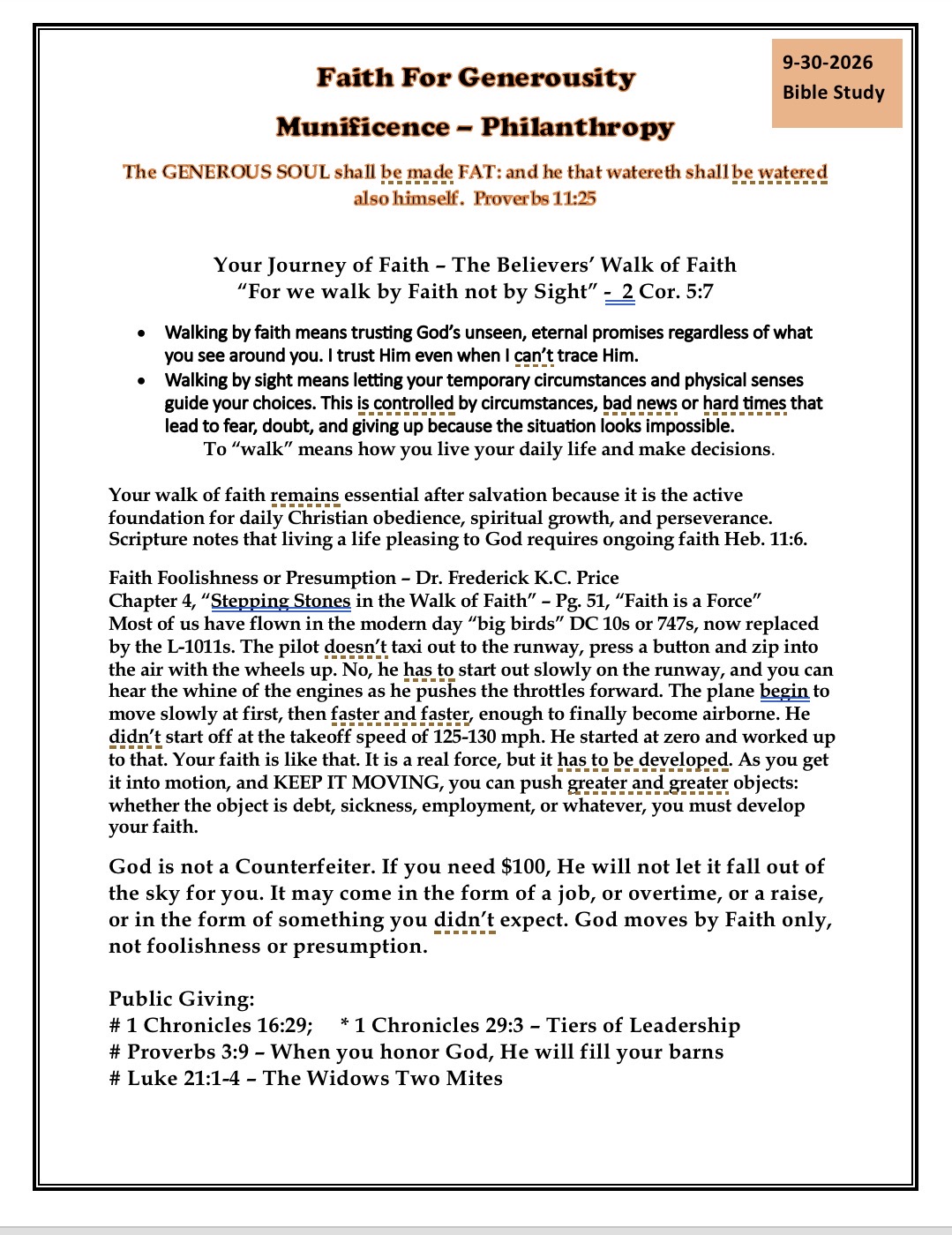
September 30, 2026Faith for Generosity — Munificence / Philanthropy+
Faith for Generosity
Bishop Lewis E. Evans • Wednesday Bible Study • September 30, 2026 • 7:00 PM
Explore generosity and the believer’s daily walk of faith. Bishop’s handout begins with Proverbs 11:25 and 2 Corinthians 5:7, then considers faith, presumption, and public giving with Hebrews 11:6, 1 Chronicles 16:29; 29:3, Proverbs 3:9, and Luke 21:1–4.
A common comprehension of faith is trusting in God. Not in something but some one, not in a belief system. The one and only key to our survival is faith in the person of Jesus Christ. It affects everything we think, say or do. 1 John 5:4, Faith is the victory that overcomes the world, the flesh and the devil. It’s the only way we’re able to live and to love. This is the only important thing we can ever do as believer’s, to learn how to understand, possess and walk in complete confidence in God. Roman 4:21, “being fully persuaded that what [God has] promised, He [will be] able also to perform.”
In other words, regardless of what we see, hear, feel or think, true faith is choosing to believe that God will do whatever He says He will do. Faith is simply a radical reliance upon God.
Hal Lindsey, “Combat Faith” - present promises that come to us through faith:
We are born into eternal life through faith
We are declared righteous before God by faith
We are healed by faith
We understand the mysteries of creation by faith
We learn God’s word by faith
We understand things to come by faith
We walk by faith and not by sight
We overcome the world by faith
We enter God’s rest by faith
We are controlled and empowered by the Holy Spirit by faith
In addition, Faith is Not seeing and not feeling, yet still believing, “Blessed are those who have not seen, and yet have believed.”John 20:29
Satan knows that faith and doubt cannot coexist. Faith enables the believer to be an overcomer. Only faith can repel the enemy. When you lack faith, you leave yourself open for his vicious attacks.
Jesus is the source of Faith. He gives the living water by which we can be saved through grace. This is why we say faith is a gift from God and Jesus is both the founder and perfector (finisher) of our faith, who for the joy that was set before Him endured the cross, despising the shame, and has sat down at the right hand of the throne of God.”
September 16, 2026Feed Your Faith & Starve Your Doubts+
Feed Your Faith & Starve Your Doubts
Wednesday Bible Study • September 16, 2026 • 7:00 PM
Today’s lesson uses the metaphor of eating and feeding to describe how we consume information and shape our minds. Faith is the central processing center, governing force, and vital connection for the spiritual man, just as the brain is the physical control center, and life-support mediator for the human body.
The brain processes the physical world through the five senses. Faith processes the unseen spiritual realm by reading and meditating on Scripture on a constant basis.
God hears you when you talk in your head:
One of God’s attributes is Omniscience; God is all-knowing, which means He knows every thought, desire, and intention before you say them out loud. Psalm 139:1-4
Proverbs 15:14, NLTA wise person is hungry for knowledge, While the fool feeds on trash.
Proverbs 15:15For the despondent, every day brings trouble; for the happy heart, life is a continual feast.
2 Corinthians 4:16-18, NIVTherefore, we do not lose heart. Though outwardly we are wasting away, yet inwardly we are being renewed day by day. 17) For our light and momentary troubles are achieving for us an eternal glory that far outweighs them all. 18) So we fix our eyes not on what is seen, but on what is unseen, since what is seen is temporary, but what is unseen is eternal.
2 Corinthians 5:7-9For we live by faith, not by sight. 8) We are confident, I say, and would prefer to be away from the body and at home with the Lord. 9) So we make it our goal to please Him, whether we are at home in the body or away from it.
How to Feed Your Faith:
Read the Bible every day to build a strong foundation of truth
Spend regular time in Prayer – connect with God
Surround yourself with positive, encouraging People (support system)
Speak positive affirmations & outcomes instead of dwelling on fear
How to Starve Your Doubt:
When negative thoughts arise, refuse to dwell on them, or give them power
Limit your exposure to pessimistic media, cynical conversations, or constant negativity
Replace worries with truth by shifting your mind back to positive promises and facts
Treat doubt like an unwanted guest by refusing to feed it energy
Book & Material Reference:
A Bout with Doubt, Bishop J. Drew Sheard, Presiding Prelate of COGIC, Int’l
Resisting the Temptation of Silent Disbelief – A Woman’s Guide to Spiritual Warfare: How to Protect Your Home, Family and Friends from Spiritual Darkness
God and Your Brain – The Tripartite Man — “Beloved, I pray that you may prosper in all things and be in health, just as your soul prospers.” 3 John 2
September 9, 2026Wednesday Bible Study - A Study in Proverbs+
Wednesday Bible Study - A Study in Proverbs
September 9, 2026 – 7:00 -8:15 PM
Biblical Proverbs are short, memorable sayings that express a general truth for practical, godly living. A parable is a short narrative story that illustrates a moral or spiritual lesson – a short earthly story with a heavenly meaning. While Proverbs lacks characters and a story, parables rely on human behavior and narrative action to make a point. However, both aim to teach timeless lessons about human nature and correct behavior. Also, Hebrew Parallelism; In a verse, the second line contrasts with the first line to make a point through opposition. Note: 1:7, “The fear of the LORD is the beginning of knowledge, (check second line) But fools despise wisdom & instructions”.
Why study Proverbs?
The book of Proverbs provides practical, everyday wisdom for living a godly life and making skillful choices aligned with God’s character. The key verse in Proverbs is Prov. 1:7; “The fear of the LORD is the beginning of knowledge, but fools despise wisdom and instruction.
King Solomon was the University president and chancellor of two schools, University of Lady Wisdom, and University of Lady Foolishness (Prov. 9:13-18). Which enrollment is believed to have run over, leaving no room for new entries? Why?
The Virtuous Woman (The Proverbs 31 Wife) Key passages: Prov. 31:10-31
The Hebrew word for wisdom (chokhmah) is grammatically feminine. Wisdom is personified as a noble, nurturing, and divine woman calling humanity to righteousness.
September 2, 2026Leaders Quest for Knowledge in Book of Proverbs+
Leaders Quest for Knowledge in Book of Proverbs
Sept. 2, 2026 – 7:00-8:15pm
Scripture does not explicitly command formal academic degrees, but strongly expects leaders to continuously grow in wisdom, knowledge, spiritual maturity, and understanding of God’s Word. Leaders are not automatically endowed with knowledge. Leadership positions grant authority, status, and responsibility. However, it is required for Leaders to have a comprehension of Scripture sufficient to teach others and defend the faith. 1 Tim. 3:2 and Titus 1:9 state that Bishops / Pastors must be “able to teach” and hold firmly to the Word of God.
The Pursuit of Knowledge:
Prov. 9:9, “Give instruction to a wise man and he will still be wiser; teach a just man, and he will increase learning”. Instruction adds to a wise man’s learning. Thus, learning is an active path of growth.
Example: Ezra 7:10, describes leaders who devote themselves to studying, living, and teaching the law of God (statues, ordinances) by example. 1 Tim. 4:13, “Until I come, devote yourself to the public reading of Scripture, to exhortation and to teaching”.
There is a Documented Shortage of Pastoral & Spiritual Leadership – Why the Shortage Exists:
Aging Clergy
High burnout rates – Heavy pressure
Declining seminary enrollment
Lack of Mentoring
Shepherds contending with Sheep Disease Maladies
Overeating – change of teaching
Irregular feeding times – need a definite time
Feeding Lambs of various sizes together – different spiritual levels
White muscle disease – vitamin deficiency = lack of spiritual truth
Twin Lamb disease (blood pressure) – undue pressure of the sheep
Death of offspring – if diet is imbalanced = lack of devotion & prayer
1 Tim. 4:13,
How to Break Solomon’s Code
Key to breaking the code: Proverbs 2:1-4, The Value of Wisdom & breaking the code (dig dig, dig, - read, read, read – study, study, study)
Institute Hour is Christ Harvest Fellowship’s Sunday morning teaching ministry. It consists of four learning classes designed for women, men, new members, and youth to grow in God’s Word and Christian community. Select a class below to open its lessons and resources.
Men’s Class • Current Study
Armor Bearers: Called to Serve and Strengthen
This introductory overview will remain in place until Bishop Sean Coney’s complete lesson materials are added.
What was an armor-bearer?In the Old Testament, an armor-bearer was a trusted attendant who carried a leader’s weapons and stood near him in battle. The role required courage, loyalty, readiness, and close attention to the leader’s direction (1 Samuel 14:6–7).
What does it teach the church today?In ministry, the picture can describe dependable men who prayerfully support pastoral leadership, help carry the work, and serve with humility—without seeking attention or position.
How do armor bearers support pastors?They pray for their leaders, anticipate practical needs, help protect time and focus, promote unity, serve faithfully, and help create an orderly environment where ministry can move forward.
What character does the role require?Spiritual maturity, discretion, integrity, courage, teachability, consistency, and a servant’s heart. Support never replaces personal obedience to God or biblical accountability.
Study foundation: 1 Samuel 14:6–7; Judges 9:54; 2 Samuel 23:37; Exodus 17:11–12; Philippians 2:3–4. Core thought: An armor bearer does not compete with the assignment—he helps strengthen the person God has entrusted to carry it.
Quarter Roadmap
Wisdom for the way we live
The Hour of Power remains part of the larger teaching ministry while keeping its own complete curriculum hub.
01
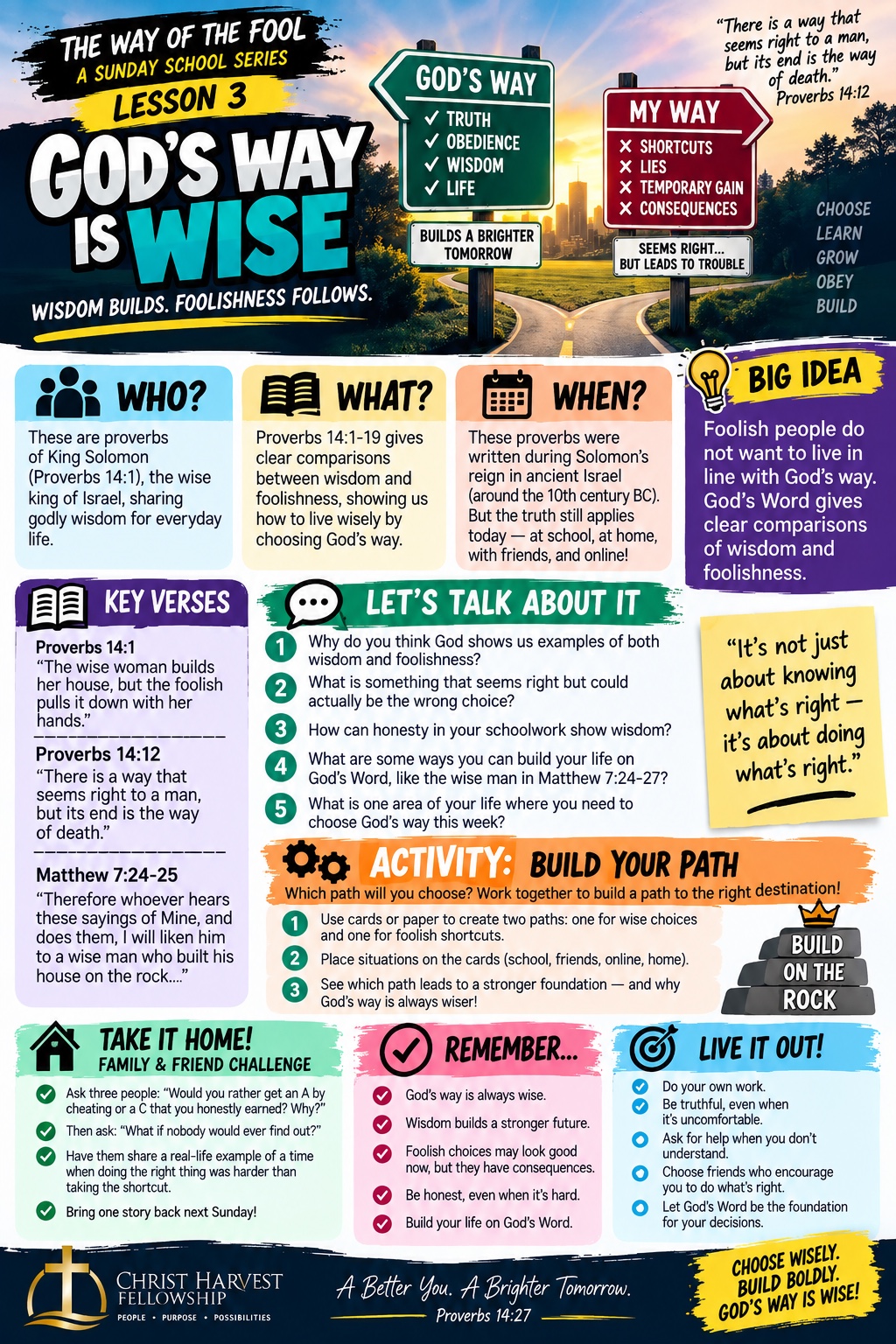
The Way of the Fool
Recognizing the cost of rejecting correction, trusting riches, following pride, and choosing what merely seems right.
02
The Way of the Wise
Learning to hear, receive, and practice God’s wisdom through Scripture.
03
Wisdom Rewarded
Seeing the fruit that grows from reverence, obedience, discernment, and faithful living.
Women’s Hour of Power • Sunday at 9:00 AM
Find Your Lesson
The current lesson comes first. Tap the + beside any lesson to open it; tap again to close it. September • Unit 1: The Way of the Fool. October • Unit 2: The Way of the Wise.
New • November 1 Hour of Power • 9:00 AM
Who’s Feeding Your Feed?
Finding God’s wisdom in a world full of opinions.
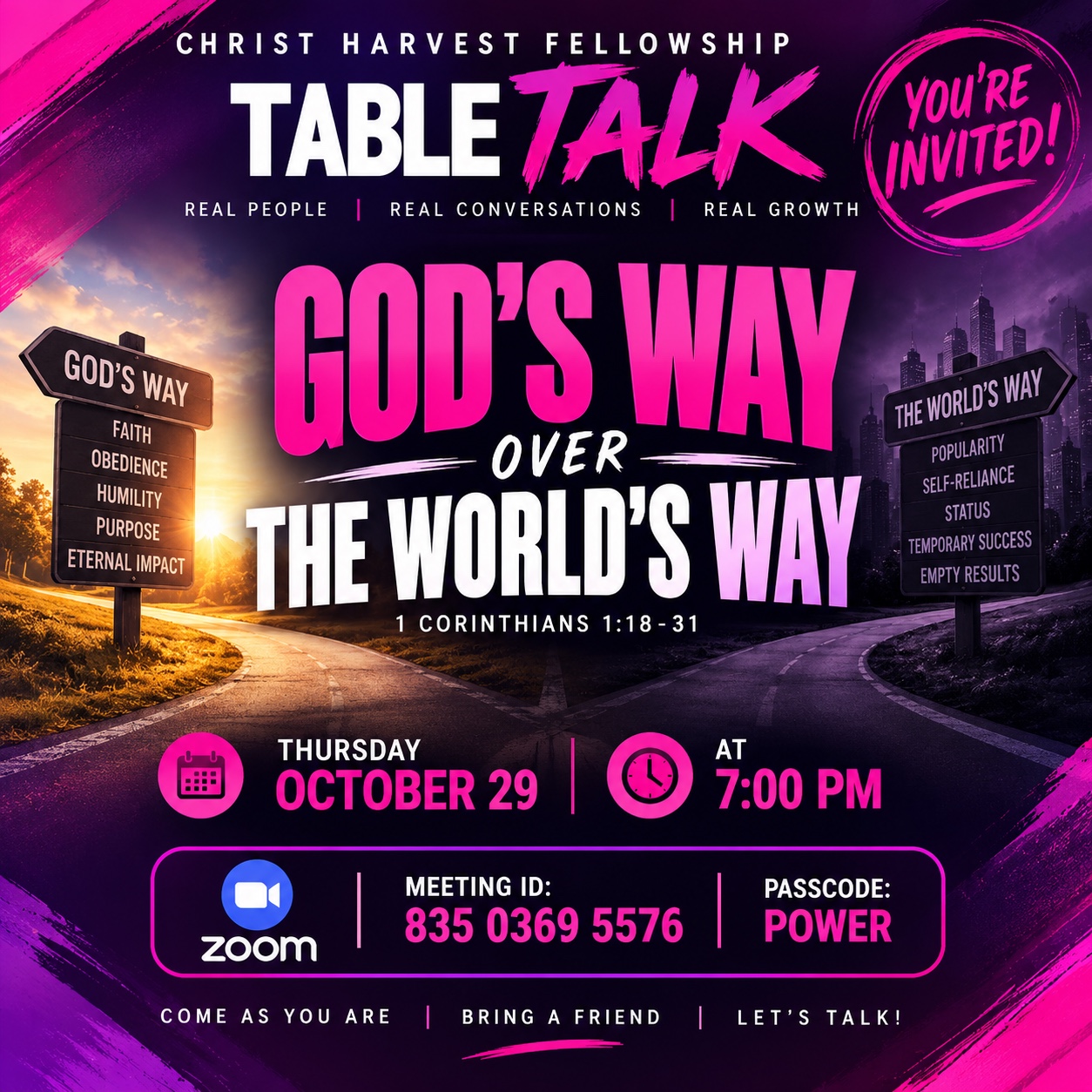
The Wisdom of the Gospel • 1 Corinthians 1:18–31
Read the Scripture, explore Pastor A’s Nuggets, enjoy the devotional and soundtrack, and unlock the Wisdom Detectives phrase.
Give God’s wisdom the attention you give everything else.
Seek for Wisdom as for Silver • Proverbs 2:1–9
Study the passage, explore the setting and key words, work through the questions, listen to the soundtrack, and complete the Wisdom Detectives challenge.
Ask for wisdom while you walk through the hard part.
Enduring Trials in Wisdom • James 1:1–11
Study the passage, explore the setting and key words, work through the questions, listen to the soundtrack, and complete the Wisdom Detectives challenge.
Recognize the rewards that do not fit on a bank statement.
Wisdom Bringing Blessings • Proverbs 3:13–35
Study the passage, explore the setting and key words, work through the questions, listen to the soundtrack, and complete the Wisdom Detectives challenge.
Put the faith you profess into the life you practice.
Fruitfulness of Wisdom • 2 Peter 1:1–11
Study the passage, explore the setting and key words, work through the questions, listen to the soundtrack, and complete the Wisdom Detectives challenge.
Who: Solomon presents Wisdom as a woman addressing the simple, scorners, and fools.
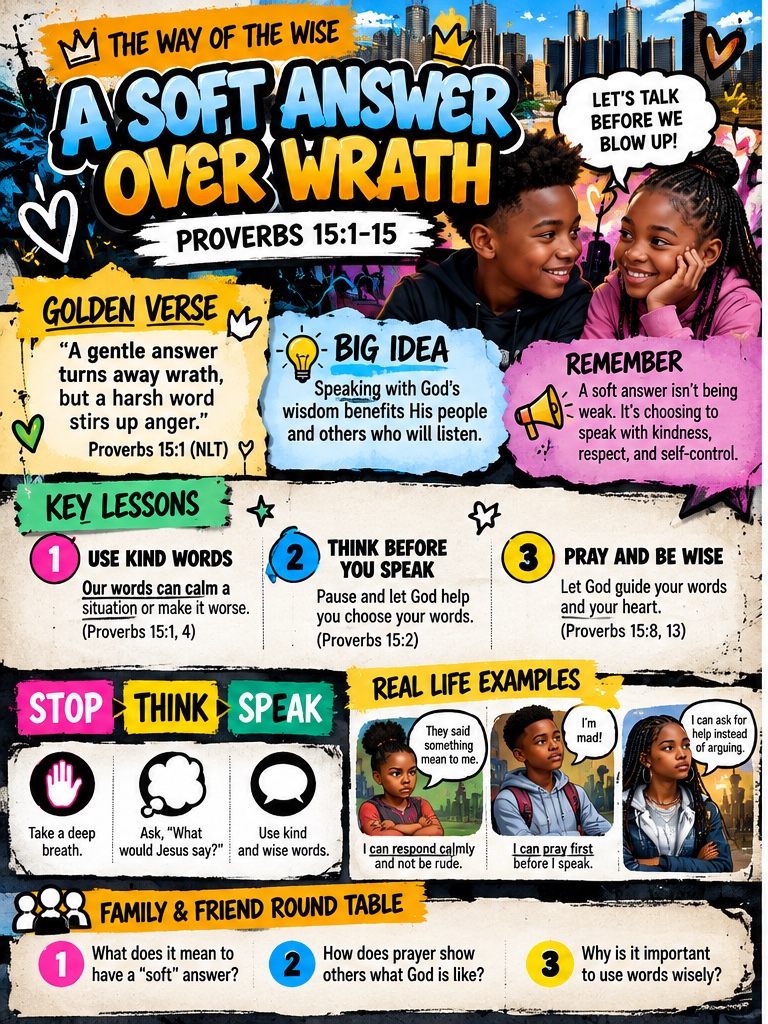
When: Israel’s wisdom tradition, associated with Solomon in the 10th century B.C.
Where: Streets, public squares, gathering places, and city gates—where real decisions were made.
Big Idea
Wisdom is not hidden. God makes wisdom available, but we must choose to listen, turn, and respond.
Key question: Where am I listening—and what am I doing with what I hear?
Passage Breakdown
Proverbs 1:20–21 — Wisdom speaks in public. God’s wisdom belongs wherever real life and real decisions happen.
Proverbs 1:22–23 — Three responses and an invitation. The simple are easily influenced, scorners resist correction, and fools reject God’s knowledge. Wisdom still says, “Turn.”
Proverbs 1:24–25 — Wisdom was available but refused. The problem was not the absence of wisdom; it was rejection of wisdom.
Proverbs 1:26–32 — Choices have consequences. Wisdom teaches us to look beyond the immediate decision to where the path leads.
Proverbs 1:33 — The promise to those who listen. Biblical listening means hearing with attention and responding.
Key Vocabulary
ChokmahWisdom; skill for godly living.
PethiSimple; naïve or easily influenced.
TokhachathCorrection intended to redirect.
ShuvTurn, return, or change direction.
Discussion & Application
What voices compete with God’s wisdom?
Have I asked for wisdom but resisted the answer?
Where do I especially need God’s wisdom this week?
When God’s wisdom contradicts the voice I prefer—who wins?
Devotional — Listen When Wisdom Calls
Key Scripture: “Turn at my rebuke; surely I will pour out my spirit on you; I will make my words known to you.” — Proverbs 1:23, NKJV
God’s correction is not rejection. It is evidence that He loves us enough to redirect us. Wisdom calls before consequences come, giving us an opportunity to stop, listen, and change. A wise person is willing to receive correction and respond to God.
Heart Check: Am I listening to God’s correction, or defending what He is asking me to change?
Prayer & Declaration: I have a teachable heart. I will listen when wisdom calls and respond when God corrects me.
Weekly Challenge: Identify one area where God has been calling you to receive correction or instruction. Respond obediently.
Lesson Context
Audience: “Low and high, rich and poor together.” This wisdom psalm speaks to everyone.
Place: Jerusalem; exact time and authorship are unknown.
Golden Text: Psalm 49:16.
Big Idea
Money is a resource, but God is our Source. Wealth cannot redeem a soul or provide eternal security.
Key question: What am I trusting to make me feel secure?
Passage Breakdown
Psalm 49:1–4 — The wisdom of God. The message is universal and must be pondered like a riddle.
Psalm 49:5–9 — The false hope of wealth. No human payment can purchase a soul’s deliverance from death.
Psalm 49:10–13 — The false hope of the world. Riches are left to others, and earthly honor cannot follow us into eternity.
Psalm 49:14–15 — The hope of believers. Death shepherds those who trust earthly power, but God redeems and receives His people.
Psalm 49:16–20 — The destiny of unbelievers. Wealth without spiritual understanding cannot save.
Key Vocabulary
BatachTrust; to rely upon or feel secure.
ChayilStrength, resources, power, or wealth.
PadahRedeem; ransom, rescue, or release.
NepheshSoul, life, or the whole person.
Discussion & Application
Why is Psalm 49’s message for everyone?
What can wealth provide—and what can it never purchase?
Who shepherds the righteous, and who shepherds the unrighteous?
What does Psalm 49:15 reveal about the believer’s hope?
Devotional — Trust the Source, Not the Resource
Key Scripture: “But God will redeem my soul from the power of the grave, for He shall receive me. Selah.” — Psalm 49:15, NKJV
Wealth may provide temporary comfort, but it cannot purchase peace, salvation, purpose, or eternal life. Our confidence is not in what we possess but in the God who holds our lives and has redeemed our souls.
Heart Check: If something I value were removed, would my faith in God remain secure?
Prayer & Declaration: God is my Source, my security, and my Redeemer. My trust is in Him alone.
Weekly Challenge: Thank God for three ways He has provided for you that money could not purchase.
Read the Lesson Scripture — Proverbs 30:1–14
Tap any highlighted name or expression for a brief explanation.
1The words of the son of , even the : the man spake unto , even unto Ithiel and ,
2Surely I am more than any man, and have not the understanding of a man.
3I neither learned wisdom, nor have the .
4Who hath ascended up into heaven, or descended? who hath gathered the wind in his fists? who hath bound the waters in a garment? who hath established all the ends of the earth? what is his name, and what is his son’s name, if thou canst tell?
5Every word of God is : he is a shield unto them that put their trust in him.
6Add thou not unto his words, lest he reprove thee, and thou be found a liar.
7Two things have I required of thee; deny me them not before I die:
8Remove far from me and lies: give me neither poverty nor riches; feed me with :
9Lest I be full, and deny thee, and say, Who is the Lord? or lest I be poor, and steal, and take the name of my God in vain.
10Accuse not a servant unto his master, lest he curse thee, and thou be found guilty.
11There is a that curseth their father, and doth not bless their mother.
12There is a generation that are pure in their own eyes, and yet is not washed from their filthiness.
13There is a generation, O how lofty are their eyes! and their eyelids are lifted up.
14There is a generation, whose teeth are as swords, and their jaw teeth as knives, to devour the poor from off the earth, and the needy from among men.
Scripture text: King James Version.
Lesson Aim
Facts: Understand the attitudes of the humble wise person and the proud foolish person. Principle: Recognize that pride leads to a life marked by foolishness. Application: Pursue the way of humility that leads to a life of wisdom.
Who?
Agur son of Jakeh is the speaker and writer named in Proverbs 30:1. Scripture gives no additional biography for him. He addresses Ithiel and Ucal, whose identities are also uncertain. Agur directs attention away from himself and toward the greatness of God.
What?
A wisdom oracle contrasting humble dependence with proud self-sufficiency. Agur admits human limitations, honors the purity of God’s Word, prays for truth and daily provision, and exposes a generation marked by dishonor, self-righteousness, arrogance, and oppression.
When?
The exact date is unknown. Proverbs 30 is not attributed to Solomon; it is a separate collection preserved within the book of Proverbs. Its message is timeless: wisdom begins when we acknowledge what we do not know and submit to what God has revealed.
Where?
The lesson tradition places the setting in Judah, although Proverbs 30 does not name a specific city. The teaching belongs to Israel’s wisdom tradition and addresses life in the home, community, worship, finances, and treatment of vulnerable people.
Why Does This Matter?
Agur shows that humility is not weakness or lack of intelligence. Humility is the wisdom to recognize that God knows what we do not know. Pride says, “I already understand.” Wisdom says, “Lord, teach me, correct me, and order my life.”
Humility is both the doorway to wisdom and the evidence that wisdom is working.
Hebrew Keyword Nugget — Wisdom
Wisdom — Chokmah (khoke-MAH) Hebrew: חָכְמָה
Chokmah means wisdom, skill, sound judgment, or the ability to live God’s truth correctly. In the Old Testament, the word can describe the skill of gifted artisans as well as the skill required for godly living (Exodus 31:3; Proverbs 9:10).
In Proverbs 30: Agur shows chokmah by admitting the limits of human understanding, trusting the purity of God’s Word, and asking God to govern his character and daily needs.
The nugget: Biblical wisdom is not simply information. Chokmah is the God-given skill to know His truth and live it faithfully.
Proverb, Parable, and Parallelism — What Is the Difference?
ProverbA short, memorable wisdom statement that expresses a general truth or principle for living. A proverb is a wise observation—not an unconditional promise that ignores every circumstance. Example: Proverbs 15:1.
ParableA story or extended comparison that places a familiar earthly picture beside a spiritual truth. Jesus frequently used parables to reveal truth and test whether hearers were willing to receive it. Example: Luke 15:11–32.
ParallelismThe main poetic pattern in Hebrew wisdom writing. A second line may repeat, contrast, or complete the first line. Example: “A wise son makes a glad father, but a foolish son is the grief of his mother” (Proverbs 10:1, NKJV).
The Hebrew connection: Mashal — מָשָׁלThe Hebrew word mashal has a wider range than the English word “proverb.” Depending on context, it can describe a proverb, comparison, parable, riddle, or wisdom saying. That is why biblical wisdom can appear as short sayings, comparisons, questions, lists, and riddles.
Memory aid: A proverb is usually a principle. A parable is usually a picture or story. Parallelism is the poetic pattern that connects the lines.
Hebrew Keyword Vocabulary — Proverbs 30
Wisdom — Chokmah (khoke-MAH)Hebrew: חָכְמָהSkill for living faithfully under God’s authority.
Knowledge — Da‘at (DAH-aht)Hebrew: דַּעַתKnowledge, discernment, or understanding; what Agur humbly says he lacks (v. 3).
Senseless — Ba‘ar (bah-AR)Hebrew: בַּעַרBrutish or lacking understanding; Agur’s strong description of human limitation (v. 2).
Refine/Pure — Tsaraph (tsah-RAHF)Hebrew: צָרַףTo refine, test, or prove pure; God’s Word has already passed the test (v. 5).
Take Refuge — Chasah (khah-SAH)Hebrew: חָסָהTo seek shelter or protection in God (v. 5).
Falsehood/Vanity — Shav (shahv)Hebrew: שָׁוְאEmptiness, deception, or falsehood; what Agur asks God to remove (v. 8).
Poverty/Need — Resh (raysh)Hebrew: רֵאשׁPoverty, need, or destitution; one extreme in Agur’s prayer (v. 8).
Riches — Osher (OH-sher)Hebrew: עֹשֶׁרWealth or abundance; the other extreme in Agur’s prayer (v. 8).
Pastor A’s Notes
1. Wisdom begins with humility — Proverbs 30:1–2. Agur does not build his credibility by pretending to know everything. His confession creates the posture required for learning. Ask: Can God teach someone who refuses to admit a need to learn?
2. Human knowledge cannot contain God — Proverbs 30:3–4. Agur’s questions emphasize God’s unmatched authority over heaven, wind, water, and the earth. The question about God’s Son points beyond human expertise and prepares us to recognize that divine wisdom must be revealed.
3. God’s Word is tested and trustworthy — Proverbs 30:5–6. God’s Word does not need our additions. It is pure, protective, and sufficient. We do not edit Scripture to fit our preferences; Scripture corrects and refines us.
4. Wisdom prays for truth and enough — Proverbs 30:7–9. Agur asks for integrity and balanced provision. He understands that both excess and desperation can become spiritual tests. His prayer is not merely about money; it is about remaining faithful in every condition.
5. Pride reveals itself in relationships — Proverbs 30:10–14. Pride dishonors parents, declares itself clean, looks down on others, and exploits the poor. Wisdom is visible in how we treat people—especially those who cannot advance us.
Key Scripture: “Every word of God is pure; He is a shield to those who put their trust in Him.” — Proverbs 30:5, NKJV
Agur’s humility released him from the pressure of pretending to know everything. He understood that human knowledge has limits, but God’s Word is pure, proven, and completely trustworthy. Humility does not mean denying the gifts God has placed within us. It means remembering where those gifts came from and remaining teachable before Him. A wise heart does not add to God’s Word or lean proudly on its own understanding—it receives His truth, trusts His provision, and lets His wisdom shape everyday conduct.
Heart Check: Am I honestly seeking God’s wisdom, or have I already decided what I want Him to say?
Prayer & Declaration: Lord, remove pride and falsehood from me. Give me a teachable heart, daily provision, and the wisdom to trust Your pure Word. I will depend on You and live faithfully with what You provide.
Lesson Outline
God’s wisdom is not dependent on human expertise — vv. 1–2
God’s wisdom compared to human wisdom — vv. 3–4
God’s Word, the source of wisdom — vv. 5–6
Agur’s prayer to God — vv. 7–9
God’s response to Agur’s prayer — vv. 10–14
Read the Supporting Scriptures
Ecclesiastes 3:11, 13–14“He hath made every thing beautiful in his time… And also that every man should eat and drink, and enjoy the good of all his labour, it is the gift of God. I know that, whatsoever God doeth, it shall be for ever…”
Job 37:14, 23–24; 38:2–4“Stand still, and consider the wondrous works of God… Touching the Almighty, we cannot find him out… Men do therefore fear him… Where wast thou when I laid the foundations of the earth? declare, if thou hast understanding.”
Psalm 12:6“The words of the Lord are pure words: as silver tried in a furnace of earth, purified seven times.”
Psalm 14:1–2“The fool hath said in his heart, There is no God… The Lord looked down from heaven upon the children of men, to see if there were any that did understand, and seek God.”
Mark 10:23–27Jesus taught that riches can become a barrier to trusting God, concluding, “With men it is impossible, but not with God: for with God all things are possible.”
Philippians 2:3“Let nothing be done through strife or vainglory; but in lowliness of mind let each esteem other better than themselves.”
Supporting selections are from the King James Version. Full related readings: Ecclesiastes 3:9–14; Job 37–39; Psalms 12:1–8 and 14:1–7; Mark 10:17–31.
Complete the Lesson Questions
Your responses are saved on this device as you type.
0 of 10 answered
Weekly Challenge: Pray Proverbs 30:7–9. Ask God to remove pride, dishonesty, and unhealthy desires from your heart.
Read the Lesson Scripture — Proverbs 14:1–19
1Every wise woman buildeth her house: but the foolish plucketh it down with her hands.
2He that walketh in his uprightness feareth the Lord: but he that is perverse in his ways despiseth him.
3In the mouth of the foolish is a rod of pride: but the lips of the wise shall preserve them.
4Where no oxen are, the crib is clean: but much increase is by the strength of the ox.
5A faithful witness will not lie: but a false witness will utter lies.
6A scorner seeketh wisdom, and findeth it not: but knowledge is easy unto him that understandeth.
7Go from the presence of a foolish man, when thou perceivest not in him the lips of knowledge.
8The wisdom of the prudent is to understand his way: but the folly of fools is deceit.
9Fools make a mock at sin: but among the righteous there is favour.
10The heart knoweth his own bitterness; and a stranger doth not intermeddle with his joy.
11The house of the wicked shall be overthrown: but the tabernacle of the upright shall flourish.
12There is a way which seemeth right unto a man, but the end thereof are the ways of death.
13Even in laughter the heart is sorrowful; and the end of that mirth is heaviness.
14The backslider in heart shall be filled with his own ways: and a good man shall be satisfied from himself.
15The simple believeth every word: but the prudent man looketh well to his going.
16A wise man feareth, and departeth from evil: but the fool rageth, and is confident.
17He that is soon angry dealeth foolishly: and a man of wicked devices is hated.
18The simple inherit folly: but the prudent are crowned with knowledge.
19The evil bow before the good; and the wicked at the gates of the righteous.
Scripture text: King James Version.
Today’s Aim
Facts: See the contrast between the way of the fool and the way of the wise. Principle: Recognize that God rewards those who choose to follow His way. Application: Shun the way that seems right to foolish people and follow the way of the Lord.
Who?
Solomon is traditionally associated with this collection of wisdom sayings. The lesson addresses women and men, the wise and foolish, the upright and wicked, the prudent and simple—every person choosing a course of life.
What?
A series of contrasts showing how wisdom builds while folly destroys. Speech, work, truthfulness, private pain, discernment, anger, and decision-making reveal which path a person is following.
When?
The curriculum places the setting between 971 and 931 B.C., during Solomon’s reign. The sayings remain timeless because every generation must choose between what merely seems right and what agrees with God’s wisdom.
Where?
Jerusalem, within Israel’s wisdom tradition. The teaching reaches beyond the city into the home, workplace, courtroom, relationships, inner life, and every crossroads where decisions are made.
Big Idea
A path can feel reasonable and still lead away from life. Wisdom does not ask only, “Does this seem right?” Wisdom asks, “Where will this way end—and does it agree with God’s Word?”
Golden Text: “The house of the wicked shall be overthrown: but the tabernacle of the upright shall flourish.” — Proverbs 14:11, KJV
Hebrew Keyword Nugget — Way
Way — Derek (DEH-rek) Hebrew: דֶּרֶךְ
The Hebrew word translated way can mean a road, path, journey, course of life, conduct, or manner of living. In Proverbs 14:12, derek describes more than one decision—it is the direction and pattern a life follows. A course of life may look straight to human eyes while its destination is death.
The contrast: Human perception judges the entrance to the road; godly wisdom considers the destination. Biblical discernment asks where a choice leads spiritually, relationally, and morally—not merely whether it feels comfortable now.
The nugget: Direction determines destination. A sincere choice can still be a wrong choice when it is disconnected from God’s Word.
Hebrew Keyword Vocabulary — Proverbs 14
Wisdom — Chokmah (khoke-MAH)Hebrew: חָכְמָהSkill for godly, constructive living; wisdom builds rather than destroys.
Way — Derek (DEH-rek)Hebrew: דֶּרֶךְA road, conduct, or course of life whose destination must be considered.
Fear/Reverence — Yare (yah-RAY)Hebrew: יָרֵאTo fear, reverence, or stand in awe of the Lord; this moves the wise away from evil.
Prudent — Arum (ah-ROOM)Hebrew: עָרוּםSensible, discerning, and careful enough to examine one’s steps.
Simple — Pethi (PEH-thee)Hebrew: פֶּתִיNaïve, open to influence, or unguarded; one who believes every claim.
Heart — Lev (lave)Hebrew: לֵבThe inner person—thought, will, desire, sorrow, and joy.
Lesson Outline
The Wise and the Foolish — Proverbs 14:1–3
The Value of Hard Work — Proverbs 14:4
Truth and Deception — Proverbs 14:5–9
The Condition of One’s Heart — Proverbs 14:10–14
The Path of Life — Proverbs 14:15–19
Pastor A’s Notes
1. Wisdom builds; folly tears down — vv. 1–3. Wisdom is practical and constructive. Reverence for God shapes conduct, while prideful speech becomes a rod that wounds the speaker and others.
2. Fruitful work may create visible mess — v. 4. An empty manger stays clean, but no increase comes from it. Growth requires responsibility, effort, maintenance, and a willingness to manage what productivity brings.
3. Truth reveals the path — vv. 5–9. A teachable person can receive knowledge; a scorner resists it. Wise people recognize deception, take sin seriously, and choose relationships that strengthen truth.
4. God sees beyond appearances — vv. 10–14. Other people cannot fully know our private bitterness or joy. Impressive structures may fall while a humble tent flourishes. The decisive issue is the condition and direction of the heart.
5. Discernment slows down and looks ahead — vv. 15–19. The simple believe every claim, but the prudent examine their steps. Wisdom fears God, departs from evil, governs anger, and considers consequences.
Teaching thread: Wisdom builds → Work produces → Truth guides → The heart chooses → The path reveals the destination.
Devotional — Check the Destination
Key Scripture: “There is a way that seems right to a man, but its end is the way of death.” — Proverbs 14:12, NKJV
Some choices look right because they are popular, comfortable, or immediately rewarding. Proverbs reminds us that sincerity alone does not make a path wise. The prudent person slows down, examines her steps, compares the direction with God’s Word, and considers where the choice will lead. God sees the entire road when we can see only the next turn. Wisdom trusts His direction above appearances, pressure, and personal preference.
Heart Check: Is there a decision I have judged only by how it feels now instead of where it may lead?
Prayer & Declaration: Lord, order my steps and sharpen my discernment. I will not follow a way simply because it seems right. I will test my choices by Your Word, listen for Your correction, and choose the path that leads to life.
Read the Supporting Scriptures
Proverbs 9:1, 6, 10, 12–13, 18“Wisdom hath builded her house, she hath hewn out her seven pillars… Forsake the foolish, and live; and go in the way of understanding… The fear of the Lord is the beginning of wisdom: and the knowledge of the holy is understanding… If thou be wise, thou shalt be wise for thyself: but if thou scornest, thou alone shalt bear it. A foolish woman is clamorous: she is simple, and knoweth nothing… But he knoweth not that the dead are there; and that her guests are in the depths of hell.”
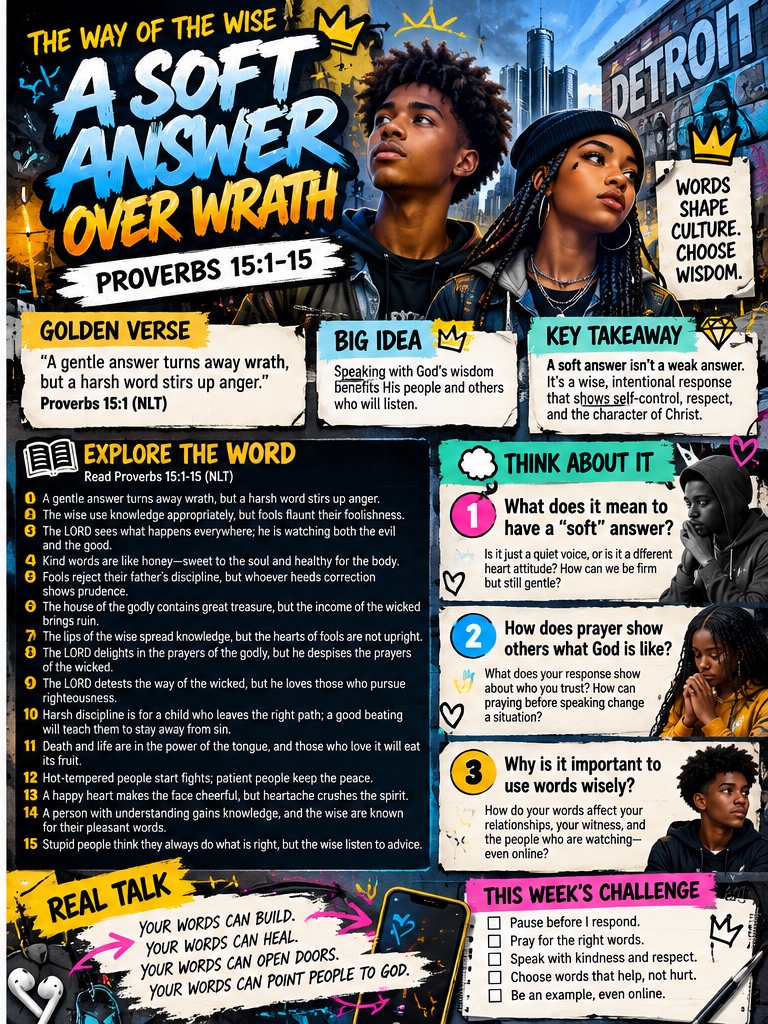
Proverbs 15:1–3, 5, 14, 31–33“A soft answer turneth away wrath: but grievous words stir up anger. The tongue of the wise useth knowledge aright: but the mouth of fools poureth out foolishness. The eyes of the Lord are in every place, beholding the evil and the good… A fool despiseth his father’s instruction: but he that regardeth reproof is prudent… The heart of him that hath understanding seeketh knowledge: but the mouth of fools feedeth on foolishness… The ear that heareth the reproof of life abideth among the wise… The fear of the Lord is the instruction of wisdom; and before honour is humility.”
Proverbs 26:1–5, 11–12“As snow in summer, and as rain in harvest, so honour is not seemly for a fool… A whip for the horse, a bridle for the ass, and a rod for the fool’s back. Answer not a fool according to his folly, lest thou also be like unto him. Answer a fool according to his folly, lest he be wise in his own conceit… As a dog returneth to his vomit, so a fool returneth to his folly. Seest thou a man wise in his own conceit? there is more hope of a fool than of him.”
Matthew 7:24–27“Therefore whosoever heareth these sayings of mine, and doeth them, I will liken him unto a wise man, which built his house upon a rock… And every one that heareth these sayings of mine, and doeth them not, shall be likened unto a foolish man, which built his house upon the sand… and it fell: and great was the fall of it.”
James 1:19–22, 25–27“Let every man be swift to hear, slow to speak, slow to wrath… receive with meekness the engrafted word, which is able to save your souls. But be ye doers of the word, and not hearers only, deceiving your own selves… Whoso looketh into the perfect law of liberty, and continueth therein… this man shall be blessed in his deed… Pure religion and undefiled before God and the Father is this, To visit the fatherless and widows in their affliction, and to keep himself unspotted from the world.”
Selected supporting passages are from the King James Version. Full related readings: Proverbs 9:1–18; Proverbs 15:1–33; Proverbs 26:1–12; Matthew 7:24–27; James 1:19–27.
Practical Points
Folly is destructive. Seek wisdom (Proverbs 14:1).
Cultivate a healthy fear of the Lord (v. 2).
Folly has negative consequences, so seek wisdom (vv. 3–4).
Evaluate your speech to see whether you are wise (vv. 5–7).
Seek wisdom, which brings great blessings (vv. 8–14).
We cannot truly know the hearts of those around us (vv. 10, 13).
Give thought to your ways rather than acting recklessly (vv. 15–17).
Folly leads to disgrace, but wisdom leads to blessing in this life and the next (vv. 18–19).
Research and Discussion
Does Proverbs guarantee that if we are wise, we will always experience physical blessings in this life?
If wisdom leads to blessings, why do fools and evildoers sometimes seem to have it better? Compare Proverbs 16:8.
How can we evaluate whether we are wise or foolish?
If we are not wise, what is the best way to seek wisdom?
If we are already wise, why must we continue to seek wisdom?
Is it possible to seek wisdom and not obtain it? Why?
Is there always a right or wrong choice when we make decisions?
If we struggle with rash decisions, what practical steps can slow down our decision-making process?
Complete the Lesson Questions
Your responses are saved on this device as you type.
0 of 10 answered
Weekly Challenge: Before an important decision, pause and ask: “Does this only seem right to me, or does it agree with God’s Word—and where will this path lead?”
Women’s Hour of Power • October 4, 2026
Wisdom Over Strength Everybody Loud Ain’t Wise.
In a world of influencers, platforms, titles, opinions, and constant noise, how do we recognize the voice of wisdom?
DON’T CONFUSE VISIBILITY WITH VALUE.
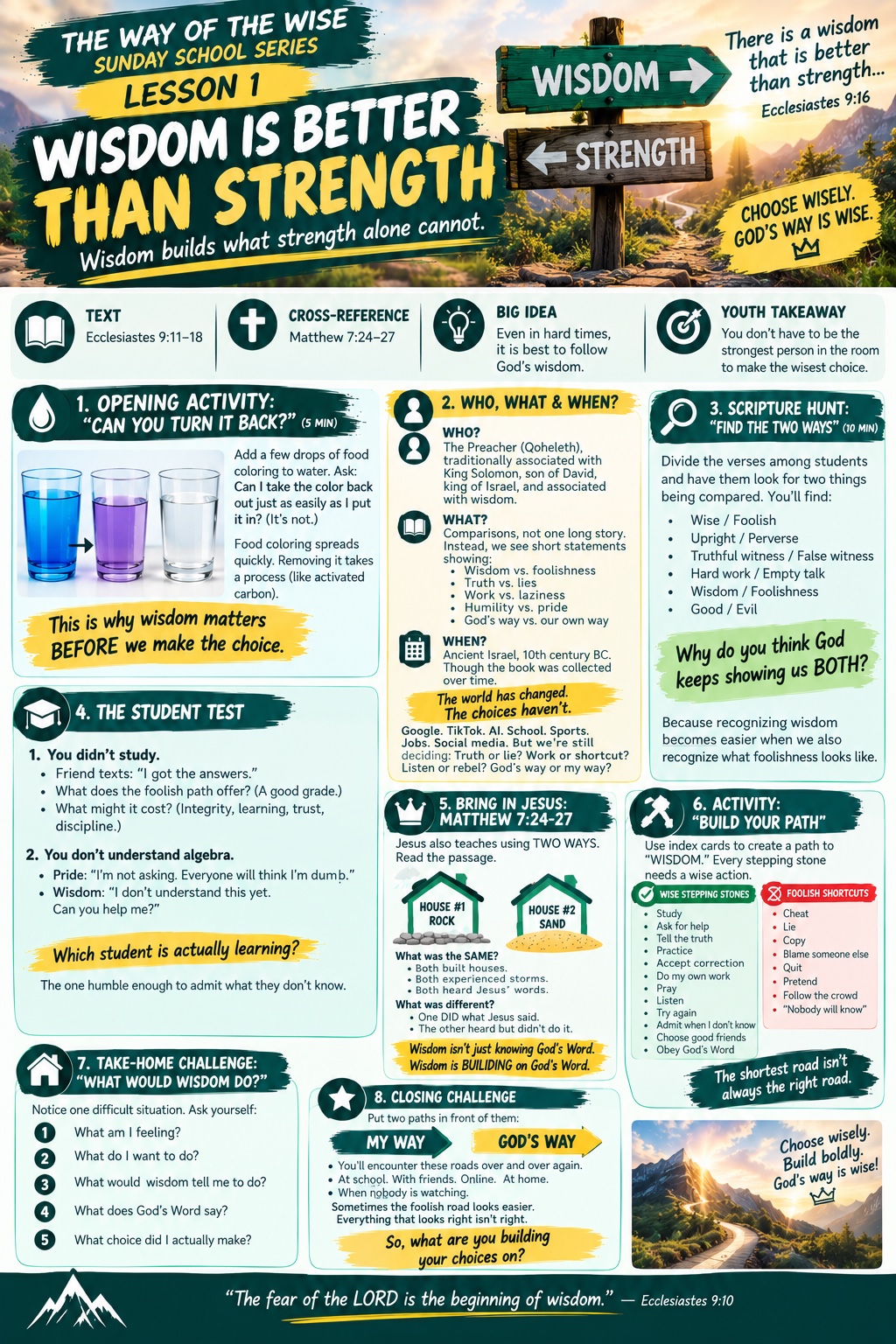
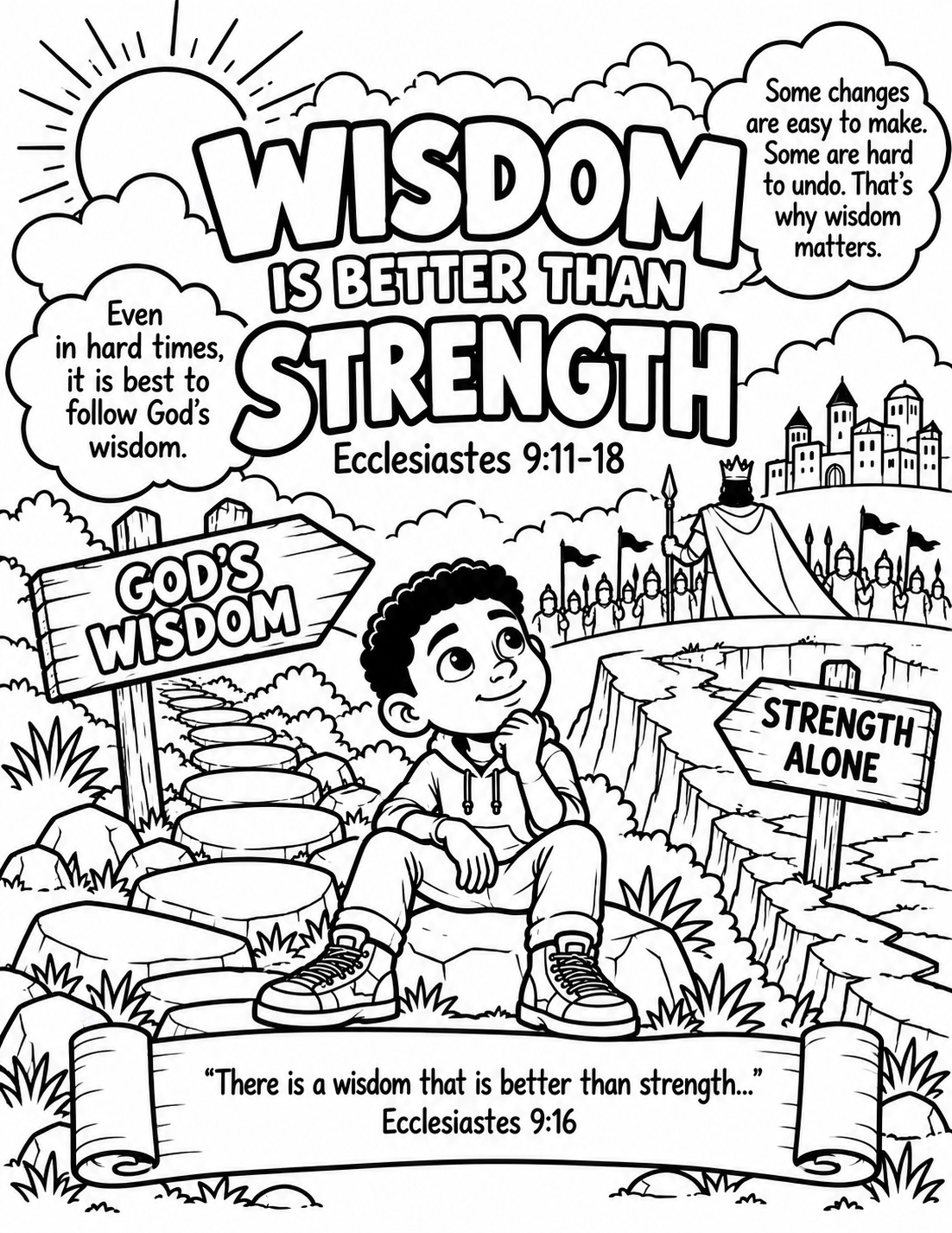
Ecclesiastes 9:11–18
🎧 THIS WEEK’S WISDOM SOUNDTRACK
“Order My Steps In Your Word” — GMWA Women of Worship
Lesson Connection: Ecclesiastes 9:16–17 values wisdom above strength and quiet counsel above noise. Let this song prompt a prayer for God’s guidance before you follow another voice.
Wisdom Check
Whose voice is ordering my steps—God’s wisdom or the loudest opinion?
Tap play below to listen here. If the player does not load, use Watch on YouTube.
Prefer Spotify? Download or open the Spotify app to listen to the Hour of Power playlist. If you don’t use Spotify, choose the YouTube player or button above.
🎧 Listen & Learn
Wisdom Over Strength
Read It • Hear It • Live It
Take the lesson with you. Listen while driving, walking, getting ready, or during your quiet time, and come to Hour of Power ready to talk.
NotebookLM Audio OverviewAudio link coming soon.
🎙️ Pastor A’s Final WordPersonal audio message coming soon.
🔥 Real Talk
Who Are You Listening To?
Social media, podcasts, friends, family, leaders, influencers, coworkers, and online personalities all compete for our attention. Some voices can help us. Others simply sound certain. What makes somebody worth listening to?
Volume, popularity, confidence, status, and visibility do not automatically equal wisdom. Ecclesiastes 9 asks us to notice the quiet wisdom that can save a city while a powerful voice attracts the crowd.
Which gets the most attention today?
Tap one to reflect. There is no scored answer.
👀 Ecclesiastes 9:13–16
Don’t Confuse Visibility With Value
The Teacher describes a small city threatened by a powerful king. A poor man had wisdom that delivered the city, yet no one remembered him. The story does not say he held a title, had wealth, or received credit. It shows that his wisdom mattered even when people overlooked him.
Being overlooked does not make you insignificant.
Have you watched a good idea get ignored until someone with a bigger title repeated it?
Have you contributed something important and someone else received the credit?
Have you dismissed someone’s wisdom because of age, position, education, appearance, or status?
The lack of recognition did not erase the value of the poor man’s wisdom. Ask God to help you hear truth wherever He places it.
📱 Ecclesiastes 9:17
Wisdom in the Age of Influence
Followers ≠ WisdomPopularity ≠ WisdomConfidence ≠ WisdomA Title ≠ WisdomGoing Viral ≠ Truth
Loud doesn’t mean right.
The quiet words of the wise deserve a hearing. When someone offers counsel, slow down. Compare it with Scripture, consider its truth and likely fruit, and seek godly counsel where needed (Proverbs 11:14; James 3:17). Do not let reach or volume make the decision for you.
🧠 Pause Before You Follow
The Wisdom Check
Before accepting advice or making a decision, ask:
Before asking “Who said it?” ask, “Is it true, wise, and consistent with God’s Word?”
🔎 Explore the Lesson
Wisdom Word Search Challenge
Find all 14 words from Ecclesiastes 9 and our study. Tap a word’s first and last letters. Look across, down, up, backward, and diagonally.
On a phone, swipe the letter grid sideways to see every column.
Find these 14 words
ECCLESIASTES
DISCERNMENT
RECOGNITION
OVERLOOKED
INFLUENCE
STRENGTH
HUMILITY
FAITHFUL
COUNSEL
WISDOM
LISTEN
TRUTH
QUIET
VALUE
Choose a first letter to begin.
Each found word saves in this browser on this device. If your iPad opens the site in a different app or browser, copy a resume link before leaving.
Connect it: Which word reminds you most to listen for wisdom beyond titles and attention? See Ecclesiastes 9:16–17.
💜 A Moment for You
What If You’re the One Being Overlooked?
Maybe you kept serving when no one called your name. You cared for family, steadied a team, solved a problem at work, or made room for someone else to grow. You may wonder if anybody saw it. Ecclesiastes does not pretend that being forgotten feels good. The poor wise man was overlooked, and the Teacher named that injustice honestly.
Recognition is not the evidence that your contribution mattered. Your wisdom can bring help even when no applause follows. Stay faithful, but do not confuse faithfulness with accepting mistreatment or never speaking up. Ask God for both a steady heart and the courage to make your contribution known when appropriate.
Heart check: Where do I need to release the need for applause, and where do I need to speak truth about what I contributed?
Prayer: Lord, help me value what You value. Keep my heart wise when I am seen and when I am unseen. Amen.
⚠️ Ecclesiastes 9:18
One Person. Big Impact.
Wisdom is better than weapons of war, yet one sinner can destroy much good. One wise person may help a city; one foolish action may undo the work of many. Our choices have a reach beyond the moment.
What is my influence building—or tearing down?
Think about a conversation at home, a decision about money, a post online, or the way you lead at church or work. Where could a wise, quieter response protect what God is building? Where do you need to repair harm from a careless word?
📚 DIG INTO THE TEXTScripture, Golden Text, Today’s Aim, study notes, 10 questions & activity • tap to show or hide
Wisdom over Strength
October 4, 2026 • Between 971 and 931 B.C. • Jerusalem
Read the Lesson Scripture — Ecclesiastes 9:11–18
11I returned, and saw under the sun, that the race is not to the swift, nor the battle to the strong, neither yet bread to the wise, nor yet riches to men of understanding, nor yet favour to men of skill; but time and chance happeneth to them all.
12For man also knoweth not his time: as the fishes that are taken in an evil net, and as the birds that are caught in the snare; so are the sons of men snared in an evil time, when it falleth suddenly upon them.
13This wisdom have I seen also under the sun, and it seemed great unto me:
14There was a little city, and few men within it; and there came a great king against it, and besieged it, and built great bulwarks against it:
15Now there was found in it a poor wise man, and he by his wisdom delivered the city; yet no man remembered that same poor man.
16Then said I, Wisdom is better than strength: nevertheless the poor man’s wisdom is despised, and his words are not heard.
17The words of wise men are heard in quiet more than the cry of him that ruleth among fools.
18Wisdom is better than weapons of war: but one sinner destroyeth much good.
Scripture text: King James Version.
Golden Text • Ecclesiastes 9:16
“Then said I, Wisdom is better than strength: nevertheless the poor man’s wisdom is despised, and his words are not heard.”
What Makes the Golden Text So Golden?
The poor man’s wisdom saved a city, yet his lack of rank meant his voice was soon forgotten. The verse calls us to judge counsel by its truth and fruit, rather than by a speaker’s power, popularity, or appearance. It also corrects the fear that an unseen contribution has no value. Wisdom may be overlooked by people and still be worth practicing.
Related Scriptures: Psalm 33:12–22; Ecclesiastes 2:12–16; 7:11–14; Proverbs 15:14–17; 16:32–17:1
Today’s Aim
Facts
Understand the inferiority of human power, skill, and ability.
Principle
Appreciate the superiority of godly wisdom, even when it is not recognized.
Application
Fear the Lord, the beginning point of wisdom.
Lesson Overview
The Teacher observes that speed, strength, knowledge, and skill do not guarantee outcomes. Then he tells of a poor wise man whose counsel delivered a small city, even though the people forgot him. The lesson invites us to value wisdom for what it accomplishes, listen beyond a person’s status, and remain faithful when recognition never comes.
Who is speaking?
Ecclesiastes presents the observations of the Teacher. This passage describes what he has seen “under the sun,” including a poor man whose wisdom saved a city.
What is happening?
The Teacher first lists outcomes that do not always follow human ability (vv. 11–12). Then he tells a story of wisdom that prevailed over a king’s military strength but was forgotten (vv. 13–16).
Why does it matter?
The passage neither promises the wise constant success nor dismisses wisdom. It asks us to notice its value even when life feels unfair and recognition is absent.
When is this happening?
The passage does not date the event in the little city. The curriculum places the lesson in the wisdom setting of ancient Israel; the Teacher’s observations speak to the uncertainty people face in every generation.
Where is this happening?
The Teacher describes life “under the sun” and tells of an unnamed little city under siege. The text does not identify that city, so its lesson is larger than one location.
Big Idea
The right word from an overlooked person can do more good than the loudest display of power. Godly wisdom deserves a hearing even when its messenger has no title, wealth, or spotlight.
Key Vocabulary — Tap to Explore
Under the sun
The Teacher’s recurring way of speaking about life as people observe it in this world.
Time and chance
Events whose timing and outcome people cannot control or predict (Ecclesiastes 9:11).
Bulwarks
Defensive or siege structures in the account of a city under attack (v. 14).
Despised
Treated as having little worth, as the poor man’s wisdom was treated (v. 16).
Chokmah — חָכְמָה
Hebrew for wisdom or skill; the wise man’s insight mattered more than the strength surrounding the city.
Hebrew Keyword Nugget
Hebrew nugget: chokmah (חָכְמָה) refers to wisdom or skill; here wisdom proves stronger than military force.
Consider how this word helps you read the passage in context.
Study the Text — Verse by Verse
Wisdom and chance — vv. 11–12
The fastest and strongest do not always prevail. “Time and chance” describes events people cannot schedule or master; humility keeps us from treating our abilities as guarantees.
A city saved and a person forgotten — vv. 13–16
The man had no wealth or rank, yet his wisdom delivered the city. The city forgot him. His overlooked contribution exposes our habit of listening to status before substance.
Quiet words and lasting consequences — vv. 17–18
Listen to the content of wise words rather than the volume or position of the speaker. The closing warning about one sinner reminds us that choices can affect many people.
Pastor A’s Notes — Wisdom in Real Life
These are reflection notes for students as we live the lesson throughout the week.
1. Talent is a gift; control is not. • Ecclesiastes 9:11–12You can prepare well, work hard, and still meet an outcome you could not predict. Do your part with diligence, then place the result in God’s hands. An unexpected result is not proof that your effort was wasted.
2. Listen for wisdom beyond the title. • Ecclesiastes 9:13–16Picture a meeting where the quietest person sees a solution everyone else missed, or a family conversation where a young person notices what adults overlooked. Before asking, “Who said it?” ask, “Is it true, wise, and consistent with God’s Word?”
3. Being forgotten does not cancel the good. • Ecclesiastes 9:15–16The city was rescued, even though the helper did not receive the honor he deserved. If you have ever served, solved a problem, cared for someone, or made peace without being thanked, do not confuse the absence of applause with the absence of impact.
4. Quiet wisdom can interrupt loud foolishness. • Ecclesiastes 9:17Volume can command a room without guiding it well. Pause before following the loudest opinion, the most confident post, or the person with the largest platform. Make room for a thoughtful voice.
5. Guard what has been built. • Ecclesiastes 9:18One reckless choice can undo much good. Wisdom asks what our words, spending, reactions, and relationships may cost other people—not only what they give us today.
Pastor A’s Nugget: You do not need to be the strongest person in the room to bring something valuable to the room. Bring truth. Bring humility. Bring wisdom.
Talk it through: Whose counsel have I dismissed because of their position? Where am I withholding a wise action because I may not get credit?
Have you ever brought a good idea, helped somebody through a hard moment, or quietly kept something from falling apart—and nobody even knew it was you? Maybe someone else received the credit. Maybe there was no thank-you at all. That can sting. The Teacher does not pretend otherwise. He tells us about a poor man whose wisdom rescued a whole city, and then says the people forgot him.
But, beloved, look again: the city was still delivered. Their memory failed; the wisdom did not. People may miss the value of a person because they are looking at money, influence, or a title. God calls us to listen more carefully. The best answer may come from someone the room barely notices.
There is another side to this lesson. We cannot make every outcome obey our effort. The fastest person does not win every race, and the strongest person does not win every battle. So prepare. Work faithfully. Speak wisely. Then release the demand to control the result or receive the applause. Your responsibility is to walk in wisdom; recognition is not the measure of your obedience.
This week, when a quiet voice offers wise counsel, honor it. And when you are the one serving without a spotlight, keep your heart steady. A faithful act can bless people who may never know your name.
Heart Check: Am I listening to wisdom wherever God allows it to appear? Am I willing to do good even when no one credits me?
Prayer: Lord, give me ears to hear truth, humility to receive it, and courage to offer it. Heal the places where being overlooked has made me bitter. Help me serve faithfully and trust You with what I cannot control. Amen.
My declaration: I will value wisdom above status. I will listen with humility, act with courage, and let my faithful work speak even when the room is quiet.
Lesson Outline
Wisdom and chance — verses 11–12
Wisdom forgotten — verses 13–16
Wisdom’s value — verses 17–18
Read the Supporting Scriptures
Psalm 33:16–18The king is not saved by the multitude of an host; the Lord’s eye is upon them that fear him. Human power is not ultimate.
Ecclesiastes 7:12–14Wisdom is a defence, and God has made both the day of prosperity and the day of adversity. Consider both with humility.
Proverbs 16:32One who rules the spirit is better than one who takes a city. A strong character can matter more than physical conquest.
Read the complete passages in your Bible. These study notes summarize their connection to the lesson.
Practical Points
Skill does not guarantee a result (Ecclesiastes 9:11).
Our time is uncertain; live thoughtfully now (v. 12).
A person’s contribution can be forgotten, but it can still be valuable (vv. 13–15).
Wisdom is better than strength even when it is despised (v. 16).
Quiet wisdom deserves our attention more than noisy folly (v. 17).
Guard your actions; one person can do great good or destroy much good (v. 18).
Research and Discussion
When have you seen ability and outcome fail to line up?
How can we hear a wise person whom others overlook?
What does the forgotten poor man teach us about seeking recognition?
Where do you rely on strength when the situation calls for discernment?
How can one person make a positive difference in a difficult setting?
The Book’s 10 Lesson Questions
Questions from the supplied lesson book. Responses save on this device as you type.
0 of 10 answered
Match the Principle to the Verse
Find the verse for each truth, then consider how that truth would shape a choice you face this week.
YOU DID IT! 🎉
TEXT THIS WEEK’S PHRASE TO PASTOR A TO BE ENTERED INTO THE WEEKLY DRAWING.
If texting does not open on this device, copy the phrase and send it to Pastor A.
On paper: explain which choices reflect the lesson Scripture and why. __________________________________________
Bring it into your week: Name one person whose wisdom you will listen to more carefully. Then write one faithful action you can take without waiting for recognition.
Weekly Challenge: Listen intentionally to someone whose wisdom you might otherwise overlook. Thank them, then put one useful insight into practice.
Bring It Into Your Week
Think It • Live It • Share It
Your reflections save on this device as you type.
Women’s Hour of Power • October 11, 2026
Wisdom and Money Don’t Trade Your Name for a Dollar
When a deal looks good, a bill feels heavy, or everybody else seems to have more, what keeps your choices rooted in wisdom?
YOUR WORTH IS NOT YOUR WEALTH. PROTECT YOUR CHARACTER.
Proverbs 22:1–16 • Golden Text: Proverbs 22:4
🎧 THIS WEEK’S WISDOM SOUNDTRACK
Featured Song: “God Provides” — Tamela Mann
Money is a resource. God is the Source.
Wisdom Check
Am I trusting what I have—or trusting the God who provides it?
Tap play below to listen here. If the player does not load, use Watch on YouTube.
Prefer Spotify? Download or open the Spotify app to listen to the Hour of Power playlist. If you don’t use Spotify, choose the YouTube player or button above.
🔥 Real Talk • Proverbs 22:1
What Is Your Name Worth?
A good name grows from the choices we make when nobody is watching. An extra dollar cannot make a dishonest choice wise. Before you accept an advantage, ask what it could cost your character or someone else’s dignity.
Don’t let a good deal talk you into a bad decision.
Which pressure most tests wise money choices?
Tap one to reflect. There is no scored answer.
👀 Proverbs 22:2, 9, 16
See the Person Before the Price Tag
Rich and poor share the same Maker. Income does not determine someone’s dignity. Wisdom asks how we treat the person who cannot repay us, impress us, or increase our status.
Income ≠ WorthPossessions ≠ CharacterGenerosity Gives DignityIntegrity Protects Your Name
Talk it through: Do I give more attention to people who have more? How can I share without making someone feel small?
🧠 Pause Before You Decide
The Wise Money Check
Is it honest?
Can I explain this choice truthfully? (v. 1)
Have I seen the risk?
Have I paused to understand the commitment? (vv. 3, 7)
Who does it affect?
Does my gain depend on someone else being harmed? (v. 16)
Does it honor God?
Are humility and generosity shaping my choice? (vv. 4, 9)
💜 A Moment for You
Your Balance Does Not Define Your Value
Beloved, money pressure can feel personal. You may be working hard, caring for family, or trying to recover from a difficult season. Proverbs 22:2 reminds us that the Lord made rich and poor alike. Your circumstances do not cancel your dignity.
You can seek provision and keep your integrity.
The Golden Text connects humility and reverence for God with a wise life. It does not guarantee that every faithful person will become wealthy. Let God shape your character while you seek help, learn, plan, and use what is in your hands wisely.
Prayer: Lord, provide for my needs and guard my heart. Help me choose honesty, humility, and generosity, even under pressure. Amen.
💬 Bring It Into Real Life
The Deal, the Debt, and the Dignity
Talk these through with your class or someone you trust. Open each prompt after you have considered your response.
A refund mistake puts extra money in your account. What now?
A good name matters more than the extra gain. Speak honestly about the mistake and seek to have it corrected. What could make honesty difficult here? (Proverbs 22:1)
A payment sounds affordable, but you have not read the terms.
Prudence notices risk. Pause, ask questions, and understand the commitment before agreeing. Verse 7 reminds us that borrowing creates obligations. What do you need to understand first? (Proverbs 22:3, 7)
You can help someone, but they ask you to keep their need private.
Generosity can share bread while protecting dignity. Ask what would help, honor their privacy, and avoid turning their hardship into a public display. (Proverbs 22:2, 9)
🔎 Explore the Lesson
Wise Words — Word Scramble Challenge
Unscramble these 10 words. Use the clues and Scripture references to help. Type your answers, then select Check My Answers. Your progress saves in this browser on this device.
0 of 10 correct.
YOU DID IT! 🎉
You unscrambled all 10 words. Connect it to your life: which word will guide a choice you make this week?
This week’s drawing phrase: A GOOD NAME MATTERS
Text the phrase to Pastor A to enter the weekly drawing.
📚 DIG INTO THE TEXTScripture, Golden Text, Today’s Aim, study notes, 10 questions & activity • tap to show or hide
Wisdom and Money
October 11, 2026 • Between 971 and 931 B.C. • Jerusalem
Read the Lesson Scripture — Proverbs 22:1–16
1A good name is rather to be chosen than great riches, and loving favour rather than silver and gold.
2The rich and poor meet together: the Lord is the maker of them all.
3A prudent man foreseeth the evil, and hideth himself: but the simple pass on, and are punished.
4By humility and the fear of the Lord are riches, and honour, and life.
5Thorns and snares are in the way of the froward: he that doth keep his soul shall be far from them.
6Train up a child in the way he should go: and when he is old, he will not depart from it.
7The rich ruleth over the poor, and the borrower is servant to the lender.
8He that soweth iniquity shall reap vanity: and the rod of his anger shall fail.
9He that hath a bountiful eye shall be blessed; for he giveth of his bread to the poor.
10Cast out the scorner, and contention shall go out; yea, strife and reproach shall cease.
11He that loveth pureness of heart, for the grace of his lips the king shall be his friend.
12The eyes of the Lord preserve knowledge, and he overthroweth the words of the transgressor.
13The slothful man saith, There is a lion without, I shall be slain in the streets.
14The mouth of strange women is a deep pit: he that is abhorred of the Lord shall fall therein.
15Foolishness is bound in the heart of a child; but the rod of correction shall drive it far from him.
16He that oppresseth the poor to increase his riches, and he that giveth to the rich, shall surely come to want.
Scripture text: King James Version.
Golden Text • Proverbs 22:4
“By humility and the fear of the Lord are riches, and honour, and life.”
What Makes the Golden Text So Golden?
This verse locates lasting value in humility and reverence toward God. It calls us to assess wealth within the larger life of faith, honor, and obedience.
Related Scriptures: Proverbs 3:1–12; 11:1–8, 24–31; 1 Timothy 6:6–10; Luke 12:13–21
Today’s Aim
Facts
Understand how biblical wisdom relates to the use of money.
Principle
Develop a proper perspective on money and possessions.
Application
Align the ways we earn and use money with biblical principles.
Lesson Overview
Proverbs 22 weighs a good name against riches, reminds rich and poor that they share one Maker, and connects prudence, humility, generosity, justice, and teachability to the way we handle resources. It gives us a way to ask whether money is serving our values or quietly shaping them.
Who?
These sayings address people across social and economic circumstances: rich and poor, parents and children, lenders and borrowers, generous and oppressive neighbors.
What?
Proverbs 22:1–16 gathers concise wisdom sayings rather than a single story. The lesson considers character, prudence, influence, family instruction, generosity, and justice.
How should we read it?
Read the sayings as wisdom for faithful living, not a promise of guaranteed wealth. Verse 4 joins humility and fear of the Lord; verses 9 and 16 test the way we treat people in need.
Big Idea
Money is a tool, but integrity and reverence for God must guide how we gain it, use it, and treat people who have less of it.
Key Vocabulary — Tap to Explore
Good name
A reputation shaped by character and integrity; valued above great riches (Proverbs 22:1).
Prudent
Discerning enough to see danger and respond wisely (v. 3).
Fear of the Lord
Reverent regard for God that guides a person’s choices (v. 4).
Bountiful eye
A generous disposition shown by sharing bread with the poor (v. 9).
Scorner
A person who mocks correction and creates contention (v. 10).
Anavah — עֲנָוָה
Hebrew for humility; paired with fear of the Lord in Proverbs 22:4.
Hebrew Keyword Nugget
Hebrew nugget: anavah (עֲנָוָה) means humility; Proverbs 22:4 pairs humility with reverence for the Lord.
Consider how this word helps you read the passage in context.
Study the Text — Verse by Verse
A good name — vv. 1–2
The first comparison places reputation and favor above silver and gold. Wealth does not change the fact that rich and poor alike are made by the Lord.
Prudence and instruction — vv. 3–6
A prudent person responds to danger; foolishness ignores it. Instruction shapes how children view character, consequences, and the way they walk.
Influence and generosity — vv. 7–12
Verse 7 recognizes the power imbalance between borrower and lender. Verse 9 commends sharing bread with the poor; the wise do not use advantage to exploit.
Excuses and oppression — vv. 13–16
The slothful person invents a reason to avoid responsibility. The unit closes with a warning against oppressing the poor to increase wealth.
Pastor A’s Notes — Living the Lesson
Reflection notes for students to take into everyday life.
A good name is lived, not advertised. • Proverbs 22:1Integrity is built in ordinary choices: telling the truth when it costs us, keeping a promise, and refusing to take advantage of someone who trusts us. A reputation cannot replace character; it should grow from character.
See a person before a price tag. • Proverbs 22:2, 7The Lord made rich and poor alike. If a person’s income changes how we listen to them or treat them, we need to examine our hearts. Verse 7 also asks us to notice the power that debt can give one person over another.
Prudence is not fear. • Proverbs 22:3–5A wise person sees danger and responds. Review the fine print, seek counsel, make a plan, and set a boundary when needed. Wisdom does not require pretending a real risk is not there.
Generosity gives dignity. • Proverbs 22:9, 16Sharing with someone in need is more than a public gesture. Ask how you can offer help without making another person feel small. The passage warns against gaining at the expense of the vulnerable.
Read blessings with care. • Proverbs 22:4Proverbs describes the fruit of humility and reverence; it is wisdom literature, not a guarantee that every faithful person will become wealthy. Do not measure God’s favor by a bank balance.
Pastor A’s Nugget: A good name is worth protecting, but it is never worth purchasing with dishonesty.
Devotional — What Is Your Name Worth?
Read: Proverbs 22:1–16 • Focus: Proverbs 22:1–2
There are moments when the easier choice could put a little more in your pocket. Maybe you could stay quiet about an error that benefits you. Maybe a deal looks good until you realize someone else will carry the unfair cost. Proverbs asks a question that can stop us in our tracks: What is a good name worth?
Beloved, a good name is more than people thinking highly of us. It is the fruit of who we are when the room is empty. Money is useful. Bills are real. Needs are real. Yet no amount in an account can make dishonesty feel like integrity or turn exploitation into generosity. God cares about the person on the other side of our decisions.
The rich and the poor meet under the care of the same Maker. That truth leaves no room to dismiss someone because they have less, flatter someone because they have more, or confuse financial success with spiritual maturity. We can pursue provision and still remain humble. We can plan wisely and still hold our resources with open hands.
So before the next money choice, pause. Ask: Will this honor God? Is it honest? Who might be harmed? What would love and wisdom require? Let your answer protect a name shaped by faith, fairness, and generosity.
Heart Check: Is there an advantage I am tempted to gain at the expense of integrity or someone else’s dignity?
Prayer: Lord, provide for my needs and guard my heart. Teach me to handle money without letting money handle me. Make my choices honest, prudent, generous, and fair. Amen.
My declaration: My worth is not my wealth. I will choose integrity, honor people, and steward what God has placed in my hands.
Lesson Outline
A good name and shared dignity — verses 1–2
Prudence and reverence for God — verses 3–6
Influence, generosity, and justice — verses 7–12
Diligence and care for others — verses 13–16
Read the Supporting Scriptures
Proverbs 3:9–10Honor the Lord with what you have; the passage connects provision with reverence rather than greed.
Proverbs 11:24–25The generous soul is strengthened. Read this beside Proverbs 22:9 and 16.
1 Timothy 6:6–10Godliness with contentment is great gain; the love of money can lead people away from faith.
Luke 12:15–21Jesus warns against covetousness and tells of a rich man who stored up possessions without being rich toward God.
Read the complete passages in your Bible. These study notes summarize their connection to the lesson.
Practical Points
A good reputation is worth more than riches (Proverbs 22:1).
God made rich and poor alike (v. 2).
Prudence takes danger seriously (vv. 3–5).
Teach children wise habits and generosity (vv. 6–9).
Generosity shares with people in need (v. 9).
Resolve strife without indulging mockery (v. 10).
Reject excuses and exploitation of the poor (vv. 13–16).
Research and Discussion
When could keeping a good name cost you something?
How does verse 2 challenge the way people assign worth?
How can families teach generosity in everyday decisions?
What does verse 7 reveal about power and influence?
What difference is there between prudent planning and trusting riches?
The Book’s 10 Lesson Questions
Questions from the supplied lesson book. Responses save on this device as you type.
0 of 10 answered
Wise Stewardship or Unwise Money Choice?
Choose an answer for each prompt, then check your responses. You can use the Scripture above as you work.
YOU DID IT! 🎉
TEXT THIS WEEK’S PHRASE TO PASTOR A TO BE ENTERED INTO THE WEEKLY DRAWING.
If texting does not open on this device, copy the phrase and send it to Pastor A.
On paper: explain which choices reflect the lesson Scripture and why. __________________________________________
Weekly Challenge: Choose one concrete act of generosity this week, and consider whether your choices reflect the good name Proverbs 22:1 values.
Bring It Into Your Week
Think It • Live It • Share It
Your reflections save in this browser on this device.
Women’s Hour of Power • October 18, 2026
A Soft Answer over Wrath Before You Press Send
A sharp text. A tense meeting. A family conversation that turns sideways. What happens when you choose your response instead of letting anger choose it for you?
DON’T LET ANGER WRITE YOUR RESPONSE.
Proverbs 15:1–15 • Golden Text: Proverbs 15:1
🎧 THIS WEEK’S WISDOM SOUNDTRACK
“I Speak Life” — Donald Lawrence featuring Donnie McClurkin
Lesson Connection: Proverbs 15:4 compares a wholesome tongue to a tree of life. Let this song prompt you to consider how your words can encourage, correct, and restore.
Wisdom Check
Will my next sentence bring life—or leave a wound?
Tap play below to listen here. If the player does not load, use Watch on YouTube.
Prefer Spotify? Download or open the Spotify app to listen to the Hour of Power playlist. If you don’t use Spotify, choose the YouTube player or button above.
🔥 Real Talk • Proverbs 15:1–2
Being Right Does Not Give You Permission to Be Reckless
You can have the facts and still use a tone that makes them hard to hear. The group chat, the comment section, and the kitchen table can all become places where we defend our point while damaging a person.
Your words have a destination. Think about where they will land.
Talk it through: What makes it hardest to answer gently—feeling disrespected, being misunderstood, or wanting the last word? How would a wise reply sound?
📱 Wisdom in Today’s World
The Screenshot Outlives the Mood
A message written in a five-minute mood can be reread for months. Before you send, post, or forward, read your words as if the person were sitting in front of you. A private concern does not always need a public audience.
Speed ≠ WisdomSarcasm ≠ StrengthA Last Word ≠ PeaceGentleness Can Be Clear
Proverbs 15:3 reminds us that God sees private reactions as well as public words. Ask Him to shape what you say when nobody else is watching.
🧠 Pause Before You Reply
The Four-Part Response Check
Is it true?
Am I addressing facts or repeating an assumption? (v. 2)
Is it gentle?
Can I say this without adding an insult? (v. 1)
Does it give life?
Does it help someone understand, grow, or repair? (v. 4)
Am I teachable?
Have I listened for something I need to learn? (vv. 5, 12, 14)
💜 A Moment for You
Soft Does Not Mean Silent
Beloved, you may be tired of being the person who keeps the peace. A soft answer does not require pretending you are unhurt or agreeing with what is wrong. You can name the concern, set a boundary, and ask for accountability with dignity.
You can lower your voice without lowering your standard.
The proverb describes the wisdom of gentleness; it does not promise that every angry person will calm down. If a conversation becomes threatening, step away and seek help. Your safety matters.
Prayer: Lord, settle my heart before I settle the matter. Give me truthful words, a wise tone, and courage to speak with grace. Amen.
💬 Bring It Into Real Life
Rewrite the Reaction
A coworker corrects you in front of everyone.
Your first thought is, “You always have something to say.” Try: “I want to understand the concern. Can you give me a specific example so I can address it?” How does that change the direction of the conversation? (Proverbs 15:1–2, 5)
A family text says, “You never do anything for us.”
Pause before listing everything you have done. Try: “That hurts to read. What do you need from me right now? Let’s talk without using ‘always’ or ‘never.’” What boundary would keep the conversation respectful? (Proverbs 15:1, 4)
You see a church disagreement becoming a public post.
Before commenting, ask whether you know the facts and whether a private conversation would help. Try: “I would like to hear your concern directly so we can work toward understanding.” What would prevent more harm? (Proverbs 15:2–3, 7)
🤝 Talk Together
Add Heat—or Bring Light?
In pairs or groups of three, choose one scenario above. Write the first response someone might give while upset. Then rewrite it so it is truthful, gentle, and useful. One person reads each version; the others describe what each response might produce.
Come back together: What changed—the truth, the tone, the timing, or the audience? Connect your answer to Proverbs 15:1 or 15:4.
📚 DIG INTO THE TEXTScripture, Golden Text, Today’s Aim, study notes, 10 questions & activity • tap to show or hide
A Soft Answer over Wrath
October 18, 2026 • Between 971 and 931 B.C. • Jerusalem
Read the Lesson Scripture — Proverbs 15:1–15
1A soft answer turneth away wrath: but grievous words stir up anger.
2The tongue of the wise useth knowledge aright: but the mouth of fools poureth out foolishness.
3The eyes of the Lord are in every place, beholding the evil and the good.
4A wholesome tongue is a tree of life: but perverseness therein is a breach in the spirit.
5A fool despiseth his father’s instruction: but he that regardeth reproof is prudent.
6In the house of the righteous is much treasure: but in the revenues of the wicked is trouble.
7The lips of the wise disperse knowledge: but the heart of the foolish doeth not so.
8The sacrifice of the wicked is an abomination to the Lord: but the prayer of the upright is his delight.
9The way of the wicked is an abomination unto the Lord: but he loveth him that followeth after righteousness.
10Correction is grievous unto him that forsaketh the way: and he that hateth reproof shall die.
11Hell and destruction are before the Lord: how much more then the hearts of the children of men?
12A scorner loveth not one that reproveth him: neither will he go unto the wise.
13A merry heart maketh a cheerful countenance: but by sorrow of the heart the spirit is broken.
14The heart of him that hath understanding seeketh knowledge: but the mouth of fools feedeth on foolishness.
15All the days of the afflicted are evil: but he that is of a merry heart hath a continual feast.
Scripture text: King James Version.
Golden Text • Proverbs 15:1
“A soft answer turneth away wrath: but grievous words stir up anger.”
What Makes the Golden Text So Golden?
A response can change the direction of a tense exchange. The verse gives a practical choice: answer gently and reduce anger, or speak harshly and stir it up.
Related Scriptures: Proverbs 17:22–28; James 1:19–27; 3:1–12; 1 Samuel 15:12–23; Psalm 69:30–36
Today’s Aim
Facts
Understand how words can be used for good or harm.
Principle
Recognize that our words affect people around us.
Application
Speak words of gentleness and encouragement.
Lesson Overview
Proverbs 15 shows that speech can calm anger or intensify it. The passage also connects our words to correction, prayer, the condition of the heart, and the knowledge God sees in private as well as in public. Wisdom is heard in our response and seen in our willingness to learn.
Who?
The sayings contrast wise and foolish speakers, people who receive or reject correction, and those whose outward worship differs from their conduct.
What?
Proverbs 15:1–15 connects the tongue, the teachable heart, and the way people respond to hardship.
Where does the lesson lead?
Begin with a soft answer (v. 1), keep learning from correction (v. 5), and examine the heart that shapes words and attitudes (vv. 8–15).
Big Idea
A gentle answer can interrupt anger, and a teachable heart can change the words we choose next.
Key Vocabulary — Tap to Explore
Soft answer
A gentle reply that can turn away wrath (Proverbs 15:1).
Grievous words
Harsh words that stir up anger (v. 1).
Wholesome tongue
Speech that brings life rather than harm (v. 4).
Reproof
Correction or rebuke that a prudent person is willing to receive (v. 5).
Scorner
A mocker who refuses correction or the company of the wise (v. 12).
Rakh — רַךְ
Hebrew for soft or gentle in the answer of Proverbs 15:1.
Hebrew Keyword Nugget
Hebrew nugget: rakh (רַךְ), translated “soft,” describes gentleness in the answer of Proverbs 15:1.
Consider how this word helps you read the passage in context.
Study the Text — Verse by Verse
The power of speech — vv. 1–4
Verse 1 contrasts a soft answer with grievous words. Wise speech uses knowledge well, and a wholesome tongue becomes a tree of life.
The value of correction — vv. 5–7
The fool despises instruction. The prudent person receives reproof, and wise lips share knowledge that helps others.
The heart before God — vv. 8–11
The Lord sees more than outward acts. Sincere prayer and a path of righteousness matter; even the hidden heart is open before Him.
Joy and a seeking heart — vv. 12–15
A scorner avoids correction. By contrast, an understanding heart keeps seeking knowledge. The passage acknowledges sorrow while describing the strength of a merry heart.
Pastor A’s Notes — Living the Lesson
Reflection notes for students to take into everyday life.
Soft does not mean silent. • Proverbs 15:1A gentle answer can be clear and firm. It does not require agreeing with a falsehood, avoiding accountability, or remaining in an unsafe situation. Choose truth and tone together.
Your first response sets a direction. • Proverbs 15:1–2Think about a tense text message, a disagreement at home, or a difficult meeting. A pause gives you room to ask whether your next sentence will add heat or bring light.
Words can give life. • Proverbs 15:4A wholesome tongue is compared with a tree of life. Encourage specifically, correct respectfully, and resist using a vulnerable moment to wound someone.
Receive correction without surrendering your dignity. • Proverbs 15:5, 10–12Being teachable means listening and testing what is true, not accepting every accusation. Ask what you can learn, make a needed change, and release what is unfair.
God hears more than polished speech. • Proverbs 15:3, 8–11The Lord sees the heart behind a public answer and a private reaction. Let prayer shape both the words others hear and the attitudes only God sees.
Pastor A’s Nugget: Your tone can open a door for truth that anger would slam shut.
Devotional — Before You Press Send
Read: Proverbs 15:1–15 • Focus: Proverbs 15:1
You know that moment: a message comes in, your shoulders tighten, and your fingers are ready to answer before your heart has caught up. You may even be right about the facts. But Proverbs asks us to think about what our words will do once they leave us.
A soft answer is not a weak answer. It can tell the truth. It can name a problem. It can set a boundary. Its strength is that it refuses to let another person’s anger choose our tone for us. Gentle words can lower the temperature enough for truth to be heard. Harsh words can turn a small disagreement into a fire.
Notice that this lesson is bigger than one sentence. Proverbs moves from our tongues to our hearts, our response to correction, and our life before God. We cannot simply practice a pleasant voice while feeding resentment inside. We need the Lord to work on the source of our words.
This week, take one holy pause. Before you speak, send, post, or respond, ask God for wisdom. Listen. Choose a truthful sentence that does not injure for the sake of winning. And if you have already spoken too sharply, humility can still make room for an apology and a better conversation.
Heart Check: What conversation needs both my honesty and a gentler tone?
Prayer: Lord, slow my reaction and search my heart. Give me words that are truthful and life-giving. Help me receive correction, repair harm, and speak with wisdom when emotions run high. Amen.
My declaration: I will not let anger write my response. God is teaching me to speak truth with wisdom and grace.
Lesson Outline
The power of speech — verses 1–4
The value of wisdom and understanding — verses 5–7
The role of the heart and attitude — verses 8–11
The impact of joy and sorrow — verses 12–15
Read the Supporting Scriptures
James 1:19–20Be swift to hear and slow to speak and to wrath; human anger does not work the righteousness of God.
James 3:5–10James compares the tongue to a small fire with far-reaching power.
Proverbs 17:27–28Restraint in words is associated with knowledge and understanding.
Read the complete passages in your Bible. These study notes summarize their connection to the lesson.
Practical Points
Gentle, wise speech can turn away trouble (Proverbs 15:1–2).
Remember that God sees our actions and hearts (vv. 3, 11).
Choose words that give life (v. 4).
Learn from instruction instead of rejecting it (v. 5).
Let sincere prayer match a righteous way of life (vv. 8–9).
Receive correction with humility (vv. 10–12).
Seek knowledge, and tend to the attitude of your heart (vv. 13–15).
Research and Discussion
How can we guard our speech in a tense meeting or family conversation?
Who can you bless with your words this week?
What makes correction difficult to accept?
What does Proverbs 15:3 add to our private conversations?
How can joy and sorrow affect the way we speak?
The Book’s 10 Lesson Questions
Questions from the supplied lesson book. Responses save on this device as you type.
0 of 10 answered
Choose Your Response
Choose an answer for each prompt, then check your responses. You can use the Scripture above as you work.
YOU DID IT! 🎉
TEXT THIS WEEK’S PHRASE TO PASTOR A TO BE ENTERED INTO THE WEEKLY DRAWING.
If texting does not open on this device, copy the phrase and send it to Pastor A.
On paper: explain which choices reflect the lesson Scripture and why. __________________________________________
Weekly Challenge: Pause before one difficult reply this week. Offer a truthful, gentle answer, then reflect on how it changed the conversation.
Bring It Into Your Week
Think It • Live It • Share It
Your reflections save on this device as you type.
Women’s Hour of Power • October 25, 2026
The Wisdom of the Meek You Can Be Right and Still Be Wrong in Your Approach
You won the argument—but what happened to the relationship? James asks us to look at the motives, manner, and fruit behind the words we call wise.
LET YOUR CONDUCT CONFIRM YOUR COUNSEL.
James 3:13–18 • Golden Text: James 3:13
🎧 THIS WEEK’S WISDOM SOUNDTRACK
“Change Me” — Tamela Mann
Lesson Connection: James 3:13–18 invites us to examine envy, ambition, and the way we treat people. Make this a moment to ask God to change your heart and guide your conduct.
Wisdom Check
Am I asking God to change everybody else—or allowing Him to work on me?
Tap play below to listen here. If the player does not load, use Watch on YouTube.
Prefer Spotify? Download or open the Spotify app to listen to the Hour of Power playlist. If you don’t use Spotify, choose the YouTube player or button above.
🔥 Real Talk • James 3:13
Winning the Argument Is Not the Whole Victory
You can quote Scripture, make a convincing point, and still leave people wounded by pride. James asks who is wise, then points to a life of good works carried out with meekness. Wisdom must show up in how we treat people.
If my approach keeps planting confusion, I need to examine what I am calling wisdom.
Talk it through: When have you heard a correct message delivered in a harmful way? What would humility have changed?
📱 Wisdom in Today’s World
The Comparison Trap
Someone gets the role, the recognition, the invitation, or the opportunity you hoped for. Now every update feels personal. James 3:14–16 names bitter envy and selfish ambition as roots of disorder. A desire to grow can become a desire to outrank.
Applause ≠ WisdomCompetition Can Hide EnvyHumility Makes RoomFruit Reveals the Source
Heart check: Can I celebrate someone else without making her success a statement about my worth? Can I pursue excellence without turning people into rivals?
🧠 Check the Fruit • James 3:17
Does My Approach Pass the Wisdom Test?
Pure and sincere?
Am I being honest about my motives and my message?
Peaceable and gentle?
Am I seeking a just resolution or enjoying the fight?
Open to reason?
Can I hear a correction without treating it as an attack?
Merciful and fair?
Do I offer the same dignity to people who cannot benefit me?
James also calls wisdom full of good fruit. Examine the pattern of your conduct, not only one impressive moment.
💜 A Moment for You
You Do Not Have to Shrink to Be Meek
Beloved, humility does not erase your gifts or silence your convictions. Meekness lets you use your strength without using people. You can lead, disagree, correct, and set boundaries while remaining willing to listen.
Let God govern your strength.
If comparison has made your heart tired, name it honestly before the Lord. Someone else’s opportunity does not decide your value. Ask what faithful service looks like in the place God has given you today.
Prayer: Lord, uncover pride and envy before they shape my actions. Teach me to listen, show mercy, and use my influence to sow peace. Amen.
💬 Bring It Into Real Life
The Credit, the Correction, and the Conflict
Another woman is chosen to lead something you wanted.
You can acknowledge disappointment without undermining her. Ask what you can contribute, celebrate what is good, and discuss your own growth with the appropriate leader. Where might selfish ambition try to disguise itself as concern? (James 3:14–16)
Someone offers a better idea after you have already made a plan.
Wisdom from above is open to reason. Try: “Help me understand how your idea would serve the group.” Changing a plan because you learned something can be an act of wise leadership. What would pride have you protect? (James 3:13, 17)
Two people ask you to take sides in a disagreement.
Hear fairly, avoid carrying gossip, and encourage truthful conversation. Peacemaking does not mean excusing harm or rushing people past accountability. What could you do that plants peace and righteousness? (James 3:17–18)
🤝 Talk Together
What Are We Planting?
In pairs or groups of three, choose a family, work, or ministry disagreement. Describe two possible approaches: one driven by envy or ego, and one shaped by James 3:17. Name the fruit each approach could grow.
Come back together: Share one sentence a peacemaker could say and one action she could take. Which quality of wisdom from above does it demonstrate?
📚 DIG INTO THE TEXTScripture, Golden Text, Today’s Aim, study notes, 10 questions & activity • tap to show or hide
The Wisdom of the Meek
October 25, 2026 • Between A.D. 40 and 48 • From Jerusalem
Read the Lesson Scripture — James 3:13–18
13Who is a wise man and endued with knowledge among you? let him shew out of a good conversation his works with meekness of wisdom.
14But if ye have bitter envying and strife in your hearts, glory not, and lie not against the truth.
15This wisdom descendeth not from above, but is earthly, sensual, devilish.
16For where envying and strife is, there is confusion and every evil work.
17But the wisdom that is from above is first pure, then peaceable, gentle, and easy to be intreated, full of mercy and good fruits, without partiality, and without hypocrisy.
18And the fruit of righteousness is sown in peace of them that make peace.
Scripture text: King James Version.
Golden Text • James 3:13
“Who is a wise man and endued with knowledge among you? let him shew out of a good conversation his works with meekness of wisdom.”
What Makes the Golden Text So Golden?
James calls wisdom visible: its evidence is a good way of life expressed with meekness, not a claim to superior knowledge.
Related Scriptures: Colossians 3:12–17; 1 Corinthians 3:18–23; 1 Peter 3:8–12; James 4:1–10
Today’s Aim
Facts
Understand the difference between earthly wisdom and God’s wisdom.
Principle
Recognize the role meekness (humility) plays in godly wisdom.
Application
Demonstrate godly wisdom and reject earthly wisdom in every word and action.
Lesson Overview
James does not measure wisdom by clever speech or influence. He asks whether good conduct is joined to meekness, then contrasts envy and selfish ambition with wisdom from above: purity, peace, gentleness, openness to reason, mercy, impartiality, and sincerity. The fruit reveals the source.
Who?
James addresses believers who may claim to be wise or knowledgeable. He points them to conduct rather than status or self-promotion.
What?
The passage contrasts bitter envy and selfish ambition with wisdom from above, then describes the fruit produced by peacemakers.
What is meekness here?
Meekness is a humble and gentle way of putting wisdom to work. It is not the absence of conviction or simply weakness.
Big Idea
Godly wisdom is visible in humble conduct and in the peace, mercy, and righteousness it helps grow.
Key Vocabulary — Tap to Explore
Meek / meekness
Gentle, humble strength expressed in good conduct; it is not simply weakness (James 3:13).
Envying
Bitter jealousy that competes for status and breeds disorder (vv. 14–16).
Strife
Self-seeking rivalry or selfish ambition in this passage (vv. 14, 16).
Easy to be intreated
Willing to listen and open to reason (v. 17).
Without partiality
Not favoring one person unfairly over another (v. 17).
Prautēs — πραΰτης
Greek for gentleness or meekness; the manner in which wise conduct is shown (v. 13).
Greek Keyword Nugget
Greek nugget: prautēs (πραΰτης) means gentleness or meekness, a humble manner of exercising strength (James 3:13).
Consider how this word helps you read the passage in context.
Earthly Wisdom
Bitter envy and selfish ambition; boasting despite what is true; disorder and harmful conduct (vv. 14–16).
Godly Wisdom
Pure, peaceable, gentle, open to reason, full of mercy and good fruits, impartial and sincere; it sows peace (vv. 13, 17–18).
Study the Text — Verse by Verse
Wisdom shown in conduct — v. 13
James asks for visible works performed with meekness. Good conduct tests a claim to wisdom.
The root and fruit of earthly wisdom — vv. 14–16
Bitter envy and selfish ambition distort the truth. Their fruit is disorder rather than peace.
The character of wisdom from above — v. 17
Purity comes first, followed by peace, gentleness, willingness to listen, mercy, good fruit, impartiality, and sincerity.
Peace sown and righteousness grown — v. 18
Peacemaking is an active work. The verse links the fruit of righteousness with people who sow in peace.
Pastor A’s Notes — Living the Lesson
Reflection notes for students to take into everyday life.
Wisdom has a witness. • James 3:13James asks us to show wisdom through conduct. A person can win an argument and still leave a trail of harm. Ask what our choices produce in relationships, not only how convincing we sound.
Check the motive beneath the message. • James 3:14–16Envy and selfish ambition can dress themselves as concern or conviction. Before correcting someone, posting a response, or competing for a role, ask: Am I serving truth and people, or protecting my ego?
Meekness is strength under guidance. • James 3:13, 17Gentleness does not mean passivity. It means using strength without arrogance. Godly wisdom can be direct, yet remain willing to hear another person.
Peace requires seed and time. • James 3:18A peacemaker is not pretending conflict is absent. She chooses truth, mercy, fairness, and patience so that righteousness has room to grow.
Use the verse 17 test. • James 3:17When a plan sounds brilliant, ask whether it is pure, peaceable, gentle, open to reason, merciful, impartial, and sincere. The test may reveal what applause cannot.
Pastor A’s Nugget: The fruit of wisdom tells the truth about its roots.
Devotional — What Is Growing Behind You?
Read: James 3:13–18 • Focus: James 3:13, 17–18
Some people can sound wise in a room and leave that same room divided. They may have the sharpest answer, the strongest opinion, or the last word. James asks us to look past the performance. What grows in the wake of that “wisdom”?
Beloved, wisdom from above has a recognizable spirit. It is pure and peaceable. It is gentle without being dishonest, merciful without pretending wrongdoing does not matter, and willing to listen without losing conviction. It does not need envy or selfish ambition to prove its strength. Meekness is not shrinking back; it is letting God govern how our strength is used.
That can get very real. Think about a ministry decision, a family disagreement, or a conversation at work. Are we trying to help people find what is right, or are we trying to be seen as the one who was right? The question is uncomfortable, and that is why it is useful. God can correct a motive before it becomes a conflict.
James says peacemakers sow in peace. Seeds do not become fruit overnight. Keep showing mercy. Be fair. Tell the truth. Listen again. Let the Lord grow a harvest of righteousness where competition could have planted confusion.
Heart Check: Is my approach producing peace and mercy, or am I using a good cause to feed envy or ego?
Prayer: Lord, search the motives beneath my words and decisions. Remove selfish ambition, teach me to listen, and give me the courage to sow peace with truth and mercy. Amen.
My declaration: I will show wisdom by my conduct. My strength will be guided by humility, and my choices will sow peace.
Lesson Outline
Meek wisdom — verse 13
Earthly wisdom — verses 14–16
God’s wisdom — verses 17–18
Read the Supporting Scriptures
Colossians 3:12–15Put on kindness, humbleness of mind, meekness, and patience; let the peace of God rule in your hearts.
1 Peter 3:8–12Show compassion, love, and courtesy; seek peace and pursue it.
James 4:1–10James traces quarrels to desires at war within and calls believers to humble themselves before God.
Read the complete passages in your Bible. These study notes summarize their connection to the lesson.
Practical Points
True wisdom is shown through meek conduct (James 3:13).
Reject jealousy and bitterness (v. 14).
Question a claim to wisdom when its fruit is selfish ambition and disorder (vv. 15–16).
God’s wisdom is gentle, open to reason, and full of mercy (v. 17).
Impartiality and sincerity belong to godly wisdom (v. 17).
Peacemakers sow the fruit of righteousness (v. 18).
Research and Discussion
How does meekness affect the way we correct another person?
What is the difference between healthy initiative and selfish ambition?
Which description in James 3:17 is hardest for you to practice?
How can you listen well without surrendering conviction?
Where can you sow peace this week?
The Book’s 10 Lesson Questions
Questions from the supplied lesson book. Responses save on this device as you type.
0 of 10 answered
Which Wisdom Is Speaking?
Choose an answer for each prompt, then check your responses. You can use the Scripture above as you work.
YOU DID IT! 🎉
TEXT THIS WEEK’S PHRASE TO PASTOR A TO BE ENTERED INTO THE WEEKLY DRAWING.
Real Conversations. Real People. Real Growth. Table Talk is a welcoming weekly conversation where we engage in God’s Word, share real-life experiences, and grow together in faith. It is facilitated by Elder Ashley with the elders and ministers.
Every Thursday Join us at 7:00 PM. All are welcome.
What You’ll Find Here Weekly lessons, presentation slides, flyers, discussion questions, and additional resources.
Open the flyer, review the lesson focus, and use the presentation before or during Thursday’s conversation.
Thursday • October 29, 2026
God’s Way Over the World’s Way
The Wisdom of the Gospel
1 Corinthians 1:18–317:00 PM • ZoomPasscode: POWER
God’s wisdom is greater than human wisdom. Explore how the message of the cross reveals God’s saving power, challenges human pride, and reminds us that our wisdom, righteousness, and salvation are found in Jesus Christ.
Bring These Questions to the Table
Moving different Have you ever faced a situation where doing things God’s way went against what society, your friends, or even your own common sense suggested? What made it difficult to choose God’s way, and what did you learn?
Faith over popular opinion In a culture where everyone has an opinion and social media often influences our thinking, how can we distinguish between advice that sounds good and wisdom that actually comes from God?
Weakness or strength? What is one area of your life where choosing God’s way might require you to surrender control?
Chosen without all the credentials Have you ever felt unqualified, overlooked, or inadequate for something you believed God was calling you to do? How does knowing that God uses ordinary people change your perspective?
True godly wisdom shows in how we live: humility, good conduct, and righteous actions. Explore the difference between earthly wisdom driven by jealousy and selfish ambition and wisdom from above that produces peace, mercy, and righteousness.
Bring These Questions to the Table
Moving different What’s one situation you handle differently today than five or ten years ago because you’ve grown in wisdom?
Humility is a sign of maturity When have you known you were right, but godly wisdom required humility instead of proving your point? What did you learn?
What are you planting? Are your words and actions planting seeds of peace or creating unnecessary conflict? What is one change you could make to produce better results?
Earlier flyers and lesson slides remain available for study.
Previous Conversation • October 15, 2026
Soft Words, Strong Power!
A Soft Answer Over Wrath
Proverbs 15:1–157:00 PM • ZoomPasscode: POWER
Discover the power of wise words, a teachable spirit, and a heart that reflects God’s wisdom in everyday life. True strength is not found in having the last word, but in allowing God’s wisdom to guide our words and actions.
Bring These Questions to the Table
Holding your peace When have you chosen a calm response even when you had every reason to be angry? Did it change the outcome?
Can you handle being corrected? How can a teachable spirit demonstrate strength rather than weakness?
True treasures Beyond money, status, and possessions, what does a truly rich household look like to you?
Strength, speed, skill, and status do not guarantee the outcome. Ecclesiastes invites us to value godly wisdom, including wisdom from people the world overlooks. Come ready to discuss how to recognize wise counsel and respond when life changes unexpectedly.
Bring These Questions to the Table
Strength or wisdom? Where are you trying harder when you may need to pause and seek wisdom?
When life changes suddenly What helps you respond wisely instead of reacting from fear or panic?
Who gets heard? Have you dismissed good counsel because it came from someone without the title or status you expected?
Quiet wisdom How can we become more intentional about hearing the wisest voice instead of the loudest one?
This conversation examines choices, words, attitudes, and reactions in Proverbs 14. The lesson asks us to look beyond what merely seems right, seek godly wisdom, and consider where a choice will lead.
Follow the Lesson
It made sense at the time. Think of a decision that seemed sensible until you realized you should have prayed first. What influenced you most: facts, feelings, other people, urgency, or what you wanted?
What are you building? • Verses 1–5 When can “I’m just telling the truth” become an excuse for speaking in an ungodly way?
Wisdom requires more than experience. • Verses 6–9 How can experience become dangerous when we stop seeking counsel?
When your heart makes a convincing argument. • Verses 10–14 How might hidden disappointment, exhaustion, or frustration influence a decision we call God’s will?
Don’t move without discernment. • Verses 15–19 Where might God be calling you to slow down, pray, seek wisdom, and investigate before taking the next step?
Proverbs 30:1–14Thursday • 7:00 PMZoom Passcode: POWER
This conversation explores why true wisdom begins with humility, dependence on God, and trust in His Word. Together we will contrast humility with pride, integrity with dishonesty, contentment with greed, and respect with self-importance.
Conversation Prompts
Who’s really in charge? Where are you relying on yourself more than God?
Less self-reliance, more dependence. What would trusting God look like this week?
Less my way, more God’s way. How does Scripture reshape a choice before you?
Less pride, more grace. Where could humility strengthen a relationship?
The Youth Sunday School class is taught by Minister Lakeita at 9:00 AM. Youth study the same quarterly themes and Scripture passages as the adult classes, with age-appropriate explanations, activities, questions, and real-life applications.
Current Theme God’s Wisdom Versus Man’s Wisdom
Youth resources and activities are available below.
The Youth Corner • Christ Harvest Fellowship • October 2026
Know the History. Grow the Fruit.
October brings costumes, candy, pumpkins—and questions! What does Halloween mean? Where does faith fit in? Let’s learn the history and think about how our choices can reflect Jesus.
First, what is “St. Hallows Eve”?
The traditional name is All Hallows’ Eve. “Hallows” refers to saints, and “eve” means the evening before. October 31 is the evening before All Saints’ Day, November 1, when many Christians remember saints and their examples of faith. The name “Halloween” developed from All Hallows’ Eve. There isn’t a saint named “Hallow” behind the name! Source: NASA
How did Halloween become what we see today?
Halloween has a layered history. Alongside Christian observances, its history includes older seasonal traditions associated with Samhain, a Celtic festival marking the transition toward winter. Over time, customs changed across communities and generations. Today, people may connect the date with costumes, treats, scary stories, or neighborhood gatherings. Its Christian name does not mean every modern activity has a Christian purpose.
Christian families make different decisions about Halloween. Some participate in selected activities, some attend harvest celebrations, and others choose not to participate.
We can ask questions, follow our family’s guidance, and treat people respectfully—even when their choices differ from ours. Learning history helps us understand a tradition; prayer and Scripture help guide our participation.
Before choosing an activity or costume, ask:
Does this honor God and respect other people?
Could this hurt, humiliate, or frighten someone?
Am I comfortable discussing this choice with a trusted adult?
How can I bring kindness into this moment?
What does this have to do with the fruit of the Spirit?
Halloween did not create the fruit of the Spirit. Our harvest theme gives us an opportunity to practice what the Holy Spirit grows in us as we follow Jesus.
Galatians 5:22–23 (NIV) names love, joy, peace, forbearance, kindness, goodness, faithfulness, gentleness, and self-control. Forbearance means patience with others.
A costume can represent a quality—but our actions show whether we’re practicing it.
Fruit of the Spirit: put it into practice
Fruit
Put it into practice
Love
Invite someone who feels left out.
Joy
Celebrate without making someone the joke.
Peace
Help settle an argument.
Patience
Wait your turn without complaining.
Kindness
Offer help before someone has to ask.
Goodness
Do what is right when nobody is watching.
Faithfulness
Keep your promise and finish your task.
Gentleness
Use words that correct without crushing.
Self-control
Pause before reacting—or grabbing the whole candy bowl!
Your “Wear It, Live It” Challenge
Choose one fruit of the Spirit to practice this week.
You might dress as a gardener to represent patience or a helper to represent kindness. Explain your idea, then show that quality through your behavior. You can also come as you are and participate wholeheartedly.
Think about it: If people could only see your actions, which fruit would they notice?
Let’s Pray
Holy Spirit, help us understand what we learn and make choices that honor Jesus. Grow Your fruit in us. Teach us to include others, respond with gentleness, and practice self-control. Let our faith show in how we treat people every day. Amen.
Costumes come off. Character keeps growing.
This Week • Sunday, October 18, 2026 • 9:00 AM
Youth Hour of Power: A Soft Answer Over Wrath
With Minister Lakeita • Read Proverbs 15:1–15 • Golden Verse: Proverbs 15:1
The Way of the Wise • Sunday’s Youth Lesson
A Soft Answer Over Wrath
Big Idea: Speaking with God’s wisdom benefits His people and others who will listen.
Explore the teaching graphics for children and teens below. Tap either graphic to open the full image.
Sunday, October 18 • Children / Young Learners
Children / Young Learners: A Soft Answer Over Wrath
To print: open the full image and choose Print. On iPhone or iPad, use Share → Print.
Read It Yourself: Read Proverbs 15:1–15 in your Bible alongside the graphics. Use the Bible passage for the complete lesson text and verse numbering.
Previous Lesson • October 11, 2026
Wisdom & Money
Proverbs 22:1–16 • Golden Verse: Proverbs 22:4
October 11, 2026Wisdom & MoneyProverbs 22:1–16 • Golden Verse: Proverbs 22:4+
Young Learners • October 11, 2026
🌱 Wisdom & Money
Read: Proverbs 22:1–16 Golden Verse: Proverbs 22:4
What are we learning?
Money helps us buy things we need and enjoy, but money isn't the most important thing we can have. God teaches us that wisdom, a good name, kindness, honesty, and trusting Him are more valuable than being rich.
Three things to remember
Work honestly. When we have a job to do—schoolwork, chores, helping someone, or eventually a real job—wisdom says we should do our best even when we don't feel like it.
Share what you have. You don't have to be rich to be generous! You can share money, food, toys, time, talents, or help. God wants us to give because we want to, not because someone forces us.
Money is a tool. Money itself isn't bad. But we shouldn't love money more than God or people.
💭 Think About It
If you had $20, what could you spend, save, and share?
Proverbs 22 challenges the idea that having more money automatically means you're doing better in life. Character, reputation, humility, generosity, honesty, and wisdom matter more than possessions.
Money itself isn't evil. 1 Timothy 6:10 warns about the love of money. Money becomes dangerous when we're willing to lie, cheat, hurt people, compromise our values, or disobey God to get it.
God's wisdom should affect how we earn money, how we spend it, how we save it, how we give it, and how we treat people who have more or less than us.
Work
Wisdom teaches us to do what needs to be done, not only what we feel like doing.
Integrity
If making money requires you to cheat, manipulate, exploit, or mistreat someone, the money isn't being gained wisely.
Generosity
God wants giving to come from the heart. Generosity isn't determined only by how much you give—it also reveals what you value.
Trust
Proverbs 3:5–6 applies to our finances too. Following God means trusting His wisdom with all of our lives.
💭 Think About It
Would you lie for $10? What about $1,000? $1 million?
If the amount changes your answer, what does that reveal?
This week's challenge
Before spending, earning, or accepting money, ask:
How did I get it?
What am I doing with it?
Am I treating people fairly?
Can I be generous?
Is money serving me—or am I serving money?
Youth Lesson Lab
Read it. Build it. Live it.
Explore the current lesson, then return to earlier lessons below.
The Way of the Wise • Lesson 1
Wisdom Is Better Than Strength
Ecclesiastes 9:11–18 • Cross-reference: Matthew 7:24–27
Big Idea: Even in hard times, it is best to follow God’s wisdom. You don’t have to be the strongest person in the room to make the wisest choice.
The Way of the Wise • Lesson 1Wisdom Is Better Than StrengthEcclesiastes 9:11–18 • Matthew 7:24–27+
Youth Lesson Summary
Choose wisely. God’s way is wise.
Big Idea
Even in hard times, it is best to follow God’s wisdom. Strength, speed, and talent cannot guarantee every outcome. Ecclesiastes tells of a poor wise man whose wisdom saved a city, yet people forgot him. Value wise counsel even when the person giving it is overlooked.
Read It Yourself
Read Ecclesiastes 9:11–18. Who saved the city? What mattered more than power? Then read Matthew 7:24–27. Both builders heard Jesus’ words; the wise builder put them into practice.
Key truth: Wisdom is better than strength (Ecclesiastes 9:16).
The Student Test
You don’t understand algebra. A friend offers copied answers. What would wisdom do?
The person humble enough to ask for help is ready to learn.
Build Your Path
Write a wise action on each index card and arrange the cards into a path: study, ask for help, tell the truth, practice, accept correction, pray, listen, try again, choose good friends, and obey God’s Word.
Compare these with shortcuts such as cheating, lying, copying, and blaming someone else. The shortest road isn’t always the right road.
Take-Home Challenge: What Would Wisdom Do?
Notice one difficult situation and ask yourself:
What am I feeling?
What do I want to do?
What would wisdom tell me to do?
What does God’s Word say?
What choice did I actually make?
Closing challenge: What are you building your choices on?
Scripture to remember: The fear of the LORD is the beginning of wisdom — Proverbs 9:10.
Ask Minister Lakeita
Write one question or one wise choice you want to practice this week.
Previous Lesson • September 20Stay Teachable: God Knows BestProverbs 30:1–14 • Official lesson: Humble Wisdom Instructs Prideful Folly+
Elementary Lesson Page
Stay Teachable: God Knows Best
Big Idea for Younger Learners
Wise kids can say, “I need help.” God knows everything, and His Word always tells the truth.
Say it together: “God, help me listen and learn.”
Read It Together
Read Proverbs 30:5 aloud with an adult. Then find these words in your Bible: word, pure, shield, and trust.
Picture it: A shield protects a person. God’s true Word protects our hearts and choices.
🧩 Little Learner Verse Builder
Say each piece in order: Every word of God / is pure / He is a shield / to those who trust Him.
Movement memory: Point upward for “God,” wipe your hands for “pure,” make a shield with your arms, and place your hands over your heart for “trust.”
🤔 What Would You Do?
Your friend gives the wrong answer. What is the kind and humble choice?
💬 Ask Minister Lakeita
Draw or write one thing you want to ask about God’s wisdom.
🎨 Elementary Drawing Challenge
Draw a shield. Inside it, write or draw one way God’s Word helps you. Give your picture to Minister Lakeita or Pastor April before 9:15 AM for the youth drawing.
Entry words: GOD’S WORD IS TRUE
Teen Lesson Page
Stay Teachable: God Knows Best
Big Idea
You do not have to pretend to know everything. Real wisdom begins when you stay humble, ask God for help, and trust His Word.
Say it: “I can be teachable because God is trustworthy.”
Meet the Lesson
Who: Agur, a wisdom teacher who admits his limits.
What: Humility, God’s pure Word, honest prayer, contentment, and the danger of pride.
Where: Israel’s wisdom tradition—and wherever you make choices today.
📖 Read It Yourself
Read Proverbs 30:1–14 in your Bible. Check each part as you finish.
Look again: Circle or write down one phrase that stands out to you.
🧩 Verse Builder
Build Proverbs 30:5 by tapping the phrases in the right order.
🤔 What Would You Do?
A classmate answers a question incorrectly. Other students laugh, and someone invites you to post about it in the group chat. What is the wisest response?
Wisdom Choice 2 — Receiving Correction
A teacher, coach, or parent corrects something you did. Your first feeling is embarrassment. What shows humble wisdom?
Wisdom Choice 3 — Contentment
Your friends are comparing clothes, shoes, and phones. Someone makes fun of what another student has. What is the wise response?
💬 Ask Minister Lakeita
What question do you still have about humility, pride, contentment, or trusting God’s Word?
Your question stays on this device until you copy or erase it. Bring it to class and ask Minister Lakeita.
🎟️ Youth Drawing Challenge
Explore this past lesson’s activities. The drawing for September 20 has closed.
Previous Lesson PhraseTEACHABLE HEART
This phrase belongs to the September 20 lesson. Ask Minister Lakeita about the current drawing in class.
Sunday • September 27Pause Before You ChooseProverbs 14:1–19 • Official lesson: There Is a Way That Seems Right+
Elementary Lesson Page
Pause Before You Choose
Big Idea for Younger Learners
Stop and think before you choose. A wise choice agrees with God’s Word and helps—not hurts—people.
Say it together: “Pause. Pray. Choose God’s way.”
Read It Together
Read Proverbs 14:15 with an adult. Listen for two kinds of people: the simple person believes everything, but the prudent person thinks carefully.
Try it: Take three slow steps while saying, “I consider my steps.”
🧩 Little Learner Verse Builder
Put these thoughts in order: Someone says it / I stop and check / I ask what God says / I make a wise choice.
Memory motion: Hold up your hand for “stop,” point to your Bible for “check,” fold your hands for “pray,” and take one careful step for “choose.”
🤔 What Would You Do?
A friend says, “Everyone is doing it, so it must be okay.” What should you do?
💬 Ask Minister Lakeita
Draw or write about one choice you want God to help you make.
🎨 Elementary Drawing Challenge
Draw two paths. Label one “My Way” and one “God’s Wise Way.” Draw yourself choosing God’s path. Give your picture to Minister Lakeita or Pastor April before 9:15 AM for the youth drawing.
Entry words: PAUSE, PRAY, CHOOSE
Teen Lesson Page
Pause Before You Choose
Next Week’s Big Idea
A choice can feel right and still lead the wrong way. Wisdom checks feelings, advice, and popular opinions against God’s Word—and thinks about where a choice will end.
Say it: “I will pause, pray, and consider my steps.”
Meet the Lesson
Who: Solomon teaches the wise, the foolish, the simple, and the prudent.
What: Everyday choices reveal what is in the heart and lead toward different outcomes.
Where: Home, school, friendships, social media, and every place decisions are made.
📖 Read It Yourself
Read Proverbs 14:1–19 in your Bible. Check each part as you finish.
Look again: Which verse gives the best advice for a decision you face?
🧩 Verse Builder
Build Proverbs 14:15 by tapping the phrases in the right order.
🤔 What Would You Do?
A friend sends you a dramatic rumor and says, “Everybody knows it’s true—share it now.” What is the wisest response?
Wisdom Choice 2 — Where Will This Lead?
You are invited somewhere, but there will be no trusted adult supervision and you are told to hide the details from home. What is wise?
Wisdom Choice 3 — Pressure to Cheat
Answers to tomorrow’s test appear in a group chat. Everyone says using them is harmless. What choice follows wisdom?
💬 Ask Minister Lakeita
What question do you have about wise choices, peer pressure, truth, or knowing which way is right?
Your question stays on this device until you copy or erase it. Bring it to class and ask Minister Lakeita.
🎟️ Youth Drawing Challenge
Complete the lesson activities, then unlock next week’s drawing-entry phrase.
Next Week’s Entry PhraseCONSIDER MY STEPS
Tell Minister Lakeita or Pastor April this phrase in class before 9:15 AM to be entered into the youth drawing.
Youth lessons follow the same weekly Scripture and theme as the women’s Hour of Power lesson. Minister Lakeita may personalize or expand each lesson in class. Scripture wording in the Verse Builder follows the NKJV.